Delta IV M
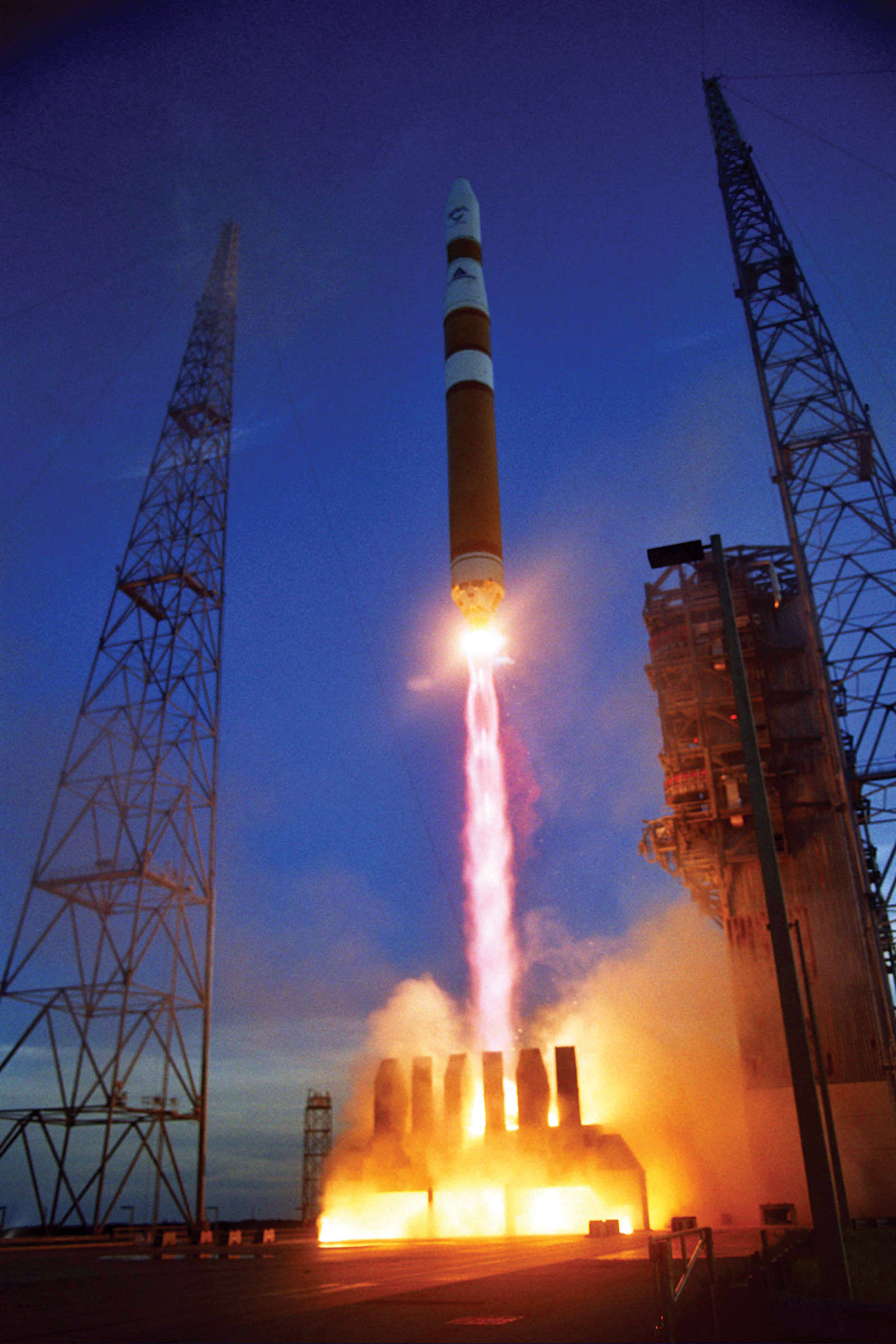
About the Delta IV M
Delta IV M
The Delta IV M (Medium) is an American orbital launch vehicle developed and operated by Boeing, later under the United Launch Alliance (ULA) banner, as part of the broader Delta IV rocket family. Developed under the United States Air Force's Evolved Expendable Launch Vehicle (EELV) program, the Delta IV family was designed to provide the U.S. government with a reliable, modern heavy-lift capability to replace aging launch systems. The Delta IV M represents the baseline, single-stick configuration of the family, intended for medium-class payloads to lower and geosynchronous transfer orbits.
Design and Capabilities
Standing 63 meters tall with a core diameter of 5 meters, the Delta IV M is built around the Common Booster Core (CBC), a liquid-fueled stage powered by the RS-68 engine burning liquid hydrogen and liquid oxygen. This propellant choice gives the vehicle a clean-burning, high-efficiency profile well suited to national security payloads. The Delta IV M is capable of delivering 8,600 kg to low Earth orbit and 3,900 kg to geostationary transfer orbit, positioning it firmly in the medium-lift class and making it appropriate for a range of government satellites.
Flight History
Our tracking data records three flights of the Delta IV M, all occurring between 2003 and 2006, and all resulting in success. This unblemished record reflects both the maturity of the underlying engineering and the rigorous launch standards demanded by its primary customer, the United States Air Force.
The vehicle's tracked missions center on critical national security satellites. These include the DSCS III A-3 and DSCS III B-6 missions, which delivered satellites for the Defense Satellite Communications System — a constellation providing secure, jam-resistant communications for U.S. military forces worldwide. The third tracked mission, DMSP F-17, lofted a satellite for the Defense Meteorological Satellite Program, which furnishes military and civilian forecasters with crucial weather and environmental data from polar orbit. Together, these missions underscore the Delta IV M's role as a trusted workhorse for U.S. national security space infrastructure during the mid-2000s.
Role and Context
The Delta IV M occupied an important transitional moment in American spaceflight. The EELV program was conceived in the 1990s to modernize U.S. launch capabilities and reduce costs through competition and commonality. While the larger Delta IV Heavy variant — combining three Common Booster Cores — attracted considerable public attention, the baseline Medium variant quietly demonstrated the core architecture's reliability in operational service. Launches took place from Space Launch Complex 37 at Cape Canaveral Air Force Station, Florida, one of the historic launch sites refurbished specifically for the Delta IV program.
The Delta IV M's brief operational window of just a few years reflects the broader market dynamics of the EELV era: as payload requirements for national security missions grew and the Delta IV Heavy and competing Atlas V vehicles absorbed demand, the baseline medium configuration gave way to stretched and augmented variants. Nevertheless, its perfect mission record stands as a testament to the sound engineering at the heart of the Delta IV family.