Delta IV Heavy
About the Delta IV Heavy
Delta IV Heavy
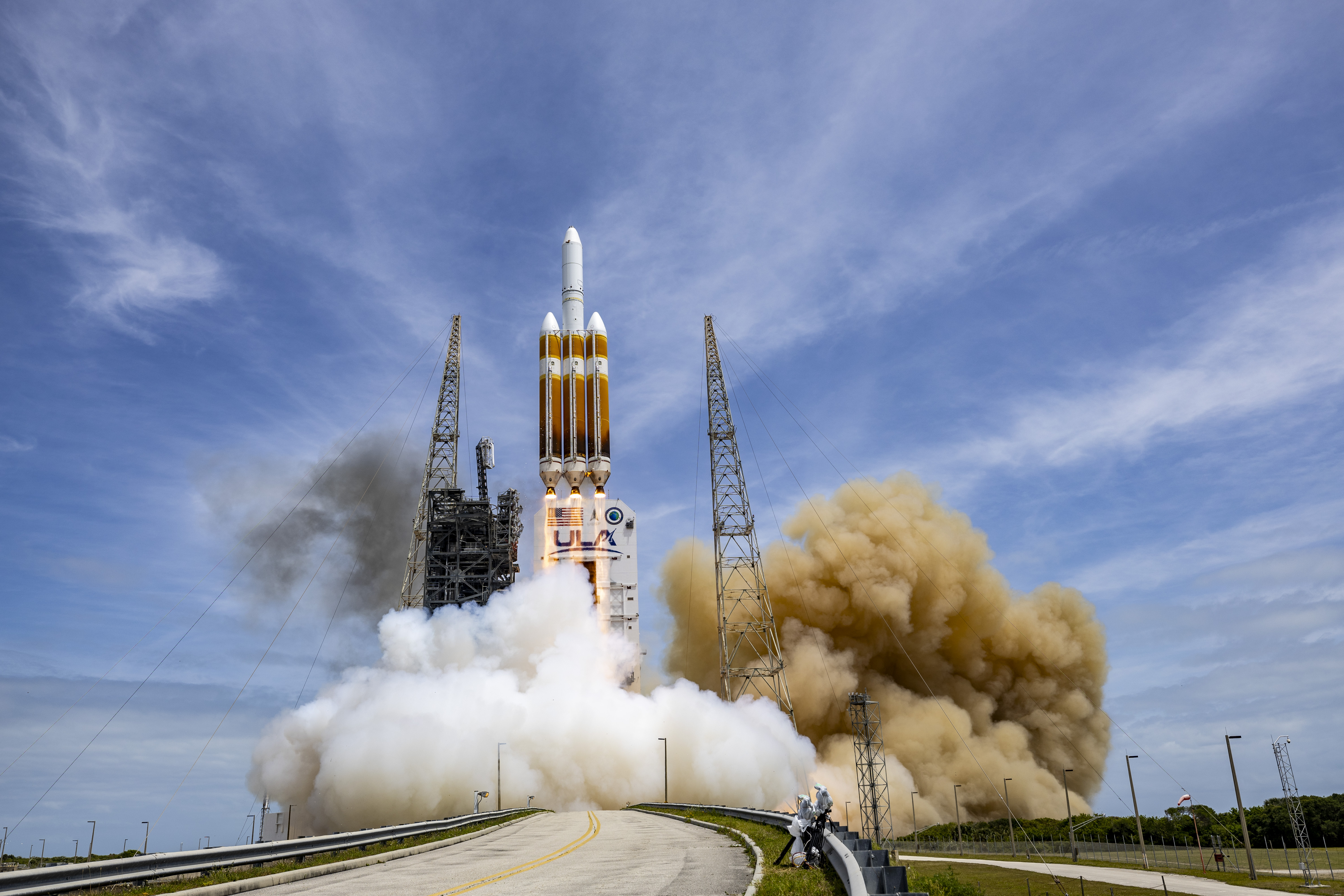
The Delta IV Heavy is an American heavy-lift expendable launch vehicle developed and operated by United Launch Alliance (ULA), a joint venture between Boeing and Lockheed Martin. Derived from the Delta IV family originally developed by Boeing, the Heavy variant represents the most powerful configuration in that lineage, combining three Common Booster Cores strapped together to dramatically increase performance over the single-stick Delta IV Medium. It remains one of the most capable American launch vehicles ever to fly.
Design and Configuration
The rocket stands 72 meters tall with a core diameter of 5 meters across each of its three liquid-fueled booster cores. Each core uses a cryogenic liquid hydrogen and liquid oxygen propellant combination, feeding a single RS-68 engine. This clean-burning propellant choice gives the vehicle its distinctive visual signature at liftoff: a brief but dramatic hydrogen burn-off that chars the lower section of the vehicle in a sheet of orange flame before main engine ignition fully takes hold. The three-core arrangement provides the thrust necessary to lift payloads of up to 28,370 kg to low Earth orbit or 14,210 kg to geostationary transfer orbit, making it well-suited to the heaviest national security and civil space payloads.
Operational History
Our flight record tracks 16 flights of the Delta IV Heavy between 2004 and 2024, logging 15 successes and 1 failure or partial failure. This span of two decades places the vehicle among the longer-serving heavy-lift rockets in the modern era. Its inaugural flight in December 2004 experienced anomalies that reduced payload performance, which accounts for the partial failure entry in the record. Subsequent flights demonstrated strong reliability across a demanding manifest.
The vehicle launched predominantly from Cape Canaveral Space Force Station in Florida and Vandenberg Space Force Base in California, with the choice of site determined by the orbital inclination requirements of each mission.
Customers and Missions
The Delta IV Heavy served an almost exclusively government manifest, with its customers dominated by United Launch Alliance contracting on behalf of U.S. national security agencies, particularly the National Reconnaissance Office (NRO). Among the most recent missions tracked are NROL-70, NROL-68, NROL-91, NROL-82, NROL-44, and NROL-71 — a succession of classified intelligence satellite deployments that underscored the vehicle's role as a trusted workhorse for America's most sensitive space assets. Notable civil missions earlier in its career included launches supporting NASA programs.
Legacy and Retirement
The NROL-70 mission in April 2024 marked the final flight of the Delta IV Heavy, closing out a launch vehicle that had served American national security space for two decades. Its retirement reflects a broader industry shift toward next-generation vehicles capable of similar or greater performance, including ULA's own Vulcan Centaur. The Delta IV Heavy leaves behind a legacy defined by reliability on high-stakes, irreplaceable payloads — missions where failure was simply not an acceptable outcome.
- Apr 09, 2024Delta IV Heavy | NROL-70Success
- Jun 22, 2023Delta IV Heavy | NROL-68Success
- Sep 24, 2022Delta IV Heavy | NROL-91Success
- Apr 26, 2021Delta IV Heavy | NROL-82Success
- Dec 11, 2020Delta IV Heavy | NROL-44Success
- Jan 19, 2019Delta IV Heavy | NROL-71Success
- Aug 12, 2018Delta IV Heavy | Parker Solar ProbeSuccess
- Jun 11, 2016Delta IV Heavy | NROL-37Success
- Dec 05, 2014Delta IV Heavy | EFT-1Success
- Aug 28, 2013Delta IV Heavy | NROL-65 (USA-245 / KH-11)Success
- Jun 29, 2012Delta IV Heavy | NROL-15 (Mentor) (USA-237)Success
- Jan 20, 2011Delta IV Heavy | NROL-49 (KH-11) (USA-224)Success
- Nov 21, 2010Delta IV Heavy | NROL-32 (Mentor) (USA-223)Success
- Jan 18, 2009Delta IV Heavy | NROL-26 (USA-202)Success
- Nov 11, 2007Delta IV Heavy | DSP-23Success
- Dec 21, 2004Delta IV Heavy | Demosat and 3CS-1 & 2Partial Failure