Delta 3924
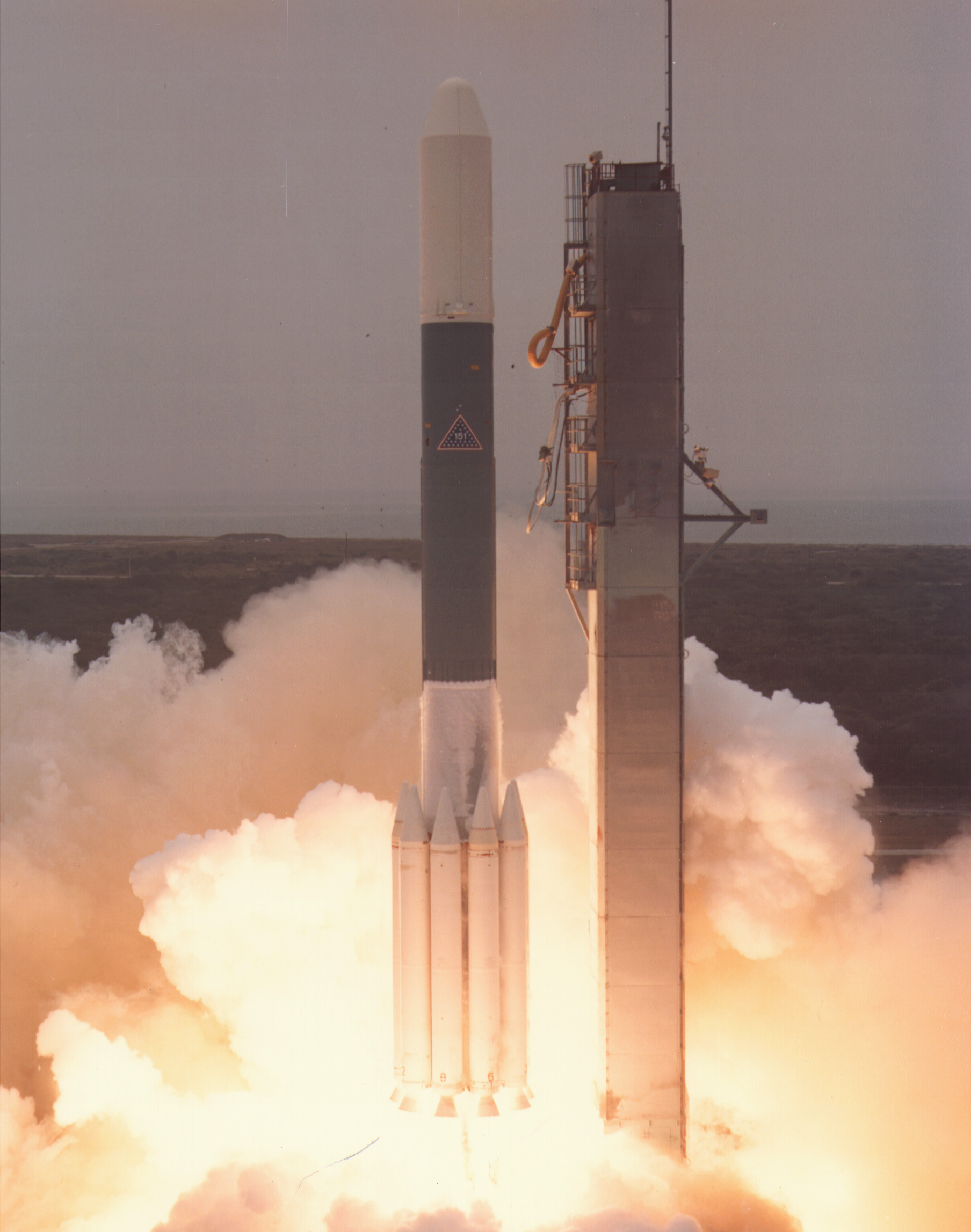
About the Delta 3924
Delta 3924
The Delta 3924 is an American expendable orbital launch vehicle operated by McDonnell Douglas for NASA and commercial and government customers. A member of the long-running Delta family developed and flown from Cape Canaveral Air Force Station in Florida, the 3924 configuration represents one of the mid-generation Delta variants that bridged the gap between the early Thor-derived rockets of the 1960s and the more powerful Delta II that followed.
Configuration and Design
The four-digit designation system used by the Delta family encodes the vehicle's configuration: the first digit indicates the core stage type, the second the number of solid strap-on boosters, the third the upper stage, and the fourth the number of burn restarts available. The 3924 accordingly flew with nine Castor IV solid rocket motors clustered around its first stage, a liquid-fueled second stage, and a solid-propellant third stage capable of boosting payloads to geosynchronous transfer orbit. Standing 36 meters tall with a core diameter of 2.44 meters, the vehicle was compact by later standards but well-suited to the medium-class payloads of its era. It was capable of delivering 954 kilograms to geosynchronous transfer orbit.
Operational History
The Delta 3924 was active from 1982 to 1987, during which it compiled a flight record of five launches — all successful. This unblemished reliability made it a trusted workhorse for high-value government and commercial payloads during a period of considerable competition and change in the American launch industry.
The United States Air Force was the vehicle's top customer, reflecting the military's reliance on Delta-family vehicles for national security and government science missions throughout the 1980s. Among the missions supported, the GOES 7 meteorological satellite stands out as a high-profile payload with direct public benefit, supporting weather observation and forecasting from geostationary orbit. The Charge Composition Explorer, part of NASA's Explorer program, demonstrated the vehicle's suitability for scientific missions requiring precise orbital insertion.
The vehicle also lofted a cluster of RCA Satcom communications satellites — Satcom 1R, Satcom 2R, and Satcom 5 — underscoring the commercial dimension of its service record. The Satcom series was among the most commercially significant communications satellite constellations of the era, carrying cable television and broadcast content across North America, and their successful delivery on the 3924 reinforced the variant's reputation for dependability with premium payloads.
Legacy
The Delta 3924's five-for-five record, though modest in total flight count, reflects the careful engineering heritage of the Delta program. McDonnell Douglas maintained a conservative, iterative approach to vehicle development, and the 3924 benefited from decades of accumulated experience with the Thor/Delta lineage. By the time the variant concluded operations in 1987, the broader Delta program was transitioning toward more capable configurations to compete with the emerging commercial launch market and address gaps left by the Space Shuttle's limitations following the *Challenger* disaster. The Delta 3924 remains a quietly significant chapter in American launch history — reliable, purposeful, and representative of the commercial and governmental demands of its decade.