Delta 3920
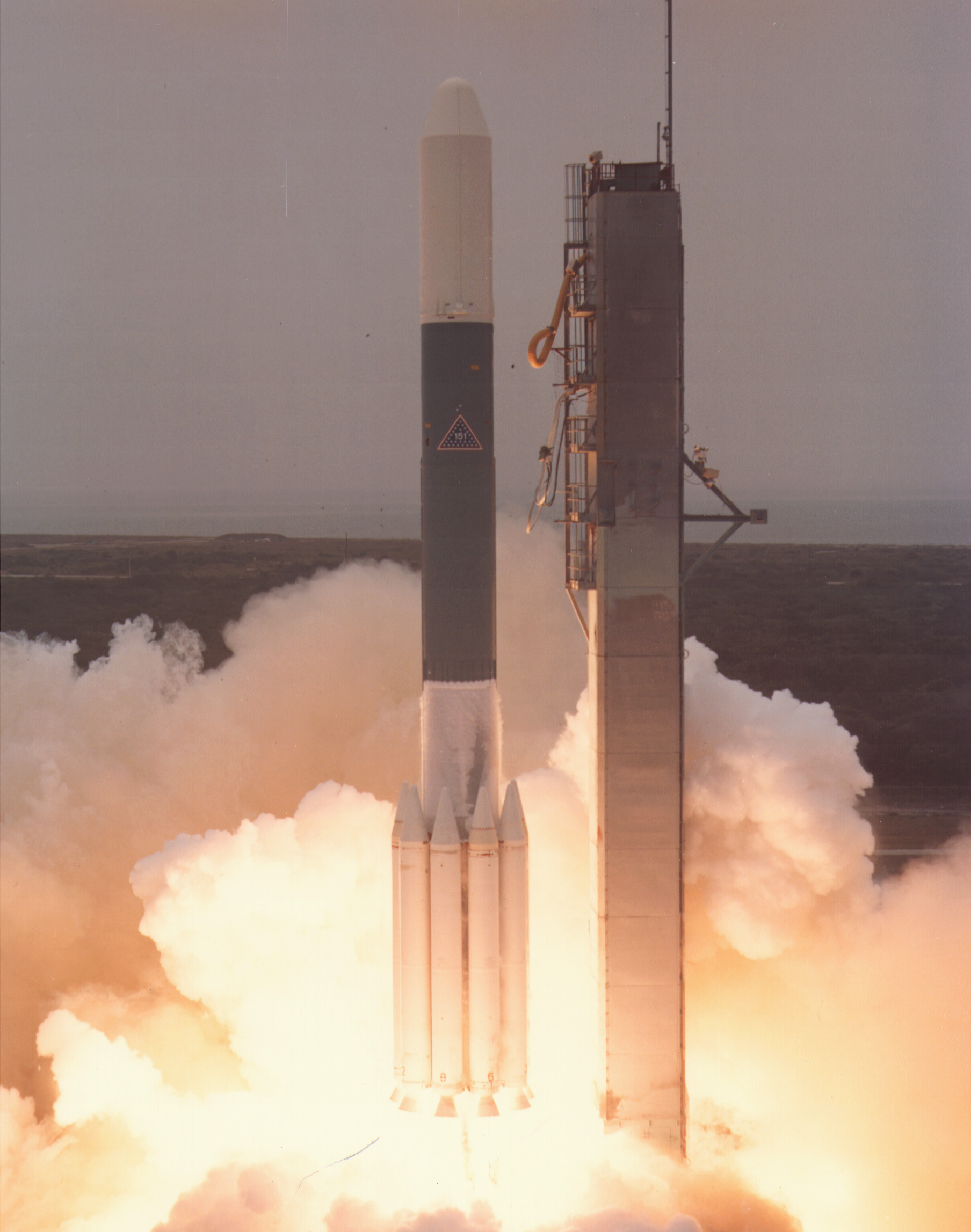
About the Delta 3920
Delta 3920
The Delta 3920 is an American expendable orbital launch vehicle developed and operated by McDonnell Douglas for NASA and the United States Air Force. A member of the long-running Delta family, the 3920 variant was introduced in the early 1980s as part of a continuing effort to increase the Delta's payload capacity while leveraging the rocket's well-proven heritage and infrastructure.
Design and Configuration
Standing 36 meters tall with a core diameter of 2.44 meters, the Delta 3920 follows the general configuration established by earlier Delta variants. The designation "3920" reflects the vehicle's specific combination of strap-on solid rocket boosters and upper-stage arrangement under McDonnell Douglas's systematic numbering scheme. The first digit indicates the tank and engine configuration, the second refers to the number of Castor solid boosters strapped to the first stage, and the remaining digits describe the upper stages. Nine Castor solid rocket boosters augment the main first-stage engine at liftoff, providing the additional thrust needed to lift heavier payloads into orbit.
The rocket launched from facilities on the United States East and West Coasts, with missions targeting a range of orbital destinations depending on payload requirements.
Operational History
The Delta 3920 was active from 1982 through 1986, a period during which it supported a select but significant set of missions. Our flight record covers three flights, all of which were successful, reflecting the reliable foundation the Delta family had built over the preceding two decades.
Among the most prominent missions attributed to the Delta 3920 are two launches in support of NASA's Landsat program. Landsat 4, launched in 1982, and Landsat 5, launched in 1984, were Earth observation satellites that became foundational assets for global land-use monitoring, environmental research, and agricultural assessment. Landsat 5 in particular went on to become one of the longest-operating Earth observation satellites in history.
The third tracked mission — the VSE & VSE Target flight — further demonstrated the vehicle's utility for defense-related payloads, consistent with the United States Air Force being the top institutional customer in our records.
Role and Legacy
The Delta 3920 occupied a specific niche in the American launch landscape of the early-to-mid 1980s, bridging the capabilities of lighter Delta configurations and the more powerful variants that would follow. Its perfect tracked record of three successful flights underscores the maturity and dependability that the Delta program had achieved by this era.
The vehicle's service overlapped with the early Space Shuttle era, a time when NASA was transitioning many payloads to the crewed orbiter. The Delta 3920 nonetheless fulfilled an important role for payloads requiring dedicated, unmanned launch services on a proven and cost-effective vehicle. Its contributions to the Landsat program alone secured its place in the broader story of American civil and scientific spaceflight, providing continuity in Earth observation at a critical period in the program's development.