Delta 3914
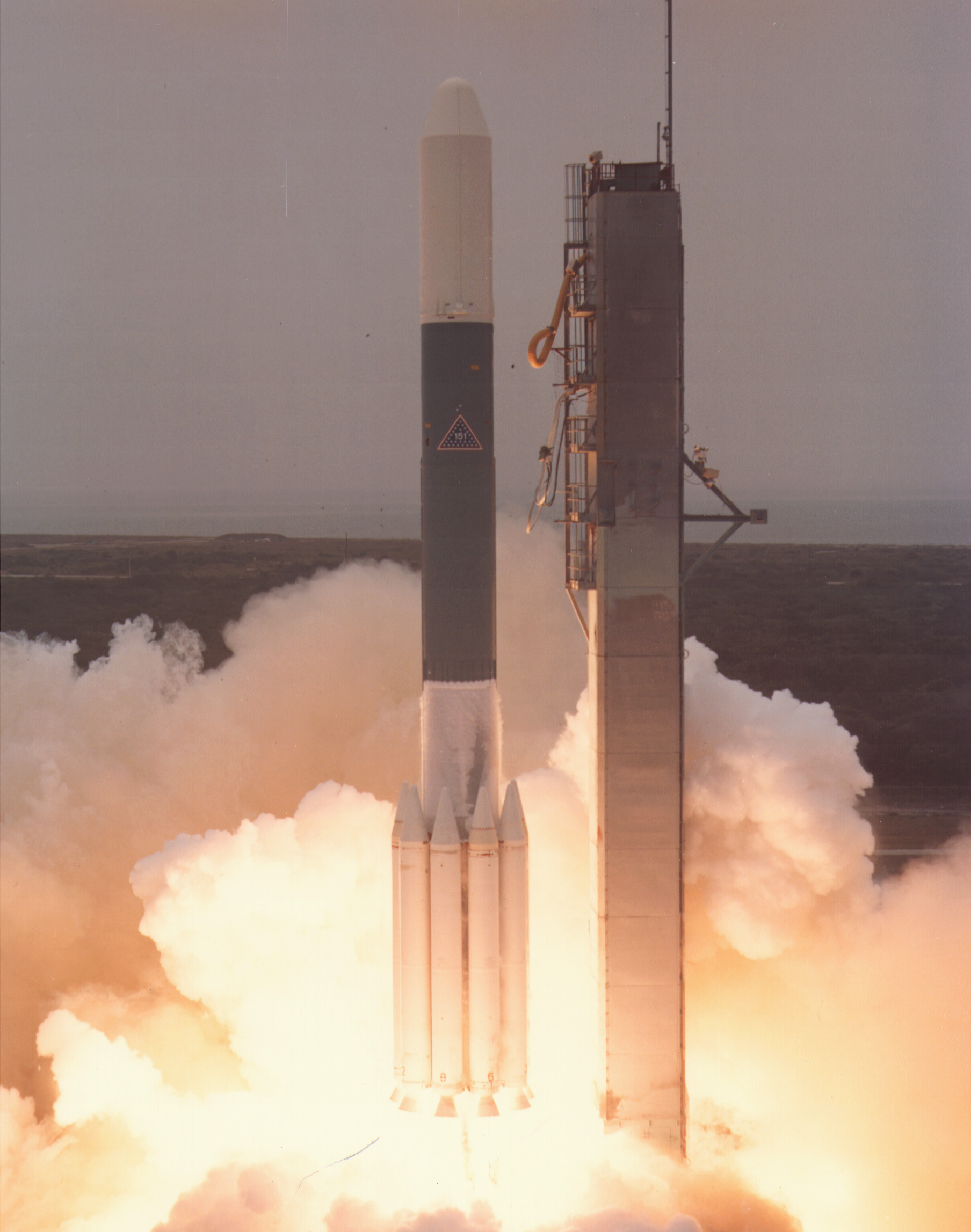
About the Delta 3914
Delta 3914
The Delta 3914 is an American expendable orbital launch vehicle operated by McDonnell Douglas on behalf of NASA and the United States Air Force. A member of the long-running Delta family, the 3914 variant was part of the "Thor-Delta" lineage that evolved steadily through the 1960s and 1970s to meet growing demands for heavier communications, meteorological, and scientific payloads. It launched from Cape Canaveral Air Force Station in Florida and was a workhorse of American medium-lift spaceflight during its operational era.
Design and Capability
Standing 35 meters tall with a core diameter of 2.44 meters, the Delta 3914 followed the established Delta configuration of a liquid-fueled first stage augmented by a cluster of solid rocket strap-on boosters, a liquid-fueled second stage, and a solid-fueled apogee kick motor for geosynchronous missions. The "3914" designation encodes its configuration: nine strap-on solid motors, a particular second stage, and a payload fairing size. It was capable of delivering 951 kg to low Earth orbit and approximately 954 kg to geostationary transfer orbit, making it well-suited to the medium-class communications and weather satellites of its era.
Operational History
Our flight record shows the Delta 3914 conducted 12 tracked flights between 1975 and 1986, achieving 10 successes alongside 2 failures or partial failures — a reliability profile broadly consistent with the Delta family's strong reputation during this period. The vehicle served a diverse manifest but was especially favored by the United States Air Force, which stands as its top customer across tracked launches.
Among its most notable missions were multiple flights supporting the GOES series of geostationary weather satellites operated by NOAA. The GOES 4, GOES 5, and GOES 6 satellites — part of a generation that dramatically improved American meteorological forecasting — were all lofted by Delta 3914 vehicles, as was the later GOES G mission. These launches underscored the rocket's reliable role in sustaining critical civil infrastructure in geostationary orbit.
The vehicle's manifest also reached beyond American programs. The NATO 3D satellite, a military communications relay serving the NATO alliance, flew on a Delta 3914, reflecting the vehicle's trusted status among allied defense customers. Perhaps the most scientifically distinctive payload was EXOSAT, a European Space Agency X-ray astronomy observatory, demonstrating that the Delta 3914 was competitive for international scientific missions as well.
Legacy
The Delta 3914 represents a transitional generation in the Delta family — capable enough to handle first-generation geostationary communications and meteorological satellites, yet predating the larger, more powerful Delta variants that would follow in the late 1980s and beyond. Its eleven-year operational span bridged an important period in commercial and government satellite deployment, and many of the weather and communications services it enabled shaped expectations for what space-based infrastructure could deliver. The missions it flew remain well-documented entries in the broader history of American medium-lift rocketry.
- May 03, 1986Delta 3914 | GOES GFailure
- Nov 14, 1984Delta 3914 | NATO 3DSuccess
- May 26, 1983Delta 3914 | ExosatSuccess
- Apr 28, 1983Delta 3914 | GOES 6Success
- May 22, 1981Delta 3914 | GOES 5Success
- Sep 09, 1980Delta 3914 | GOES 4Success
- Dec 07, 1979Delta 3914 | Satcom 3Success
- Dec 16, 1978Delta 3914 | Anik BSuccess
- May 11, 1978Delta 3914 | OTS 2Success
- Sep 13, 1977Delta 3914 | OTS 1Failure
- Mar 26, 1976Delta 3914 | Satcom 2Success
- Dec 13, 1975Delta 3914 | Satcom 1Success