Delta 3910/PAM
About the Delta 3910/PAM
Delta 3910/PAM
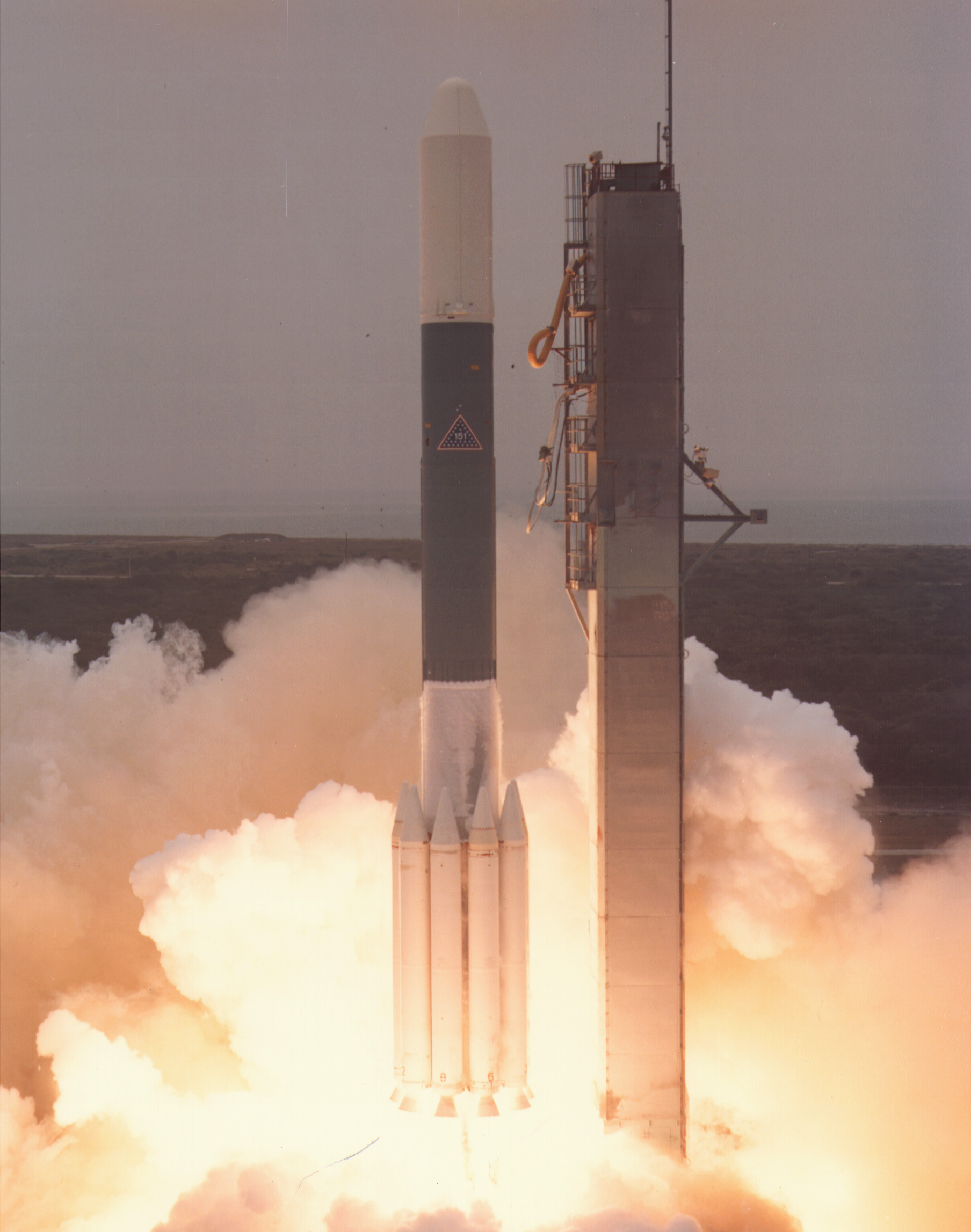
The Delta 3910/PAM is an American expendable orbital launch vehicle developed and operated by McDonnell Douglas for NASA and commercial customers. A member of the long-running Delta rocket family, it represents one of the more capable configurations fielded during the early 1980s, combining an upgraded Delta core stage with a Payload Assist Module (PAM-D) upper stage to deliver communications satellites to geostationary transfer orbit.
Design and Configuration
The 3910/PAM designation follows the Delta family's numerical coding system, in which the digits describe the core stage, strap-on booster arrangement, and upper stage configuration. The "3910" portion denotes a Thor-derived first stage paired with nine Castor IV solid-fueled strap-on boosters, six of which ignite at liftoff and three at altitude. Standing 35 meters tall with a core diameter of 2.44 meters, the vehicle presents a compact but powerful profile characteristic of the Delta lineage.
The distinguishing feature of this variant is the PAM-D (Payload Assist Module — Delta class) kick stage, a solid-propellant motor developed by McDonnell Douglas. The PAM-D was specifically designed to boost a satellite from a low or intermediate parking orbit into geostationary transfer orbit, filling a role that previous Delta upper stages handled with liquid-propellant engines. Its spin-stabilized design offered simplicity and reliability for commercial telecommunications payloads. The vehicle's payload capacity to low Earth orbit is 1,087 kg.
Operational History
The Delta 3910/PAM flew exclusively between 1980 and 1982, compiling a record of seven flights with seven successes — a perfect operational run. This unblemished performance reflected both the maturity of the Delta platform and the reliability of the PAM upper stage concept.
The vehicle's manifest was dominated by high-profile commercial and civil communications satellite missions. Notable payloads included Satcom 3R and Satcom 4 for RCA, the Westar 4 and Westar 5 satellites for Western Union, SBS 2 for Satellite Business Systems, and Insat 1A, an Indian national satellite built with international cooperation. The United States Air Force featured as a top customer in the flight record, reflecting the broader governmental interest in assured access to reliable medium-lift launch services during this period.
Historical Significance
The 3910/PAM sits within a pivotal moment in commercial spaceflight. The early 1980s saw explosive demand for geostationary communications satellites, and the Delta family — particularly PAM-equipped variants — served as a workhorse for that market before the Space Shuttle temporarily displaced expendable vehicles from commercial launch duties. The PAM-D upper stage itself was later adapted for Shuttle-based deployments, flying on several early Shuttle missions before the Challenger accident prompted a reassessment of commercial satellite launches aboard crewed vehicles.
The Delta 3910/PAM's short but flawless service life underscores the iterative, modular philosophy that made the Delta family so enduring. By combining proven heritage hardware with a modern solid kick stage, McDonnell Douglas delivered a reliable solution precisely tailored to the communications satellite boom of its era.
- Jun 09, 1982Delta 3910/PAM | Westar 5Success
- Apr 10, 1982Delta 3910/PAM | Insat 1ASuccess
- Feb 26, 1982Delta 3910/PAM | Westar 4Success
- Jan 16, 1982Delta 3910/PAM | Satcom 4Success
- Nov 20, 1981Delta 3910/PAM | Satcom 3RSuccess
- Sep 24, 1981Delta 3910/PAM | SBS 2Success
- Nov 15, 1980Delta 3910/PAM | SBS 1Success