Delta 3910
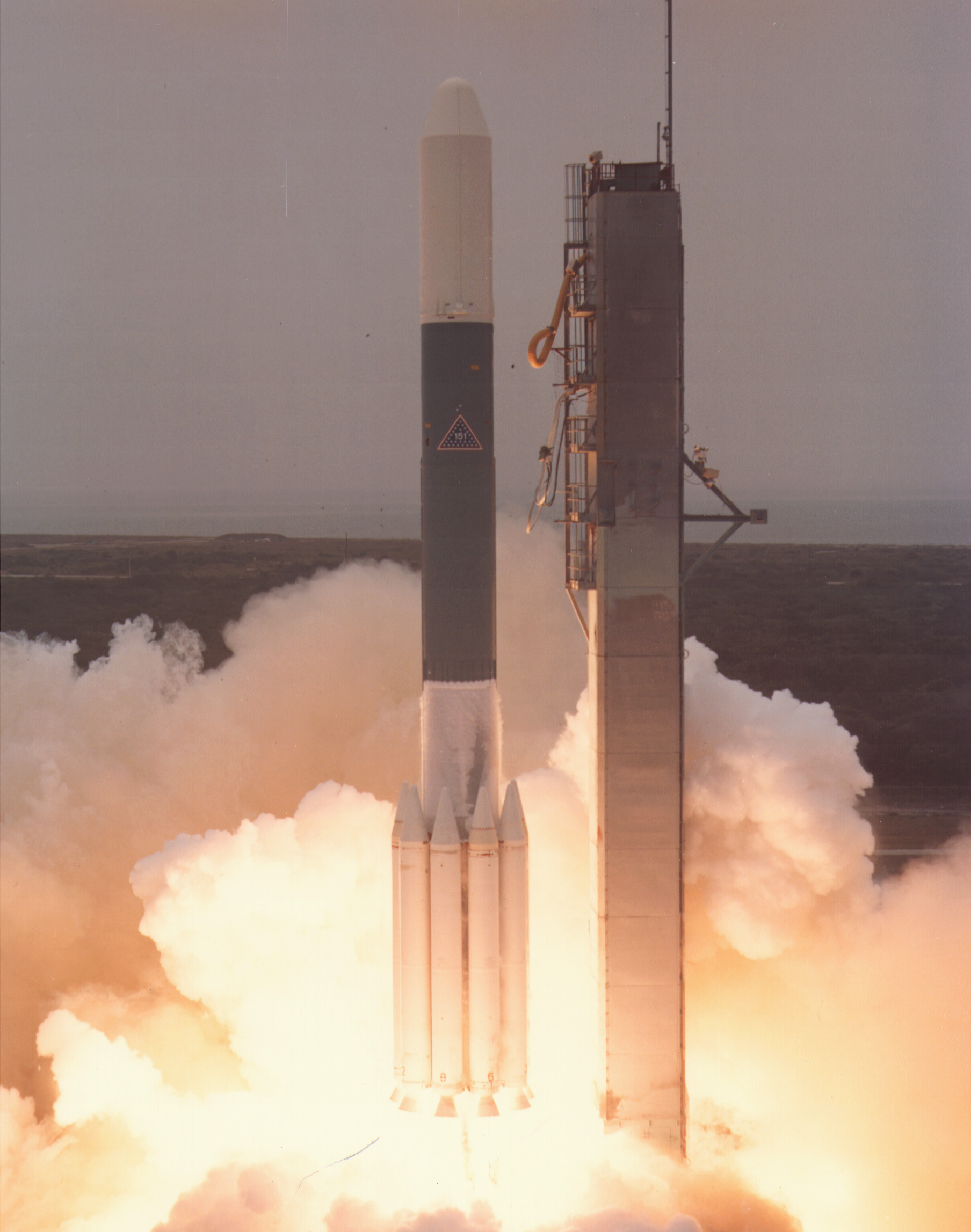
About the Delta 3910
Delta 3910
The Delta 3910 is an American orbital launch vehicle developed and operated by McDonnell Douglas for NASA and the United States Air Force. A member of the long-running Delta family, it represents one of the intermediate configurations that bridged the gap between early Delta variants and the more capable vehicles that followed in the 1980s and 1990s. Like all Delta rockets of its era, it launched from Cape Canaveral in Florida, serving as a reliable workhorse for government satellite and science missions.
Design and Configuration
Standing 35 metres tall with a core diameter of 2.44 metres, the Delta 3910 follows the classic Delta architecture of a liquid-fueled first stage augmented by a cluster of solid-fueled strap-on boosters. The "39" portion of its designation reflects the use of nine Castor IV solid rocket motors arranged around the first stage — a configuration that meaningfully increased liftoff thrust compared to earlier, less-augmented Delta variants. The "10" suffix indicates its upper-stage arrangement. Together, these elements gave the 3910 a well-rounded capability suited to placing payloads into low Earth orbit as well as higher-energy trajectories.
Operational History
Our flight record documents three flights of the Delta 3910 between 1980 and 1988, all of which were successful. This unblemished record underscores the maturity and reliability that the Delta family had achieved by that period, drawing on more than two decades of incremental development dating back to the earliest Delta flights of the early 1960s.
The United States Air Force stands as the top customer represented in the tracked flight record, reflecting the vehicle's role in supporting national security and government science objectives during a period of considerable activity in American space policy.
Notable Missions
Among the missions in our record, several stand out for their scientific significance. The Solar Maximum Mission (Solar Max) was a NASA solar observatory designed to study the Sun during a period of intense solar activity; its launch on a Delta 3910 made it one of the most scientifically prominent payloads the vehicle carried. IRAS — the *Infrared Astronomical Satellite* — was a joint mission involving NASA, the Netherlands, and the United Kingdom that produced the first all-sky survey at infrared wavelengths, fundamentally reshaping understanding of stellar and galactic astronomy. Both missions demonstrated that the Delta 3910 was trusted with high-value scientific payloads of international importance.
The TVE mission rounds out the tracked launch record, further illustrating the vehicle's versatility across different payload types and customer requirements.
Legacy
The Delta 3910 occupied an important niche in American launch capability during the early 1980s, offering a proven and flexible platform at a time when demand for government satellite launches was growing. Its success rate within our tracked data reflects both sound engineering and the accumulated reliability improvements that characterized the Delta lineage. Though eventually superseded by more capable variants as payload mass requirements increased, the 3910 contributed meaningfully to a remarkable series of scientific and operational achievements that defined an era of American spaceflight.