Delta 2914
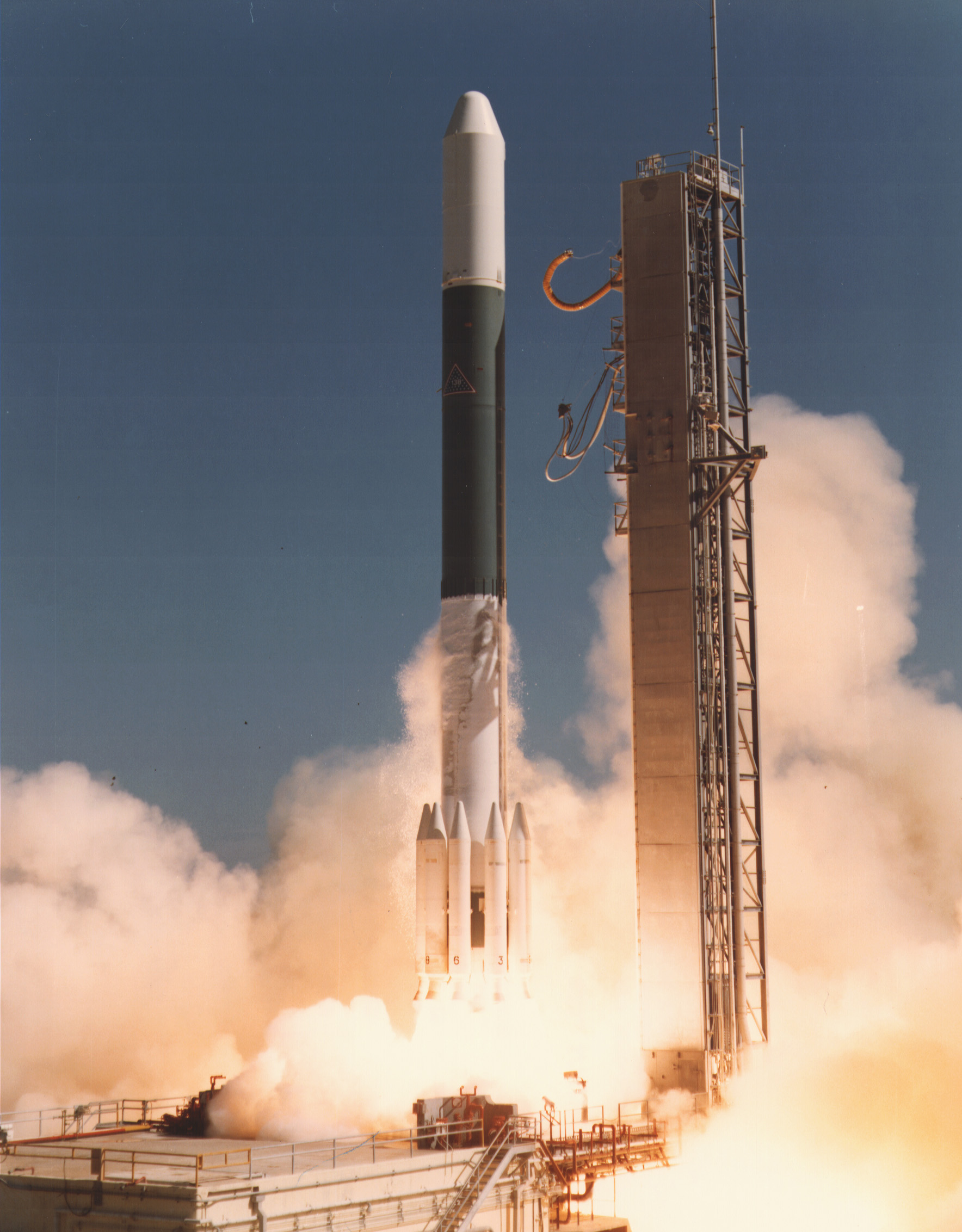
About the Delta 2914
Delta 2914
The Delta 2914 is an American expendable orbital launch vehicle developed and operated by McDonnell Douglas for NASA, representing one of the most capable configurations of the long-running Delta rocket family produced during the 1970s. Launched from Cape Canaveral, Florida, the 2914 variant served as a workhorse for medium-class payloads during a particularly active period of civil, military, and commercial satellite deployment.
Design and Configuration
Standing 35 meters tall with a core diameter of 2.44 meters, the Delta 2914 follows the established Delta design philosophy of pairing a Thor-derived liquid-fueled first stage with solid-fueled strap-on boosters and an upper stage. The "2914" designation encodes the vehicle's configuration within McDonnell Douglas's systematic Delta numbering scheme: the first digit indicates the stage and booster arrangement, while subsequent digits describe the upper stage and fairing choices. The result is a vehicle capable of delivering 724 kilograms to low Earth orbit — a meaningful capability for the era that made it attractive across a range of mission types.
Operational History
According to tracked flight records, the Delta 2914 flew 30 missions between 1974 and 1979, achieving 28 successes alongside 2 failures or partial failures — a strong reliability record that reflected both the maturity of the Delta lineage and the rigorous launch cadence McDonnell Douglas maintained throughout the decade. This operational tempo made the 2914 one of the more frequently flown Delta configurations of its generation.
The vehicle's customer base was anchored by the United States Air Force, reflecting the strategic importance of satellite communications and defense-related payloads during the Cold War era. However, the manifest extended well beyond military applications.
Notable Missions
The Delta 2914 supported an impressive cross-section of scientific, meteorological, and commercial programs. On the scientific side, it lofted ISEE 3 (the International Sun-Earth Explorer 3), a pioneering heliospheric probe operated jointly by NASA and the European Space Agency, and Geos 2, a European geodetic research satellite. Meteorological contributions included GOES 3, part of NASA's Geostationary Operational Environmental Satellite series that established the foundation for modern weather forecasting from orbit.
Commercial and institutional communications satellites were equally prominent. The Westar 3 mission supported Western Union's domestic satellite communications network, an early milestone in commercial American telecommunications. NATO 3C extended the alliance's dedicated military communications infrastructure in geostationary orbit. The SCATHA mission (Spacecraft Charging at High Altitudes) contributed to understanding the effects of the space environment on spacecraft electronics — research with lasting relevance for satellite engineering.
Legacy
The Delta 2914's five-year operational run coincided with a formative moment in the global space industry, bridging early experimental satellite programs and the emergence of routine commercial launch services. Its balanced combination of reliability, payload capacity, and versatility helped cement the Delta family's reputation as a dependable platform that would continue evolving for decades. The missions it carried — spanning weather observation, scientific exploration, military communications, and commercial services — reflect the breadth of ambition that characterized spaceflight during the 1970s.
- Aug 10, 1979Delta 2914 | Westar 3Success
- Jan 30, 1979Delta 2914 | SCATHASuccess
- Nov 19, 1978Delta 2914 | NATO 3CSuccess
- Aug 12, 1978Delta 2914 | ISEE 3Success
- Jul 14, 1978Delta 2914 | Geos 2Success
- Jun 16, 1978Delta 2914 | GOES 3Success
- Apr 07, 1978Delta 2914 | Yuri 1Success
- Jan 26, 1978Delta 2914 | IUESuccess
- Dec 15, 1977Delta 2914 | SakuraSuccess
- Nov 23, 1977Delta 2914 | Meteosat 1Success
- Oct 22, 1977Delta 2914 | ISEE 1 & 2Success
- Jul 14, 1977Delta 2914 | HimawariSuccess
- Jun 16, 1977Delta 2914 | GOES 2Success
- Apr 20, 1977Delta 2914 | Geos 1Failure
- Mar 10, 1977Delta 2914 | Palapa A2Success
- Jan 28, 1977Delta 2914 | NATO 3BSuccess
- Oct 14, 1976Delta 2914 | Marisat 3Success
- Jul 08, 1976Delta 2914 | Palapa A1Success
- Jun 10, 1976Delta 2914 | Marisat 2Success
- Apr 22, 1976Delta 2914 | NATO 3ASuccess
- Feb 19, 1976Delta 2914 | Marisat 1Success
- Jan 17, 1976Delta 2914 | HermesSuccess
- Oct 16, 1975Delta 2914 | GOES 1Success
- Aug 27, 1975Delta 2914 | Symphonie 2Success
- May 07, 1975Delta 2914 | Anik A3Success
- Feb 06, 1975Delta 2914 | SMS 2Success
- Dec 19, 1974Delta 2914 | Symphonie 1Success
- Oct 10, 1974Delta 2914 | Westar 2Success
- May 17, 1974Delta 2914 | SMS 1Failure
- Apr 13, 1974Delta 2914 | Westar 1Success