Delta 2913
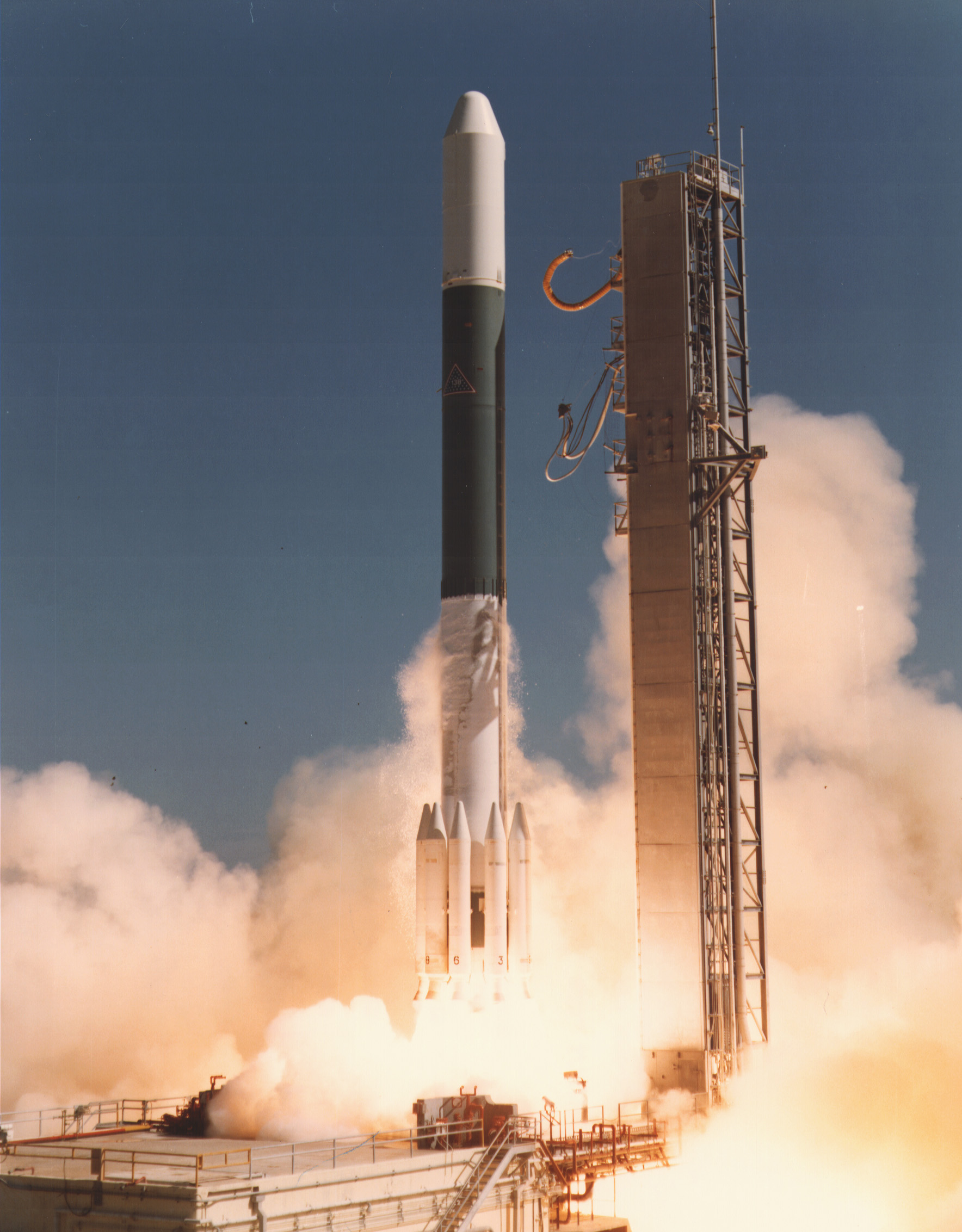
About the Delta 2913
Delta 2913
The Delta 2913 is an American expendable orbital launch vehicle operated by the United States Air Force and manufactured by McDonnell Douglas as part of the long-running Delta family of rockets. A member of the Thor-Delta lineage that traces its origins to the late 1950s, the Delta 2913 represents one of several numbered configurations within the broader Delta program, in which each digit of the designation encodes specific choices of core stage, strap-on boosters, and upper stage. Launches in this configuration took place from Vandenberg Air Force Base and Cape Canaveral, two facilities that together served as the primary spaceports for American civil and military satellite programs throughout the Cold War era.
Configuration and Capabilities
Standing approximately 35 meters tall with a core diameter of 2.44 meters, the Delta 2913 is a medium-class launch vehicle sized to place a meaningful range of government payloads into useful orbits. It is capable of delivering around 2,000 kilograms to low Earth orbit and approximately 700 kilograms to geostationary transfer orbit, figures that positioned it competitively among the American expendable vehicles available during the mid-1970s. Like other Delta configurations of its era, the 2913 variant combined a liquid-propellant main stage derived from the Thor intermediate-range ballistic missile with a complement of solid-fueled strap-on boosters and an upper stage, offering mission planners a degree of flexibility for different orbital destinations.
Flight History
The Delta 2913 flew twice across its operational period of 1975 to 1976, achieving a perfect success rate on both missions. Though its active window was brief, the two flights it conducted carried scientifically and strategically significant payloads that left a lasting mark on the history of space exploration.
The Lageos 1 mission, launched in 1976, placed into orbit a passive laser-ranging satellite jointly developed by NASA and the Italian space agency. Lageos 1 became one of the most precisely tracked objects ever put into space, contributing decades of data on Earth's geodesy, tectonic plate motion, and gravitational field. Its unusually high, stable orbit was designed to give the satellite an extraordinarily long operational lifetime — measured not in years but in millions of years.
The COS-B mission carried a European Space Agency gamma-ray astronomy satellite built to map high-energy radiation sources across the Milky Way. COS-B operated successfully for several years and produced an important early catalog of gamma-ray sources, laying groundwork for later high-energy astrophysics missions.
Legacy
Although the Delta 2913 configuration itself saw only a handful of flights, its missions punched well above their weight in scientific return. The vehicle exemplifies the broader Delta program's role as a dependable, adaptable workhorse for American and allied space programs during a pivotal era of satellite development. The Delta family as a whole would continue to evolve through numerous successive variants, serving government and commercial customers for decades, but the 2913 configuration's brief contribution — two launches, two successes, two enduring spacecraft — stands as a clean and accomplished chapter in that history.