Delta 2910
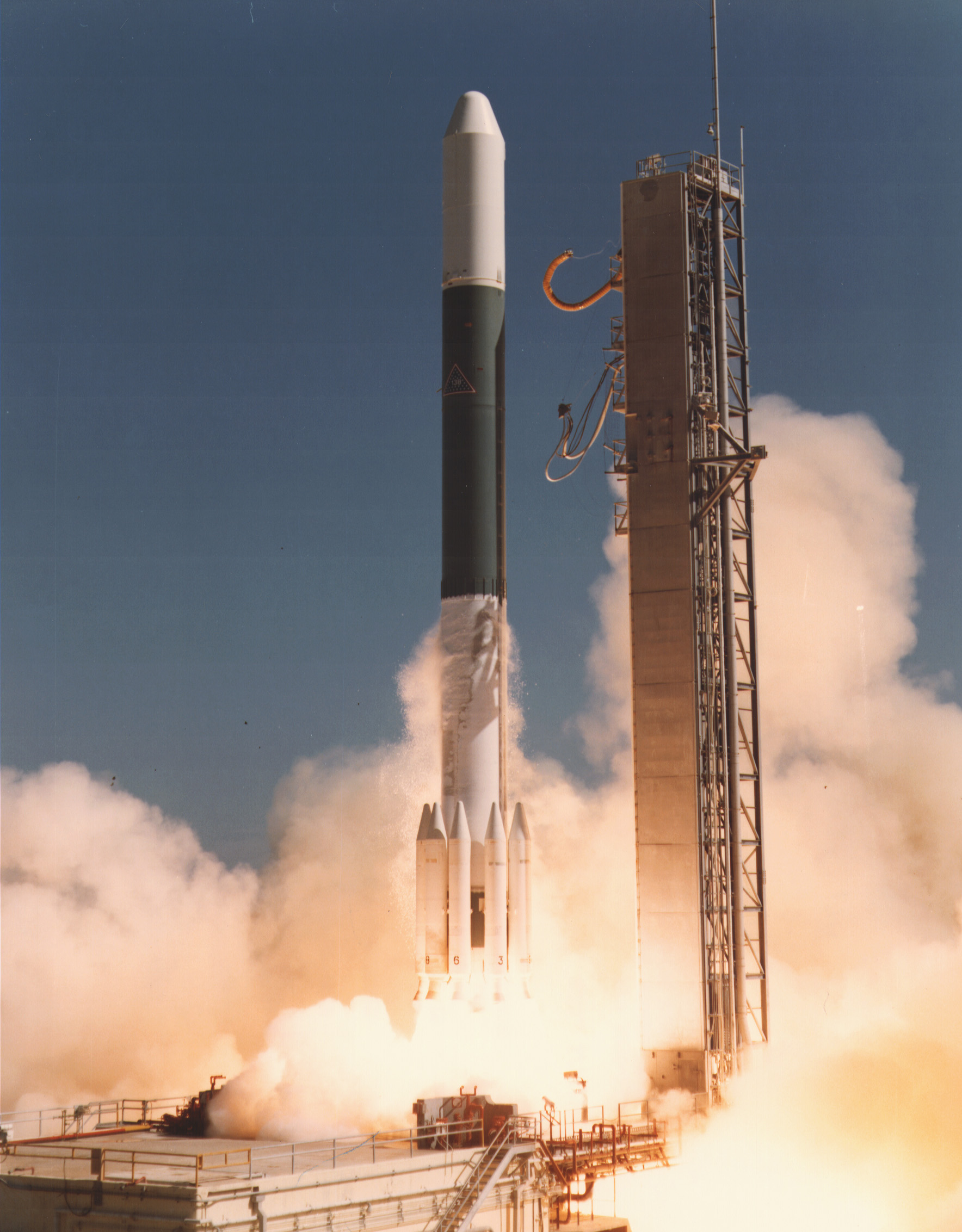
About the Delta 2910
Delta 2910
The Delta 2910 is an American expendable orbital launch vehicle operated by NASA and manufactured by McDonnell Douglas, belonging to the long-running Delta family of rockets that traces its lineage to the Thor intermediate-range ballistic missile of the 1950s. A workhorse of the United States civil and military space programs, the Delta 2910 represents one of the configurations developed during the 1970s to meet growing demand for reliable, medium-class satellite delivery.
Configuration and Design
Standing 35 meters tall with a core diameter of 2.44 meters, the Delta 2910 follows the general architecture common to Thor-Delta derivatives of its era. The designation "2910" encodes key details of the vehicle's configuration within McDonnell Douglas's numbering system: the first digit indicates the generation of the core stage, the second reflects the number of solid strap-on boosters (nine, in this case), the third describes the second stage, and the fourth the payload fairing arrangement. The nine Castor solid rocket motors clustered around the first stage give the 2910 a meaningful boost in liftoff thrust compared to unaugmented Delta variants, allowing it to place moderately sized payloads into low Earth orbit and sun-synchronous trajectories.
Operational History
In the tracked flight record, the Delta 2910 flew six times between 1975 and 1978, achieving six consecutive successes with no recorded failures or partial failures — a testament to the maturity of the Delta design and the rigorous launch processing practices at the time. All six missions are associated with significant scientific and Earth-observation programs, with the United States Air Force among the primary customers, alongside NASA-sponsored science payloads.
The vehicle's manifest highlights its role in supporting flagship government science programs of the mid-1970s. Missions included Landsat 2 and Landsat 3, part of NASA's pioneering Earth resources observation program that fundamentally shaped the field of satellite remote sensing. The vehicle also lofted Nimbus 6 and Nimbus 7, advanced meteorological and atmospheric research satellites that contributed decades of climate and environmental data. Rounding out the record are AE-D and AE-E, spacecraft belonging to NASA's Atmosphere Explorer series designed to study the upper atmosphere and its interactions with solar radiation.
Legacy and Context
The Delta 2910 operated during a particularly productive period for American civil space science, when Earth-observing and atmospheric research satellites were becoming central tools of environmental monitoring and policy. Its perfect reliability record across six flights reflects both the conservative engineering culture of the Delta program and the relative stability of payloads and mission profiles during this era.
The broader Delta family would continue evolving well beyond the 2910's active years, eventually leading to the Delta II and Delta IV vehicles. The 2910 configuration occupies a specific and well-defined niche within that lineage — capable, dependable, and closely associated with some of the most scientifically significant Earth and atmospheric observation missions of the 1970s.