Delta 2310
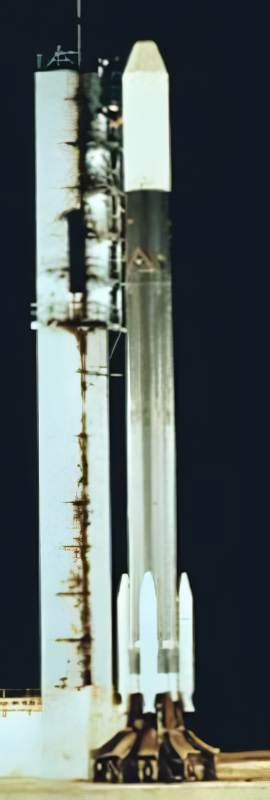
About the Delta 2310
Delta 2310
The Delta 2310 is an American expendable orbital launch vehicle operated by NASA and manufactured by McDonnell Douglas, representing a specific configuration within the long-running Delta family of rockets. A workhorse of the United States space program during the 1970s and early 1980s, it served as a reliable medium-lift vehicle for government satellite missions during an era of significant expansion in civil and military space activity.
Origins and Configuration
The Delta rocket family traces its lineage to the Thor intermediate-range ballistic missile developed in the 1950s, with successive upgrades producing a wide variety of numbered configurations. The 2310 designation encodes specific details about the vehicle's stage and motor arrangement within the Thor-Delta naming convention. Standing 35 meters tall with a core diameter of 2.44 meters, the 2310 represents a mid-generation Delta variant combining an upgraded first stage with upper stages suited to placing small-to-medium payloads into low Earth or sun-synchronous orbits. Launches in this era typically took place from Cape Canaveral Air Force Station or Vandenberg Air Force Base, depending on the orbital inclination required by each mission.
Operational History
The Delta 2310 flew across a period spanning 1974 to 1981, accumulating three tracked flights, all of which were successful. This unblemished record reflects both the maturity of the Delta platform by this period and the rigorous mission assurance practices applied to high-value government payloads. The United States Air Force was the top customer associated with this configuration, though the missions flown spanned both civil and scientific objectives.
Among the most notable missions carried by the Delta 2310 was NOAA 4, part of the ITOS series of operational meteorological satellites managed by the National Oceanic and Atmospheric Administration. Its sister mission, NOAA 5, continued that series, providing critical weather data for civil and governmental users. The most recent mission in the tracked record is the Solar Mesosphere Explorer, a NASA scientific satellite designed to study the processes that create and destroy ozone in Earth's upper atmosphere — a research priority that grew significantly in public importance during the late 1970s.
Legacy
The Delta 2310's clean operational record, though modest in total flight count, underscores the dependability that made the Delta family one of the most trusted launch vehicle lineages in spaceflight history. By bridging routine Earth-observation satellite launches with dedicated scientific missions, the configuration demonstrated the versatility inherent in the modular Delta architecture. The broader Delta program would continue evolving through subsequent decades, eventually producing the Delta II and Delta IV families, but configurations like the 2310 represent an important middle chapter — connecting the pioneering days of American rocketry to the more mature commercial and scientific launch industry that followed.
Its contribution to continuous meteorological coverage and atmospheric science, delivered with consistent reliability, remains a quiet but meaningful part of the larger story of American space infrastructure in the 1970s.