Commercial Titan III
About the Commercial Titan III
Commercial Titan III
The Commercial Titan III was an American expendable launch vehicle developed and operated by Martin Marietta as a commercial derivative of the United States Air Force's proven Titan III rocket family. Designed to compete in the growing international market for commercial satellite launches during the late 1980s and early 1990s, it represented one of the more capable heavy-lift options available to satellite operators of that era.
Origins and Design
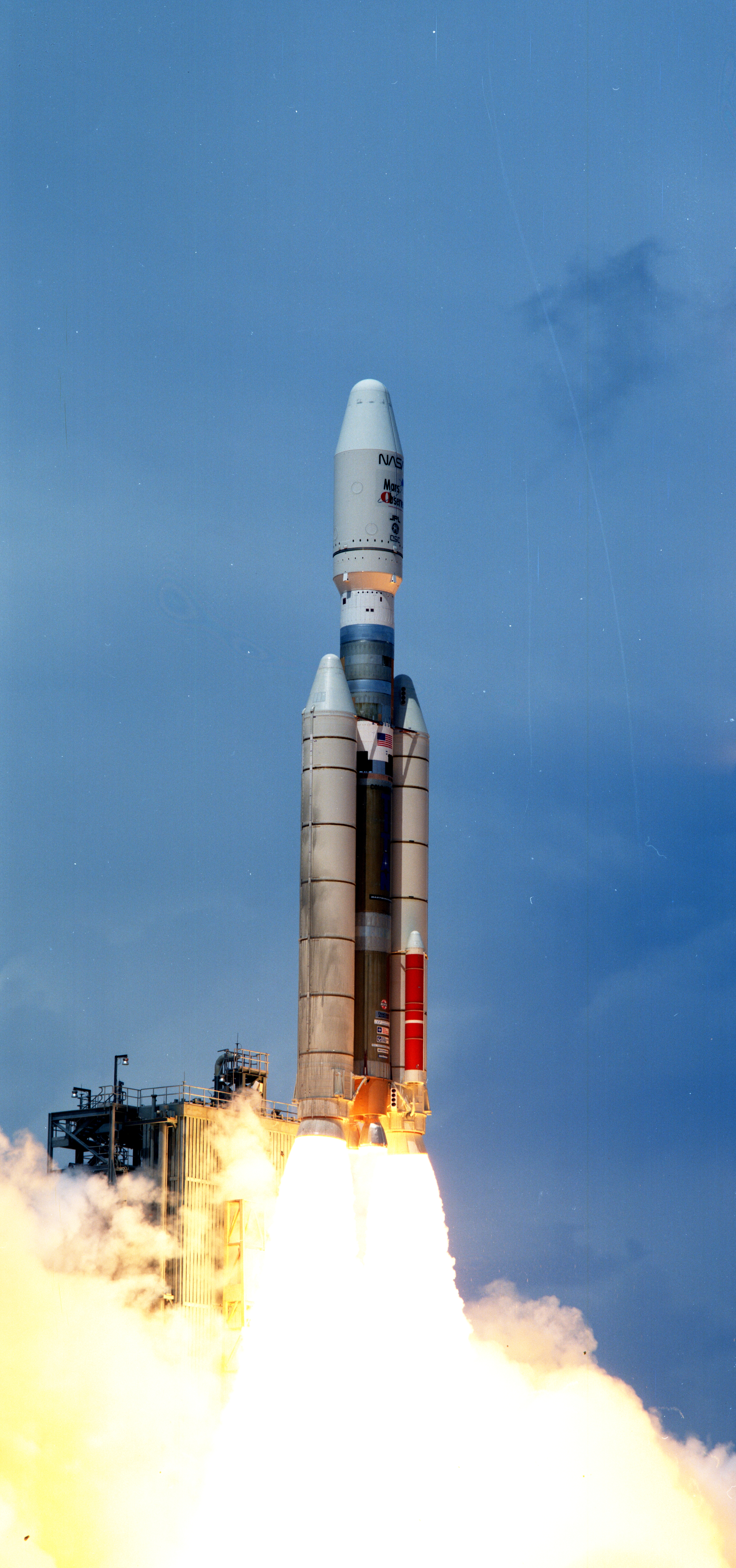
The vehicle emerged from the broader Titan lineage, a family of rockets with roots stretching back to the early 1960s. Martin Marietta adapted the military Titan III configuration for commercial customers, pairing a large liquid-fueled core stage with twin solid rocket motors to achieve the heavy-lift performance demanded by the generation of large geostationary communications satellites then entering service. At 47.3 meters tall and 3.05 meters in diameter, the Commercial Titan III was a substantial rocket, capable of delivering up to 14,742 kg to low Earth orbit or approximately 4,990 kg to geostationary transfer orbit. The vehicle flew from Space Launch Complex 40 at Cape Canaveral Air Force Station in Florida.
Service History
The Commercial Titan III flew a notably compact operational career, with all four tracked flights taking place between 1990 and 1992. Every mission in the record ended in success, giving the vehicle a perfect 4-for-4 flight record. Its customer manifest reflected the dominant commercial and governmental satellite users of the period.
The vehicle's missions included the delivery of Intelsat 603 and Intelsat 604, both belonging to the multinational Intelsat consortium's sixth-generation communications satellite series. A dual-manifest flight carried Skynet 4A, a British military communications satellite, alongside JCSat 2, a Japanese commercial communications spacecraft — a pairing that demonstrated the vehicle's ability to accommodate multiple payloads in a single launch. The final tracked mission was the delivery of Mars Observer, a NASA planetary science spacecraft bound for Mars, illustrating the vehicle's versatility across both commercial and scientific mission profiles.
Legacy and Context
The Commercial Titan III occupied an important niche during a transitional moment in the launch industry, when the United States government was actively encouraging private sector involvement in space transportation following the 1986 Challenger disaster. Martin Marietta positioned the vehicle as a domestically built alternative to the European Ariane 4, which dominated commercial launch services at the time.
Although the Commercial Titan III's operational life was brief, its clean flight record and the significance of its payloads secured its place in launch history. Martin Marietta would subsequently develop the more capable Titan IV for government missions and later merged with Lockheed Corporation in 1995 to form Lockheed Martin, which continued to develop the Atlas and Titan families. The Commercial Titan III stands as a notable, if short-lived, effort to harness American heavy-lift heritage for the competitive commercial satellite market of the early post-Cold War era.