Blue Scout Jr
About the Blue Scout Jr
Blue Scout Jr
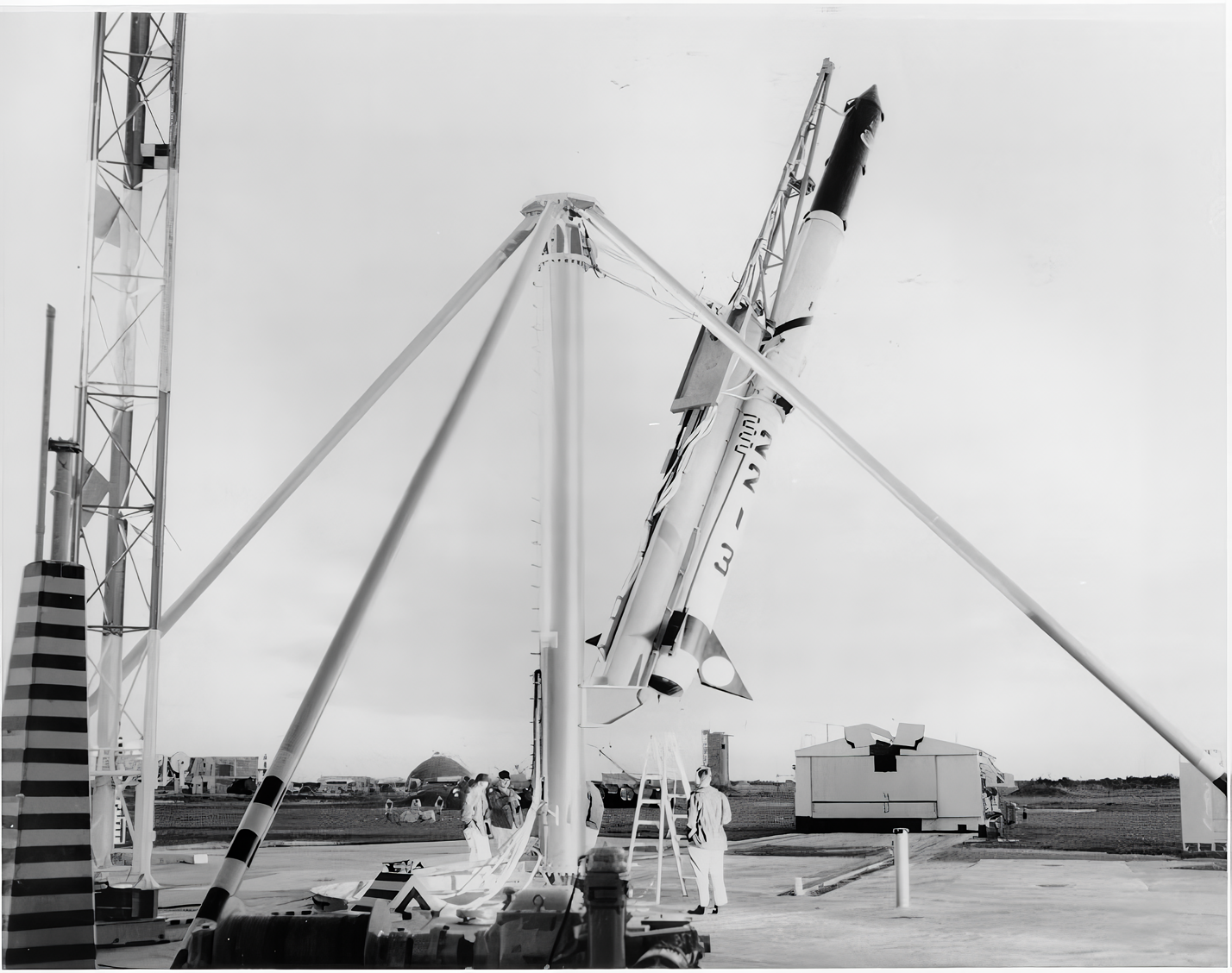
The Blue Scout Jr is an American solid-fueled orbital launch vehicle developed as a compact, cost-effective derivative of the Scout rocket family, operated primarily by the United States Air Force. Designed to place small scientific and experimental payloads into orbit, it represents one of the more specialized members of the broader Scout lineage — a family of all-solid rockets that became workhorses of early American space activity in the 1960s.
Origins and Design
The Blue Scout Jr emerged from the Air Force's interest in a lighter, more economical vehicle tailored to specific research and upper-atmospheric missions. Like its Scout relatives, it relied entirely on solid-propellant stages, which offered simplicity, rapid preparation, and relatively low operational costs compared to liquid-fueled alternatives of the era. Standing 12.4 meters tall and 0.79 meters in diameter, it is a slender, modest vehicle by any measure — well suited to the small satellites and instrumented payloads typical of early-1960s scientific programs. Specific thrust and payload figures are not detailed here, but the vehicle's scale places it firmly in the lightweight category of orbital launchers.
Operational History
According to tracked flight data, the Blue Scout Jr conducted 8 orbital launch attempts across its active period from 1960 to 1965, achieving a perfect record with all 8 missions logged as successful. This unblemished performance is notable for any launch vehicle of the era, a period when rocket failures were commonplace and launch vehicle technology was still maturing rapidly.
The vehicle's customer base was dominated by the United States Air Force, reflecting its role as a dedicated military and government science asset rather than a commercial or broad-agency platform. Missions tracked under the designation OAR 22 series — including OAR 22-1, OAR 22-4, OAR 22-5, OAR 22-8, and OAR 22-9 — point to a sustained program of related Air Force research payloads, likely associated with upper-atmosphere and ionospheric research programs active during the early Space Age. The mission designated Blue Scout Jr. O-2 further illustrates the variety of experimental objectives the vehicle supported during its service life.
Legacy and Context
The Blue Scout Jr operated during one of the most consequential periods in spaceflight history, when the United States was rapidly expanding its orbital launch capabilities in parallel with the Soviet Union. Small, solid-fueled rockets like the Blue Scout Jr played a critical supporting role in this expansion, enabling the Air Force to conduct frequent, relatively affordable research missions without committing large liquid-fueled boosters to modest payloads.
While the vehicle's operational career was brief — spanning roughly five years — its perfect mission success rate across eight flights speaks to the reliability of its design and the competence of its launch teams. The Scout family as a whole went on to have a long and distinguished career in American spaceflight, and the Blue Scout Jr stands as a capable, focused chapter within that broader story. Though it never carried high-profile payloads or made major headlines, its quiet reliability made it a dependable tool during a formative era of American military and scientific space activity.
- Jun 09, 1965Blue Scout Jr | OAR 22-5Success
- May 12, 1965Blue Scout Jr | OAR 22-8Success
- Apr 09, 1965Blue Scout Jr | OAR 22-9Success
- Mar 30, 1965Blue Scout Jr | OAR 22-4Success
- Jul 30, 1963Blue Scout Jr | OAR 22-1Success
- Dec 04, 1961Blue Scout Jr | Blue Scout Jr. O-2Success
- Aug 17, 1961Blue Scout Jr | O-1Success
- Sep 21, 1960Blue Scout Jr | Blue Scout D-1Success