Atlas V 551
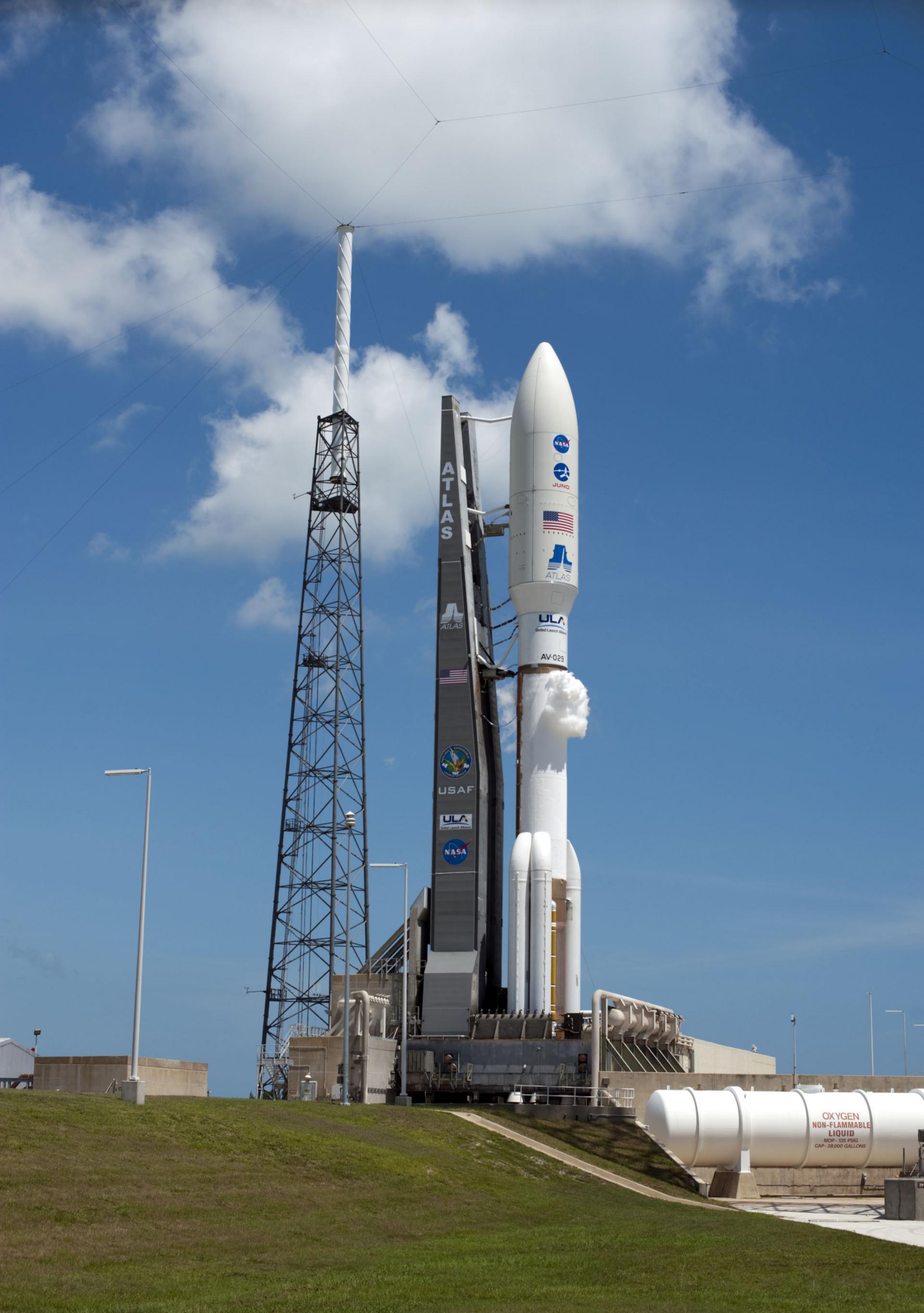
About the Atlas V 551
Atlas V 551
The Atlas V 551 is an expendable orbital launch vehicle operated by United Launch Alliance (ULA), a joint venture between Boeing and Lockheed Martin based in the United States. It represents the most powerful configuration of the Atlas V rocket family, distinguished by its five solid rocket boosters, a five-meter payload fairing, and a single-engine Centaur upper stage — the combination from which its "551" designation is derived.
Vehicle Configuration and Capability
The Atlas V 551 stands 59.7 meters tall with a core diameter of 3.8 meters. The five strap-on solid rocket boosters clustered around the common core booster give this variant substantially more liftoff thrust than lighter Atlas V configurations, making it well suited to missions demanding either high mass to low Earth orbit or demanding trajectories to geostationary transfer orbit. With a payload capacity of 18,850 kg to LEO and 8,890 kg to GTO, it occupies the upper tier of medium-to-heavy launch vehicles and has consistently been selected for some of the most demanding civil, commercial, and national security payloads in the American launch manifest.
Operational History
According to tracked flight data, the Atlas V 551 has accumulated 23 flights between 2006 and 2026, with a record of 22 successes and no failures or partial failures — a reliability profile that reflects both the maturity of the Atlas V platform and the rigorous launch processing standards maintained by ULA. Launches have taken place from Cape Canaveral Space Force Station in Florida, the vehicle's primary East Coast launch site.
The 551 variant has carried an eclectic mix of payloads over its operational life. Notable commercial missions include the ViaSat-3 F2 (ViaSat-3 EMEA) broadband communications satellite, a very large geostationary spacecraft that demanded the variant's full heavy-lift capability. In more recent years, the 551 has played a central role in deploying Amazon's Project Kuiper broadband constellation, with multiple dedicated Kuiper launches — designated LA-04 through LA-08 — marking one of the vehicle's most prominent late-career commercial campaigns. The selection of the Atlas V 551 for a constellation deployment program underscores the confidence major customers place in its performance and schedule reliability.
Role and Legacy
The Atlas V family traces its lineage to the storied Atlas rocket programs of the early Space Age and entered service in 2002 as a next-generation evolved expendable launch vehicle (EELV). United Launch Alliance has been the sole operator since its formation in 2006. The 551 configuration, as the most capable variant in the family, has served as a reliable workhorse for payloads that could not be accommodated by smaller configurations, and it has faced no direct like-for-like competition within the ULA catalog.
As Atlas V production winds down in favor of ULA's next-generation Vulcan Centaur rocket, the 551's late-career Kuiper manifest has ensured the variant remains operationally active well into the mid-2020s. Its near-perfect flight record across two decades positions it among the most dependable heavy-lift configurations in American spaceflight history.
- Jul 02, 2026Atlas V 551 | Amazon Leo (LA-08)Success
- May 29, 2026Atlas V 551 | Amazon Leo (LA-07)Success
- Apr 28, 2026Atlas V 551 | Amazon Leo (LA-06)Success
- Apr 04, 2026Atlas V 551 | Amazon Leo (LA-05)Success
- Dec 16, 2025Atlas V 551 | Amazon Leo (LA-04)Success
- Nov 14, 2025Atlas V 551 | ViaSat-3 F2 (ViaSat-3 EMEA)Success
- Sep 25, 2025Atlas V 551 | Amazon Leo (KA-03)Success
- Jun 23, 2025Atlas V 551 | Amazon Leo (KA-02)Success
- Apr 28, 2025Atlas V 551 | Amazon Leo (KA-01)Success
- Jul 30, 2024Atlas V 551 | USSF-51Success
- Sep 10, 2023Atlas V 551 | NROL-107 (Silent Barker)Success
- Dec 07, 2021Atlas V 551 | STP-3Success
- Mar 26, 2020Atlas V 551 | AEHF-6Success
- Aug 08, 2019Atlas V 551 | AEHF-5 (USA 292)Success
- Oct 17, 2018Atlas V 551 | AEHF-4 (USA 288)Success
- Apr 14, 2018Atlas V 551 | AFSPC-11Success
- Jun 24, 2016Atlas V 551 | MUOS-5Success
- Sep 02, 2015Atlas V 551 | MUOS-4Success
- Jan 21, 2015Atlas V 551 | MUOS-3Success
- Jul 19, 2013Atlas V 551 | MUOS-2Success
- Feb 24, 2012Atlas V 551 | MUOS-1Success
- Aug 05, 2011Atlas V 551 | JunoSuccess
- Jan 19, 2006Atlas V 551 | New HorizonsSuccess