Atlas V 541
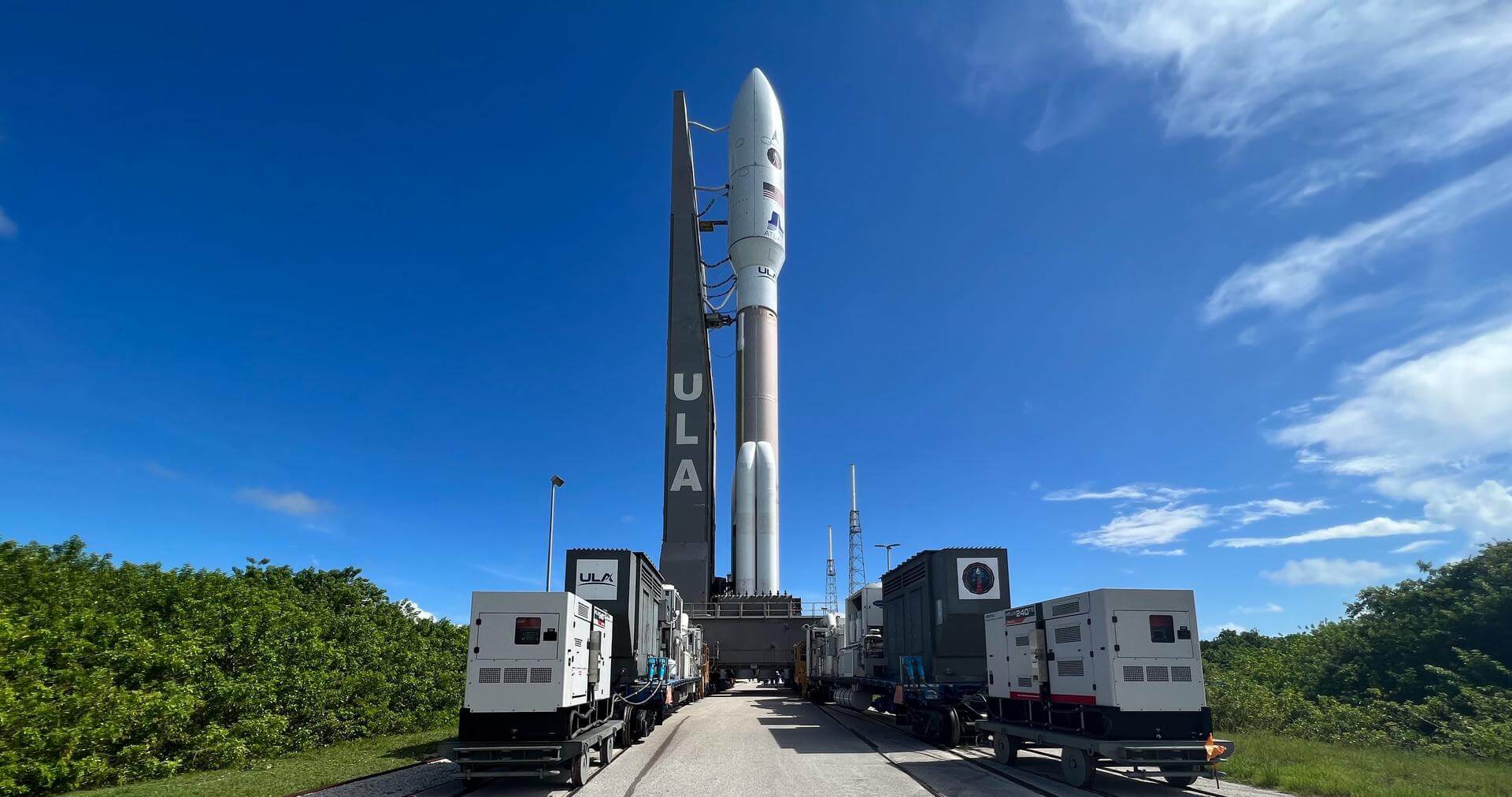
About the Atlas V 541
Atlas V 541
The Atlas V 541 is a heavy-lift expendable launch vehicle operated by United Launch Alliance (ULA), an American launch services provider jointly formed by Lockheed Martin and Boeing. It represents one of the more capable configurations within the broader Atlas V family, which has served as a workhorse of American civil, commercial, and national security space launches since the early 2000s.
Configuration and Design
The "541" designation follows the standard Atlas V numbering convention, where the digits indicate the payload fairing diameter (5-meter), the number of solid rocket boosters (four), and the number of upper-stage engines (one, on the Centaur upper stage). The addition of four solid rocket boosters gives this configuration substantially greater liftoff thrust than lighter Atlas V variants, enabling it to handle demanding missions to geostationary transfer orbit and beyond. Standing 60 meters tall with a core diameter of 3.8 meters, the vehicle pairs a Russian-built RD-180 main engine on its first stage with a Centaur upper stage powered by an RL-10 engine. The 541 is rated to carry 17,410 kg to low Earth orbit and 8,290 kg to geostationary transfer orbit.
Flight History
Our tracking records document nine flights of the Atlas V 541 configuration, spanning 2011 to 2022, all of which concluded successfully — a perfect mission record across more than a decade of service. This reliability made it a trusted choice for high-value government payloads that could not afford launch failures.
The 541's mission manifest reflects the confidence placed in it for flagship programs. Among its most prominent launches was Mars 2020, which carried NASA's Perseverance rover and the Ingenuity helicopter on their journey to Mars — arguably the most scientifically significant mission flown on this configuration. The vehicle also lofted multiple satellites in the GOES series (GOES-R, GOES-S, and GOES-T), the next-generation geostationary weather satellites operated by NOAA that now provide critical meteorological data for North America. National security missions are also well represented, including NROL-42 for the National Reconnaissance Office and USSF-12 for the United States Space Force.
Role and Legacy
The Atlas V 541 occupied a specific and important niche in American launch capability: a configuration powerful enough to dispatch large geostationary satellites and deep-space spacecraft, yet part of a proven and highly standardized vehicle family. Its customers were predominantly United States government agencies — NASA, the NRO, and the Space Force — reflecting the configuration's alignment with demanding, mission-critical requirements rather than the commercial satellite market.
As a member of the Atlas V family, the 541 benefited from decades of heritage stretching back to the original Atlas rocket of the late 1950s. ULA has been transitioning its launch manifest toward the next-generation Vulcan Centaur rocket, and the broader Atlas V program has been winding down accordingly. The 541's final tracked flight in 2022 places it among the later Atlas V configurations to complete its operational run, leaving behind a record that stands as a testament to the reliability standards that defined the Atlas V era of American rocketry.
- Jul 01, 2022Atlas V 541 | USSF-12Success
- Mar 01, 2022Atlas V 541 | GOES-TSuccess
- Jul 30, 2020Atlas V 541 | Mars 2020 (Perseverance rover & Ingenuity helicopter)Success
- Mar 01, 2018Atlas V 541 | GOES-SSuccess
- Sep 24, 2017Atlas V 541 | NROL-42Success
- Nov 19, 2016Atlas V 541 | GOES-RSuccess
- Dec 13, 2014Atlas V 541 | NROL-35 (USA-259)Success
- Apr 10, 2014Atlas V 541 | NROL-67 (USA-250)Success
- Nov 26, 2011Atlas V 541 | MSL (Curiosity)Success