Atlas V 521
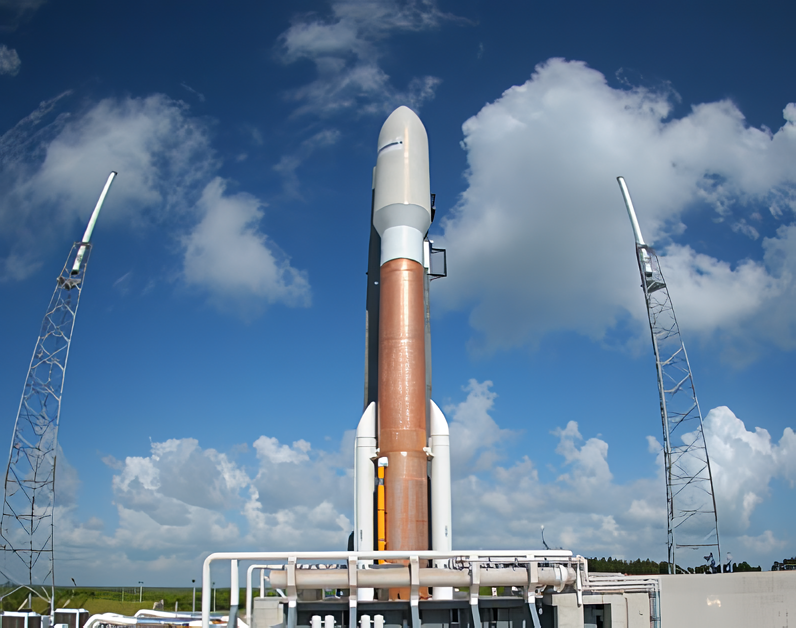
About the Atlas V 521
Atlas V 521
The Atlas V 521 is an American expendable orbital launch vehicle operated by Lockheed Martin as part of the broader Atlas V family, developed and manufactured in the United States. A member of the 400-series configuration line, the 521 variant represents one of the medium-lift options within the highly flexible Atlas V architecture, which was designed to serve a wide range of commercial, civil, and government satellite customers.
Configuration and Design
The Atlas V family uses a modular design philosophy, with each variant designated by a three-digit code that encodes its fairing diameter, number of solid rocket boosters, and upper stage engine count. The 521 designation indicates a 5-meter payload fairing, two solid rocket boosters, and a single-engine Centaur upper stage. This combination gives the vehicle a balanced performance envelope suited to medium and heavy commercial payloads. The rocket stands 58.3 meters tall with a core diameter of 3.81 meters, and is capable of delivering up to 13,490 kg to low Earth orbit or approximately 6,475 kg to geostationary transfer orbit, making it well-suited for large commercial communications satellites.
The Atlas V was developed under the United States Air Force's Evolved Expendable Launch Vehicle (EELV) program, which sought to modernize American launch capabilities and reduce costs. Missions typically launch from Space Launch Complex 41 at Cape Canaveral, Florida.
Flight History
According to tracked flight records, the Atlas V 521 flew twice, with both missions recorded as successes and no failures or partial failures. Its operational window in this configuration spanned 2003 to 2004, making it one of the earlier Atlas V variants to see active service following the rocket's introduction.
Both tracked missions carried commercial communications satellites. The Rainbow 1 mission delivered a satellite for what was then a growing direct-broadcast television market, while the AMC 16 mission served a similar commercial communications role. Lockheed Martin stands as the top customer associated with this configuration across the tracked record, reflecting the company's role both as operator and as a key stakeholder in commercial satellite launches during this period.
Role and Significance
The Atlas V 521's short but successful operational history illustrates the modular versatility that made the Atlas V family one of the most reliable American launch vehicles of its era. By offering multiple configurations with differing numbers of solid boosters and fairing sizes, the Atlas V program allowed mission planners to closely match vehicle performance to payload requirements, avoiding the cost penalties of over-capability.
The two-booster, five-meter fairing combination occupied a useful middle ground in the Atlas V lineup, capable of handling heavier commercial payloads that exceeded the capacity of single-booster or no-booster variants without requiring the full four-booster configuration. Though the 521 variant saw only a limited number of flights, both missions were completed without incident, contributing to the Atlas V program's broader reputation for high reliability across its many configurations.