Atlas V 411
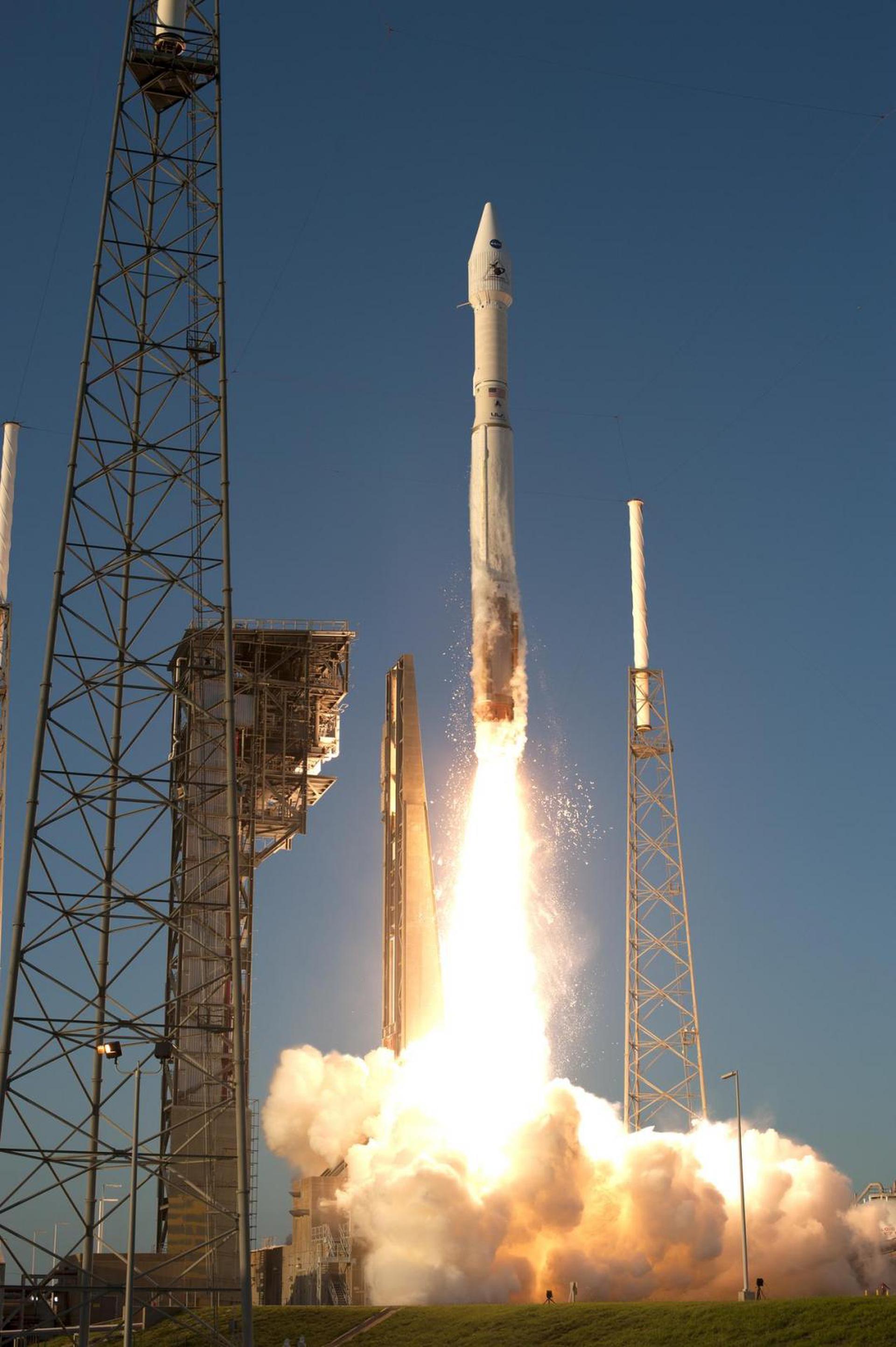
About the Atlas V 411
Atlas V 411
The Atlas V 411 is an American expendable launch vehicle operated by United Launch Alliance (ULA), a joint venture between Lockheed Martin and Boeing. It belongs to the Atlas V rocket family, one of the most reliable and long-serving launch vehicle lineages in the history of American spaceflight. The Atlas V was developed by Lockheed Martin and entered service in the early 2000s, with ULA assuming operational responsibility following the company's formation in 2006.
Configuration and Design
The 411 designation follows the standard Atlas V naming convention, where the three digits describe the payload fairing diameter, the number of solid rocket boosters, and the number of upper-stage engines. In the case of the 411, this means a four-meter payload fairing, one solid rocket booster attached to the first stage, and a single-engine Centaur upper stage. The asymmetric single-booster arrangement is a distinctive visual characteristic of this variant, making it immediately recognizable on the launch pad. The vehicle stands 58.3 meters tall with a core diameter of 3.8 meters, and it is capable of delivering 8,080 kg to low Earth orbit and 5,950 kg to geostationary transfer orbit.
The single solid booster places the 411 between the booster-less 401 variant and the twin-booster 421 in terms of lift capability, giving mission planners a precisely calibrated option for payloads that fall within a specific mass range. Launches have historically taken place from Cape Canaveral Space Force Station in Florida and Vandenberg Space Force Base in California, depending on the target orbit.
Flight History
Within our tracking data, the Atlas V 411 recorded six flights between 2006 and 2020, achieving a perfect success rate across all tracked missions. This spotless record is consistent with the broader Atlas V family's reputation for exceptional reliability.
The variant's missions spanned a wide range of customers and objectives. Its earliest tracked flight carried Astra 1KR, a commercial communications satellite. Subsequent missions demonstrated the vehicle's versatility: NROL-28 and NROL-34 served the U.S. National Reconnaissance Office, delivering classified payloads — the latter deploying a pair of naval ocean surveillance satellites. The SBIRS GEO Flight 4 mission lofted a Space-Based Infrared System geosynchronous satellite for the U.S. Space Force's missile warning constellation.
Two missions in particular gave the 411 variant a prominent place in scientific exploration history. OSIRIS-REx, launched in 2016, sent NASA's asteroid sample-return spacecraft on its journey to the near-Earth asteroid Bennu — a mission that ultimately returned samples to Earth in 2023. Solar Orbiter, launched in February 2020 and representing the final tracked flight of this variant, was a joint ESA/NASA mission designed to study the Sun from unprecedented vantage points, including out-of-ecliptic perspectives.
Legacy
The Atlas V 411 served a remarkably diverse clientele, supporting commercial satellite operators, U.S. national security programs, and international scientific agencies within its relatively small number of flights. Its consistent performance across such varied mission profiles reflects both the fundamental soundness of the Atlas V platform and the precision with which ULA tailored individual configurations to specific payload needs.
- Feb 10, 2020Atlas V 411 | Solar OrbiterSuccess
- Jan 20, 2018Atlas V 411 | SBIRS GEO Flight 4 (SBIRS GEO-3)Success
- Sep 08, 2016Atlas V 411 | OSIRIS-RExSuccess
- Apr 15, 2011Atlas V 411 | NROL-34 (2 x NOSS (USA-229))Success
- Mar 13, 2008Atlas V 411 | NROL-28 (USA-200)Success
- Apr 20, 2006Atlas V 411 | Astra 1KRSuccess