Atlas SLV-3D Centaur
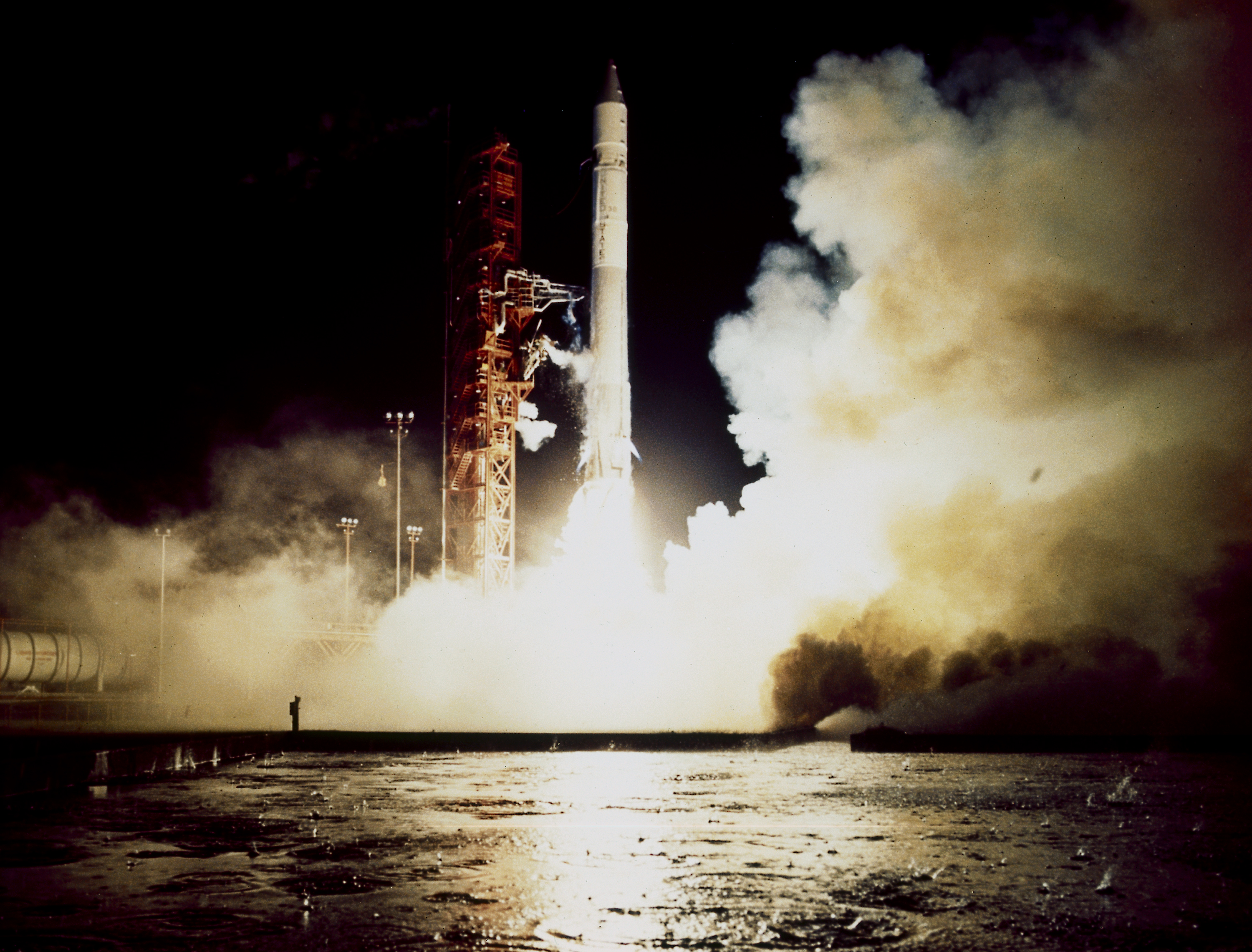
About the Atlas SLV-3D Centaur
Atlas SLV-3D Centaur
The Atlas SLV-3D Centaur is an American expendable orbital launch vehicle developed and operated by Convair (a division of General Dynamics) on behalf of the United States government. A member of the long-running Atlas rocket family, it pairs the proven Atlas SLV-3D booster with the cryogenic Centaur upper stage — one of the earliest and most capable high-energy upper stages in the history of spaceflight. The vehicle launched from facilities at Cape Canaveral Air Force Station in Florida and served as a reliable workhorse for medium-weight payloads throughout the 1970s and early 1980s.
Design and Capabilities
The Atlas SLV-3D Centaur stands 21 meters tall with a diameter of 3.05 meters, placing it among the more compact configurations of the Atlas-Centaur lineage. Like all Atlas vehicles of its era, it employed a pressure-stabilized "balloon tank" structure that kept the rocket rigid through internal propellant pressure rather than heavy structural members alone. The Centaur upper stage burns liquid hydrogen and liquid oxygen, providing the high specific impulse needed to deliver payloads to geostationary transfer orbit — the destination for most of the vehicle's commercial and military satellites. Its payload capacity to low Earth orbit is approximately 800 kg.
Operational History
The Atlas SLV-3D Centaur was active from 1973 to 1983, a decade during which it compiled a strong reliability record. Of the 32 flights tracked, 30 were fully successful, with only 2 resulting in failure or partial failure — a success rate reflecting the accumulated engineering refinements of the broader Atlas-Centaur program dating back to the early 1960s.
Its two principal customers were the United States Air Force and Convair itself, the latter acting in a launch services capacity for commercial satellite operators. Among the most significant payloads carried were satellites in the Intelsat series — globally important commercial communications satellites — and the FLTSATCOM constellation, which provided critical ultra-high-frequency communications for U.S. Navy and Air Force operations. Recent missions in the vehicle's record include launches of Intelsat 501 through 506 and FLTSATCOM 5, underscoring the vehicle's central role in building out both international commercial communications infrastructure and American military satellite networks during this period.
Legacy and Context
The Atlas SLV-3D Centaur represented a mature point in the evolution of the Atlas-Centaur family before the line transitioned to later configurations such as the Atlas G and, eventually, the Atlas II series. Its decade of service coincided with a pivotal era in satellite communications, when geostationary orbit was rapidly becoming crowded with operational spacecraft serving broadcasting, telephony, and defense missions. The vehicle's consistent performance helped establish Convair and the Atlas brand as dependable options for high-value government and commercial payloads at a time when launch reliability was far from guaranteed across the industry. The Centaur upper stage technology pioneered and refined through vehicles like this one remains in use today, making the Atlas SLV-3D Centaur a meaningful ancestor of modern American launch systems.
- May 19, 1983Atlas SLV-3D Centaur | Intelsat 506Success
- Sep 28, 1982Atlas SLV-3D Centaur | Intelsat 505Success
- Mar 05, 1982Atlas SLV-3D Centaur | Intelsat 504Success
- Dec 15, 1981Atlas SLV-3D Centaur | Intelsat 503Success
- Aug 06, 1981Atlas SLV-3D Centaur | FLTSATCOM 5Success
- May 23, 1981Atlas SLV-3D Centaur | Intelsat 501Success
- Feb 21, 1981Atlas SLV-3D Centaur | Comstar 1DSuccess
- Dec 06, 1980Atlas SLV-3D Centaur | Intelsat 502Success
- Oct 31, 1980Atlas SLV-3D Centaur | FLTSATCOM 4Success
- Jan 18, 1980Atlas SLV-3D Centaur | FLTSATCOM 3Success
- Sep 20, 1979Atlas SLV-3D Centaur | HEAO 3Success
- May 04, 1979Atlas SLV-3D Centaur | FLTSATCOM 2Success
- Nov 13, 1978Atlas SLV-3D Centaur | Einstein ObservatorySuccess
- Aug 08, 1978Atlas SLV-3D Centaur | Pioneer Venus MultiprobeSuccess
- Jun 29, 1978Atlas SLV-3D Centaur | Comstar 1CSuccess
- May 20, 1978Atlas SLV-3D Centaur | Pioneer Venus OrbiterSuccess
- Mar 31, 1978Atlas SLV-3D Centaur | Intelsat-4A 6Success
- Feb 09, 1978Atlas SLV-3D Centaur | FLTSATCOM 1Success
- Jan 07, 1978Atlas SLV-3D Centaur | Intelsat-4A 3Success
- Sep 30, 1977Atlas SLV-3D Centaur | Intelsat-4A 5Failure
- Aug 12, 1977Atlas SLV-3D Centaur | HEAO 1Success
- May 26, 1977Atlas SLV-3D Centaur | Intelsat-4A 4Success
- Jul 22, 1976Atlas SLV-3D Centaur | Comstar 1BSuccess
- May 13, 1976Atlas SLV-3D Centaur | Comstar 1ASuccess
- Jan 29, 1976Atlas SLV-3D Centaur | Intelsat-4A 2Success
- Sep 26, 1975Atlas SLV-3D Centaur | Intelsat-4A 1Success
- May 22, 1975Atlas SLV-3D Centaur | INTELSAT IV F1Success
- Feb 20, 1975Atlas SLV-3D Centaur | INTELSAT IV F6Failure
- Nov 21, 1974Atlas SLV-3D Centaur | INTELSAT IV F8Success
- Nov 03, 1973Atlas SLV-3D Centaur | Mariner 10Success
- Aug 23, 1973Atlas SLV-3D Centaur | INTELSAT IV F7Success
- Apr 06, 1973Atlas SLV-3D Centaur | Pioneer 11Success