Atlas SLV-3C Centaur
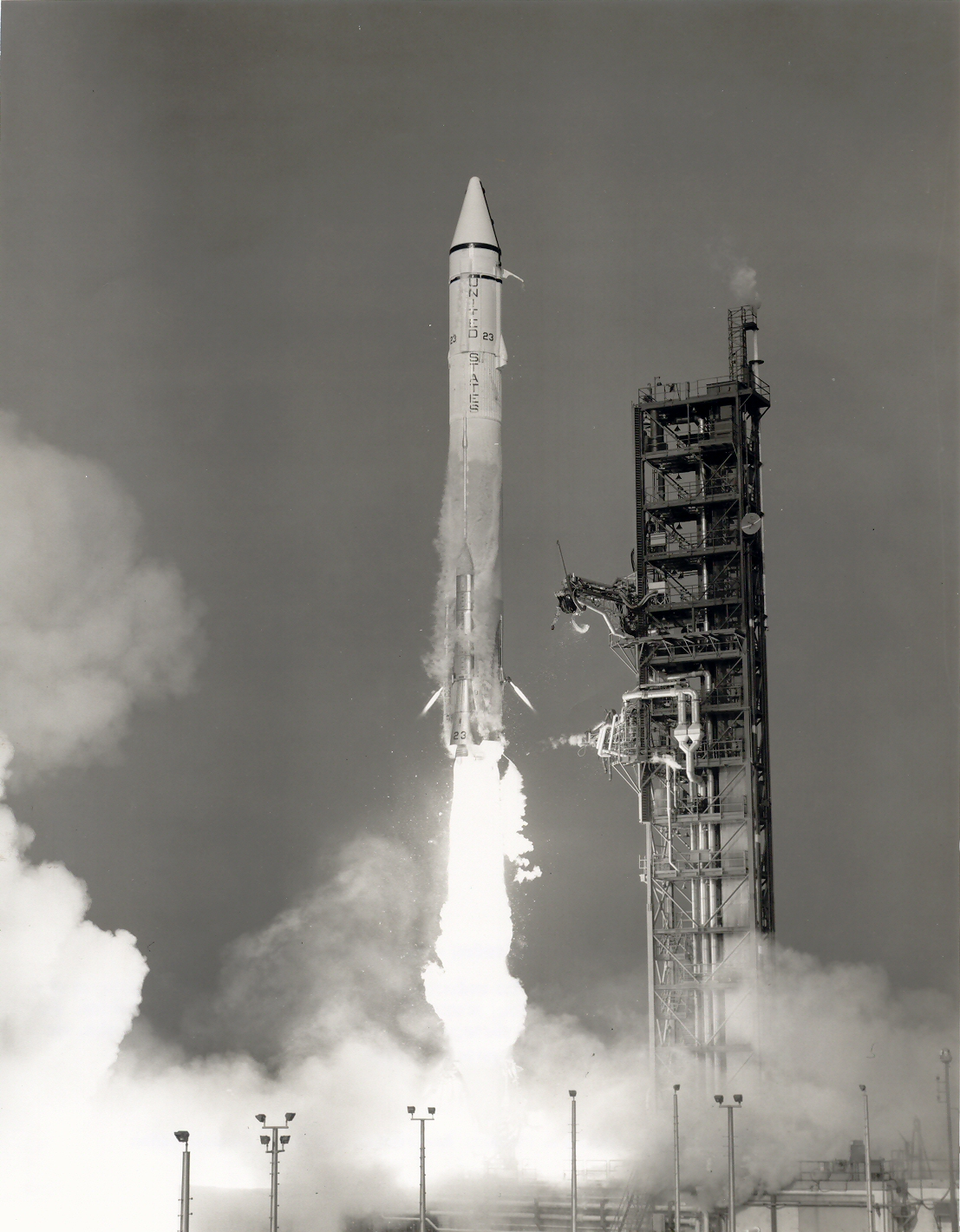
About the Atlas SLV-3C Centaur
Atlas SLV-3C Centaur
The Atlas SLV-3C Centaur is an American orbital launch vehicle developed and operated by General Dynamics for the United States government, combining the heritage Atlas SLV-3C booster with the high-energy Centaur upper stage. A member of the long-running Atlas rocket family, it served as one of the United States' most capable medium-to-heavy lift expendable launch systems during the late 1960s and early 1970s, supporting ambitious scientific, communications, and military satellite programs.
Standing 21 meters tall with a diameter of 3.05 meters, the vehicle was notable for its use of liquid oxygen and liquid hydrogen propellants in the Centaur stage — a technically demanding combination that delivered significantly greater performance than conventional upper stages of the era. This made the SLV-3C Centaur particularly well suited to missions requiring high-energy trajectories, including deep-space interplanetary flights and geostationary orbit insertions. The rocket was capable of delivering approximately 800 kilograms to low Earth orbit.
Service History
Based on tracked flight data, the Atlas SLV-3C Centaur flew 17 missions between 1967 and 1972, achieving 15 successes alongside 2 failures or partial failures — a reliability record broadly consistent with the vehicle's reputation as a workhorse of the era. The rocket launched predominantly from facilities at Cape Canaveral, Florida, serving a customer base led by the United States Air Force.
The vehicle's mission manifest reflects the breadth of American spaceflight ambitions during this period. On the commercial side, the SLV-3C Centaur lofted multiple INTELSAT IV communications satellites — including F3, F4, and F5 — which formed a cornerstone of international telecommunications infrastructure. These large geostationary payloads demanded the high-energy performance that the Centaur upper stage uniquely provided among operational American launch vehicles of the time.
Scientific Legacy
The SLV-3C Centaur's scientific contributions were equally significant. It launched Mariner 9 in 1971, which became the first spacecraft to orbit another planet when it entered Mars orbit later that year, returning thousands of images and transforming humanity's understanding of the Martian surface. The vehicle also launched Pioneer 10, the first spacecraft designed to travel through the asteroid belt and conduct a close flyby of Jupiter, beginning a journey that would eventually carry it out of the solar system entirely.
The mission designated Copernicus — formally the Orbiting Astronomical Observatory 3 — further demonstrated the vehicle's versatility, placing a sophisticated ultraviolet telescope into orbit that conducted landmark observations of stellar atmospheres and the interstellar medium.
Place in the Atlas Family
The SLV-3C Centaur represented a mature evolution of the Atlas airframe, refining the booster's performance and reliability ahead of later variants. The pairing of the Atlas and Centaur stages had been pioneered in the early 1960s, and the SLV-3C configuration built on that foundation to handle increasingly demanding payloads. Its operational period bridged the Apollo era and the transition toward more capable launch systems, cementing the Atlas-Centaur lineage as a defining element of American space launch history.
- Aug 21, 1972Atlas SLV-3C Centaur | CopernicusSuccess
- Jun 13, 1972Atlas SLV-3C Centaur | INTELSAT IV F5Success
- Mar 03, 1972Atlas SLV-3C Centaur | Pioneer 10Success
- Jan 23, 1972Atlas SLV-3C Centaur | INTELSAT IV F4Success
- Dec 20, 1971Atlas SLV-3C Centaur | INTELSAT IV F3Success
- May 30, 1971Atlas SLV-3C Centaur | Mariner 9Success
- May 09, 1971Atlas SLV-3C Centaur | Mariner 8Failure
- Jan 26, 1971Atlas SLV-3C Centaur | INTELSAT IV F2Success
- Nov 30, 1970Atlas SLV-3C Centaur | OAO BFailure
- Aug 12, 1969Atlas SLV-3C Centaur | ATS 5Success
- Mar 27, 1969Atlas SLV-3C Centaur | Mariner 7Success
- Feb 25, 1969Atlas SLV-3C Centaur | Mariner 6Success
- Dec 07, 1968Atlas SLV-3C Centaur | OAO 2Success
- Aug 10, 1968Atlas SLV-3C Centaur | ATS 4Success
- Jan 07, 1968Atlas SLV-3C Centaur | Surveyor 7Success
- Nov 07, 1967Atlas SLV-3C Centaur | Surveyor 6Success
- Sep 08, 1967Atlas SLV-3C Centaur | Surveyor 5Success