Atlas SLV-3A Agena D
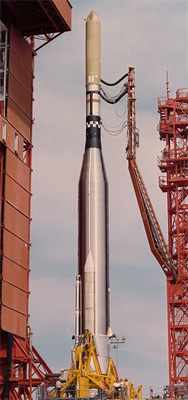
About the Atlas SLV-3A Agena D
Atlas SLV-3A Agena D
The Atlas SLV-3A Agena D is an American orbital launch vehicle developed and operated by the United States, combining a stretched variant of the Atlas SLV-3A booster with the versatile Agena D upper stage. Built by General Dynamics (Atlas) and Lockheed (Agena), the vehicle served as a workhorse of the United States Air Force's classified satellite launch program throughout the late 1960s and 1970s.
Design and Configuration
Standing 36 meters tall with a diameter of 3 meters, the Atlas SLV-3A Agena D follows the characteristic design philosophy of the Atlas family — a thin-walled, pressure-stabilized booster that relies on internal tank pressurization for structural rigidity. The Agena D upper stage, one of the most flight-proven spacecraft buses in early American spaceflight, added a restartable engine capable of placing payloads into precise orbits, making it especially well-suited to intelligence-gathering and reconnaissance missions. The vehicle is capable of delivering approximately 1,000 kg to low Earth orbit.
The Atlas SLV-3A represented a refinement over earlier Atlas variants, offering improved reliability and performance. The Agena D upper stage had accumulated extensive heritage across multiple programs before being paired with this booster configuration, lending the combined vehicle a high degree of operational confidence.
Operational History
Our flight record shows 12 tracked flights conducted between 1968 and 1978, of which 11 were successful and one was a failure or partial failure — a strong reliability record consistent with the mature state of both vehicle stages by this period. Launches were conducted from Vandenberg Air Force Base in California, the standard site for polar and sun-synchronous orbits serving reconnaissance payloads.
The United States Air Force was the dominant customer for this vehicle, and the mission manifest reflects the classified nature of Cold War-era satellite programs. Recent missions tracked in our records include the Aquacade and Canyon series — signals intelligence satellites operated under the umbrella of the National Reconnaissance Office. The Canyon satellites were designed to intercept Soviet communications, while the Aquacade series continued and expanded on that signals intelligence mission. Both programs represent some of the most strategically significant satellite operations of the era, many details of which remained classified for decades.
Legacy
The Atlas SLV-3A Agena D occupies an important place in the history of American space launch capability. Its decade-long service life bridged the gap between the early experimental years of the space race and the more institutionalized era of routine national security launches. The combination of a proven, pressure-stabilized booster with a restartable upper stage gave mission planners flexibility that was critical for the demanding orbital requirements of intelligence satellites.
The Agena D upper stage in particular contributed to an extraordinary range of missions across multiple vehicle pairings, and its role aboard the Atlas SLV-3A Agena D demonstrated how mature upper-stage technology could extend the utility of an existing booster family well into a new decade. The vehicle's strong success rate across our tracked missions underscores its reliability during a period of intense operational demand.
- Apr 07, 1978Atlas SLV-3A Agena D | Aquacade 4Success
- Dec 11, 1977Atlas SLV-3A Agena D | Aquacade 3Success
- May 23, 1977Atlas SLV-3A Agena D | Canyon 7Success
- Jun 18, 1975Atlas SLV-3A Agena D | Canyon 6Success
- Mar 06, 1973Atlas SLV-3A Agena D | Aquacade 2Success
- Dec 20, 1972Atlas SLV-3A Agena D | Canyon 5Success
- Dec 04, 1971Atlas SLV-3A Agena D | Canyon 4Failure
- Sep 01, 1970Atlas SLV-3A Agena D | Canyon 3Success
- Jun 19, 1970Atlas SLV-3A Agena D | Aquacade 1Success
- Apr 13, 1969Atlas SLV-3A Agena D | Canyon 2Success
- Aug 06, 1968Atlas SLV-3A Agena D | Canyon 1Success
- Mar 04, 1968Atlas SLV-3A Agena D | OGO 5Success