SM-65D Atlas
About the SM-65D Atlas
SM-65D Atlas
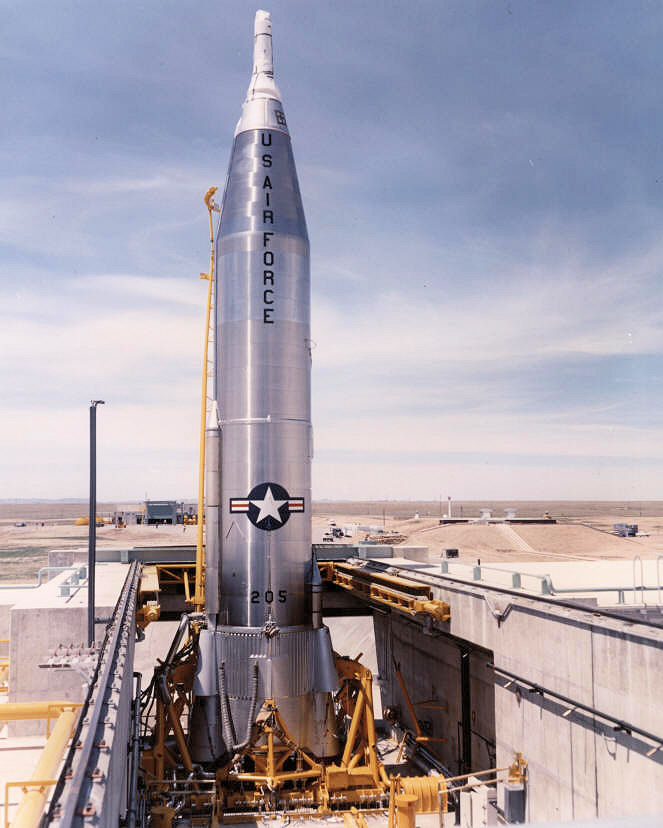
The SM-65D Atlas, commonly known as the Atlas D, is an American orbital launch vehicle operated by the United States Air Force and developed by Convair (a division of General Dynamics). A member of the pioneering Atlas rocket family, the Atlas D began its life as an intercontinental ballistic missile before being adapted to serve as a space launch vehicle, reflecting a pattern common to early American rocketry in which military missile programs provided the foundation for orbital capability.
Design and Configuration
The Atlas D retains the distinctive stage-and-a-half configuration that defines the Atlas family. Rather than discarding an entire first stage, the design jettisons its two outboard booster engines shortly after liftoff while the central sustainer engine continues burning through to orbital insertion. This approach, combined with the vehicle's thin pressure-stabilized stainless steel propellant tanks, gives the Atlas its unusually slender and lightweight structure. The vehicle stands 25.15 meters tall with a diameter of 3 meters, and is capable of delivering approximately 1,400 kilograms to low Earth orbit.
Operational History
In our flight record, the SM-65D Atlas conducted 9 tracked orbital launches between 1964 and 1967, achieving 6 successes against 3 failures or partial failures — a success rate reflecting both the genuine capability of the platform and the developmental challenges inherent in early spaceflight. By the mid-1960s the Atlas D represented a mature variant within the Atlas lineage, yet launches of this era remained demanding technical undertakings.
The vehicle's tracked mission manifest is dominated by the Orbiting Vehicle 1 (OV1) series of small scientific satellites developed for the Air Force. These missions — including OV1-2, OV1-3, OV1-4 & 5, OV1-7, OV1-9 & 10, and OV1-11, 12 & 86 — were designed to gather data on the space environment, including radiation, micrometeorites, and orbital dynamics. The OV1 satellites were notable for often flying as piggyback or clustered payloads, allowing multiple spacecraft to be deployed on a single Atlas D mission and maximizing scientific return. The United States Air Force was the sole top customer in this flight record, underscoring the vehicle's role as a dedicated military and government science platform during this period.
Place in Spaceflight History
The Atlas family as a whole occupies a foundational place in American spaceflight. Earlier Atlas variants launched the first American orbital astronaut, John Glenn, in 1962 and supported the entirety of the Mercury orbital program. By the time the Atlas D was flying OV1 payloads in the mid-1960s, more capable Atlas variants were already in development and service, and the vehicle was finding its niche as a reliable workhorse for smaller government scientific and experimental missions.
The SM-65D Atlas represents an important transitional chapter — a Cold War missile repurposed for science, bridging the improvisational urgency of the early Space Race and the more systematic orbital programs that would follow. Its contribution to low-cost, clustered small-satellite operations through the OV1 program offered an early glimpse of mission models that would become increasingly common in later decades.
- Jul 27, 1967Atlas D | OV1-11,12,86Failure
- Dec 11, 1966Atlas D | OV1-9 & 10Success
- Jul 14, 1966Atlas D | OV1-7Success
- Mar 30, 1966Atlas D | OV1-4 & 5Success
- Oct 05, 1965Atlas D | OV1-2Success
- May 28, 1965Atlas D | OV1-3Failure
- May 22, 1965Atlas D | FIRE 2Success
- Jan 21, 1965Atlas D | OV1-1Failure
- Apr 14, 1964Atlas D | FIRE 1Success