Atlas LV-3 Agena D
About the Atlas LV-3 Agena D
Atlas LV-3 Agena D
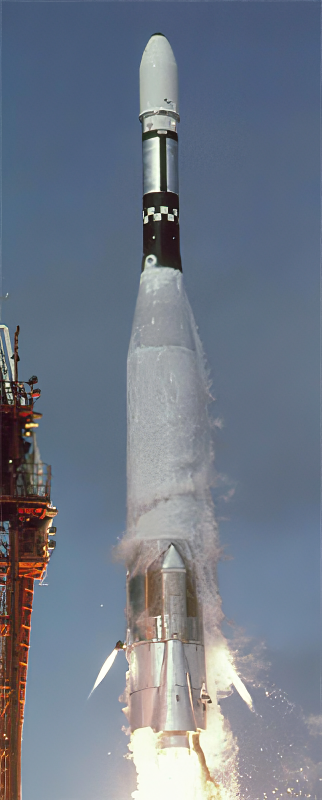
The Atlas LV-3 Agena D is an American expendable orbital launch vehicle developed and operated by the United States Air Force during the early 1960s. A member of the storied Atlas rocket family, it pairs the Atlas LV-3 booster with the Agena D upper stage — a standardized, restartable upper stage produced by Lockheed that became one of the most versatile and widely used spacecraft buses of the Space Race era. The combination was produced and managed under the broad Atlas-Agena program, which played a central role in both military reconnaissance and scientific exploration missions throughout the decade.
Design and Capabilities
Standing 36 meters tall with a diameter of 3 meters, the Atlas LV-3 Agena D carries forward the characteristic "stage-and-a-half" propulsion architecture of the Atlas family, in which the booster's outer engines are jettisoned during ascent while the sustainer engine continues to burn. The Agena D upper stage adds a restartable engine capable of performing orbital insertion and, where required, orbit adjustment burns — a capability that proved critical for missions demanding precise final orbits. The vehicle is rated to deliver approximately 1,000 kg to low Earth orbit, placing it in the medium-lift class for its era.
Operational History
Our flight record documents 15 launches of the Atlas LV-3 Agena D, spanning the years 1963 to 1965, all of which were successful — a remarkable reliability record that underscores the maturity of the Atlas-Agena combination by this point in its development. The vehicle launched from facilities on the United States West Coast, with Vandenberg Air Force Base serving as the primary site for polar and sun-synchronous trajectories suited to reconnaissance payloads.
The United States Air Force was the dominant customer, using the vehicle extensively for classified reconnaissance satellites. Among the notable military payloads were missions in the KH-7 GAMBIT series — high-resolution optical reconnaissance satellites that represented a significant leap forward in imagery intelligence capability. Missions such as KH-7 9 and KH-7 13 are recorded in our data, reflecting the Air Force's sustained reliance on this vehicle for strategic surveillance during a critical period of the Cold War.
Beyond military applications, the Atlas LV-3 Agena D also carried significant scientific and exploratory payloads. The vehicle was entrusted with Mariner 3 and Mariner 4, NASA's ambitious Mars flyby spacecraft. While Mariner 3 suffered a shroud failure that prevented mission success, Mariner 4 achieved the first successful flyby of Mars in July 1965, returning the first close-up images of another planet — one of the landmark achievements in the history of space exploration. The vehicle also launched the Vela 2A & 2B and Vela 3A & 3B satellites, part of a nuclear test detection constellation operated under a joint Department of Defense program.
Legacy
The Atlas LV-3 Agena D represents a high point in early American spaceflight capability, bridging military necessity and scientific ambition within a single, reliable airframe. Its unblemished record across 15 tracked flights — and the historic importance of payloads like Mariner 4 — cement its place as one of the more consequential launch vehicles of the 1960s.
- Jul 20, 1965Atlas Agena D | Vela 3A & 3BSuccess
- Nov 28, 1964Atlas Agena D | Mariner 4Success
- Nov 05, 1964Atlas Agena D | Mariner 3Success
- Oct 23, 1964Atlas Agena D | KH-7 13Success
- Jul 17, 1964Atlas Agena D | Vela 2A & 2BSuccess
- Jul 06, 1964Atlas Agena D | KH-7 9Success
- May 19, 1964Atlas Agena D | KH-7 8Success
- Apr 23, 1964Atlas Agena D | KH-7 7Success
- Mar 11, 1964Atlas Agena D | KH-7 6Success
- Feb 25, 1964Atlas Agena D | KH-7 5Success
- Dec 18, 1963Atlas Agena D | KH-7 4Success
- Oct 25, 1963Atlas Agena D | KH-7 3Success
- Oct 17, 1963Atlas Agena D | Vela 1A & 1BSuccess
- Sep 06, 1963Atlas Agena D | KH-7 2Success
- Jul 12, 1963Atlas Agena D | KH-7 1Success