Atlas LV-3 Agena B
About the Atlas LV-3 Agena B
Atlas LV-3 Agena B
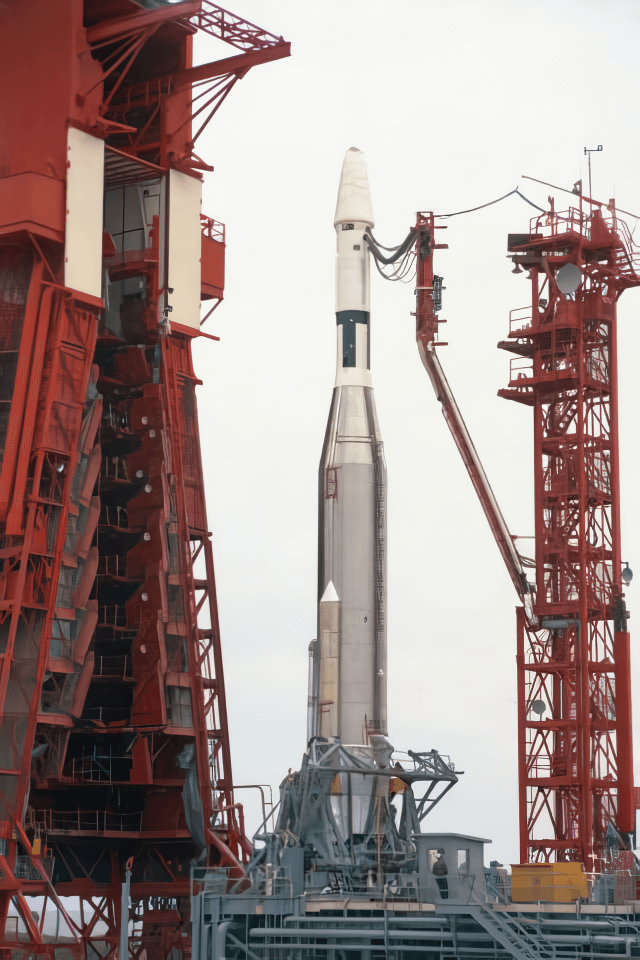
The Atlas LV-3 Agena B is an American orbital launch vehicle developed and operated primarily by the United States Air Force during the early 1960s. A member of the broader Atlas-Agena family, it combines the proven Atlas booster with the restartable Agena B upper stage, giving it a versatility that made it one of the workhorses of early American space operations.
Design and Configuration
Standing 20.27 meters tall with a diameter of 3.05 meters, the Atlas LV-3 Agena B follows the characteristic design philosophy of the Atlas family — a thin-walled, pressurized propellant tank structure that relies on internal pressure for structural rigidity rather than heavy conventional framing. The Agena B upper stage, developed by Lockheed, introduced a longer propellant tank compared to the earlier Agena A, and its engine was capable of restarting in orbit, a significant capability that allowed for more precise injection of payloads into their intended trajectories. This combination gave mission planners meaningful flexibility in targeting a range of orbital profiles.
Operational History
Our flight records show the Atlas LV-3 Agena B was active from 1961 through 1965, during which it conducted 29 tracked flights. Of those, 21 were successful, while 8 resulted in failure or partial failure — a reliability profile broadly consistent with the demanding standards of early spaceflight development, when launch vehicles and spacecraft alike were pushing the frontiers of engineering knowledge.
The vehicle's top customer was the United States Air Force, reflecting its central role in national security space programs of the era. Among its most prominent missions were flights supporting the MIDAS early-warning satellite program, which aimed to detect ballistic missile launches from orbit.
Notable Missions
The Atlas LV-3 Agena B is perhaps most publicly recognized for its role in NASA's early planetary and space science programs. The vehicle carried multiple spacecraft from the Ranger series, including Ranger 6, Ranger 7, Ranger 8, and Ranger 9 — missions designed to photograph the lunar surface at close range in preparation for eventual crewed landings. Ranger 7, launched in 1964, became a landmark success, returning thousands of high-resolution images of the Moon before impact.
The vehicle also lofted OGO 1 (Orbiting Geophysical Observatory 1), a sophisticated NASA science platform designed to conduct coordinated measurements of Earth's geophysical environment. The Midas 9 mission further underscored the vehicle's importance to national security space objectives.
Legacy
The Atlas LV-3 Agena B occupies a meaningful place in spaceflight history as a transitional vehicle that helped the United States develop confidence in upper-stage restartability, multi-orbit operations, and high-precision payload delivery. Its service during the early 1960s bridged the gap between the pioneering first generation of American launch vehicles and the more capable systems that would follow. The missions it supported — spanning military surveillance, space science, and lunar reconnaissance — collectively represent some of the most consequential early achievements of the American space program.
- Mar 21, 1965Atlas Agena B | Ranger 9Success
- Feb 17, 1965Atlas Agena B | Ranger 8Success
- Sep 05, 1964Atlas Agena B | OGO 1Success
- Jul 28, 1964Atlas Agena B | Ranger 7Success
- Jan 30, 1964Atlas Agena B | Ranger 6Success
- Jul 19, 1963Atlas Agena B | Midas 9Success
- Jun 12, 1963Atlas Agena B | Midas 8Failure
- May 09, 1963Atlas Agena B | Midas 7Success
- Dec 17, 1962Atlas Agena B | Midas 6Failure
- Nov 11, 1962Atlas Agena B | Samos-E6 5Success
- Oct 18, 1962Atlas Agena B | Ranger 5Success
- Aug 27, 1962Atlas Agena B | Mariner 2Success
- Aug 05, 1962Atlas Agena B | Samos-E6 4Success
- Jul 22, 1962Atlas Agena B | Mariner 1Failure
- Jul 18, 1962Atlas Agena B | Samos-E6 3Success
- Jun 17, 1962Atlas Agena B | Samos-E6 2Success
- Apr 26, 1962Atlas Agena B | Samos-E6 1Success
- Apr 23, 1962Atlas Agena B | Ranger 4Success
- Apr 09, 1962Atlas Agena B | Midas 5Success
- Mar 07, 1962Atlas Agena B | Samos 6Success
- Jan 26, 1962Atlas Agena B | Ranger 3Success
- Dec 22, 1961Atlas LV-3A | Samos 5Partial Failure
- Nov 22, 1961Atlas LV-3A | Samos 4Failure
- Nov 18, 1961Atlas LV-3A | Ranger 2Failure
- Oct 21, 1961Atlas LV-3A | MIDAS 4 & Westford-1Success
- Sep 09, 1961Atlas LV-3A | Samos 3Failure
- Aug 23, 1961Atlas LV-3A | Ranger 1Partial Failure
- Jul 12, 1961Atlas LV-3A | MIDAS 3Success
- Jan 31, 1961Atlas LV-3A | Samos 2Success