Atlas-Able
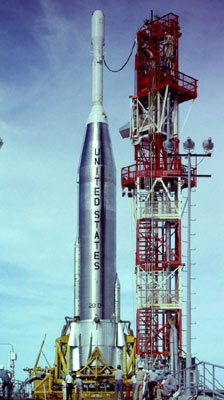
About the Atlas-Able
Atlas-Able
The Atlas-Able was an American expendable orbital launch vehicle developed in the late 1950s as a collaborative effort between the United States Air Force and NASA, building on the Atlas missile airframe to support early lunar and interplanetary exploration ambitions. Operated under U.S. government direction, it represented one of the earliest American attempts to reach the Moon and high Earth orbit during the opening years of the Space Age.
Origins and Design
The Atlas-Able combined the Atlas SM-65 intercontinental ballistic missile — developed by Convair and already in service as a foundational American rocket — with an upper stage derived from the Vanguard program's Able second and third stages. Standing 35 meters tall with a diameter of 3.05 meters, the vehicle inherited Atlas's distinctive "balloon tank" stainless-steel structure, which required pressurization to maintain rigidity. The addition of the Able upper stage gave it the reach needed to target lunar trajectories and geosynchronous transfer orbits, with a rated payload capacity to GTO of 250 kilograms. This configuration made it one of the more ambitious American launch vehicles of its era, if also one of the most technically demanding.
Operational History
Atlas-Able flew during a brief but eventful window between 1959 and 1960, conducting three launches on behalf of its top customer, the United States Air Force. All three missions ended in failure or partial failure, leaving the vehicle with a 0-for-3 flight record — a stark reflection of the enormous technical challenges facing early American spaceflight programs.
The three tracked missions were P-3, P-30 (Able VA), and P-31, each intended to place spacecraft into high-energy trajectories. The P-3 mission in 1959 was lost shortly after liftoff due to a launch vehicle malfunction. The subsequent P-30 and P-31 attempts similarly failed to achieve their objectives, with upper-stage performance and vehicle reliability proving to be persistent obstacles. These missions were part of the broader Pioneer lunar probe program, reflecting the intense American drive to reach the Moon ahead of the Soviet Union during the early Cold War space race.
Legacy
Despite its unbroken string of failures, the Atlas-Able occupies a meaningful place in spaceflight history. It demonstrated the United States' willingness to rapidly iterate on existing hardware — adapting a ballistic missile into an orbital launch vehicle within a compressed timeline — and provided hard-won engineering lessons that informed later, more successful programs. The challenges encountered with the Able upper stage contributed to ongoing improvements in American upper-stage technology throughout the early 1960s.
The vehicle was ultimately retired after its third failed attempt, superseded by more capable and reliable configurations such as the Atlas-Agena, which would go on to achieve substantial success in both scientific and national security missions. Though Atlas-Able never delivered a payload to orbit, its brief operational period captured the urgency and technical ambition that defined the earliest years of the Space Age, when each launch represented not only an engineering test but a statement of national capability.