Athena II
About the Athena II
Athena II
The Athena II is an American small-lift orbital launch vehicle developed and operated by Lockheed Martin. It represents the larger variant of the Athena family, which was designed to offer a cost-competitive, commercially oriented alternative to government-run launch systems for small to medium satellite payloads. The vehicle is a solid-fueled rocket, building on heritage from Thiokol and Orbital Sciences propulsion technology, and was marketed primarily toward commercial remote sensing and scientific missions during the late 1990s.
Design and Capabilities
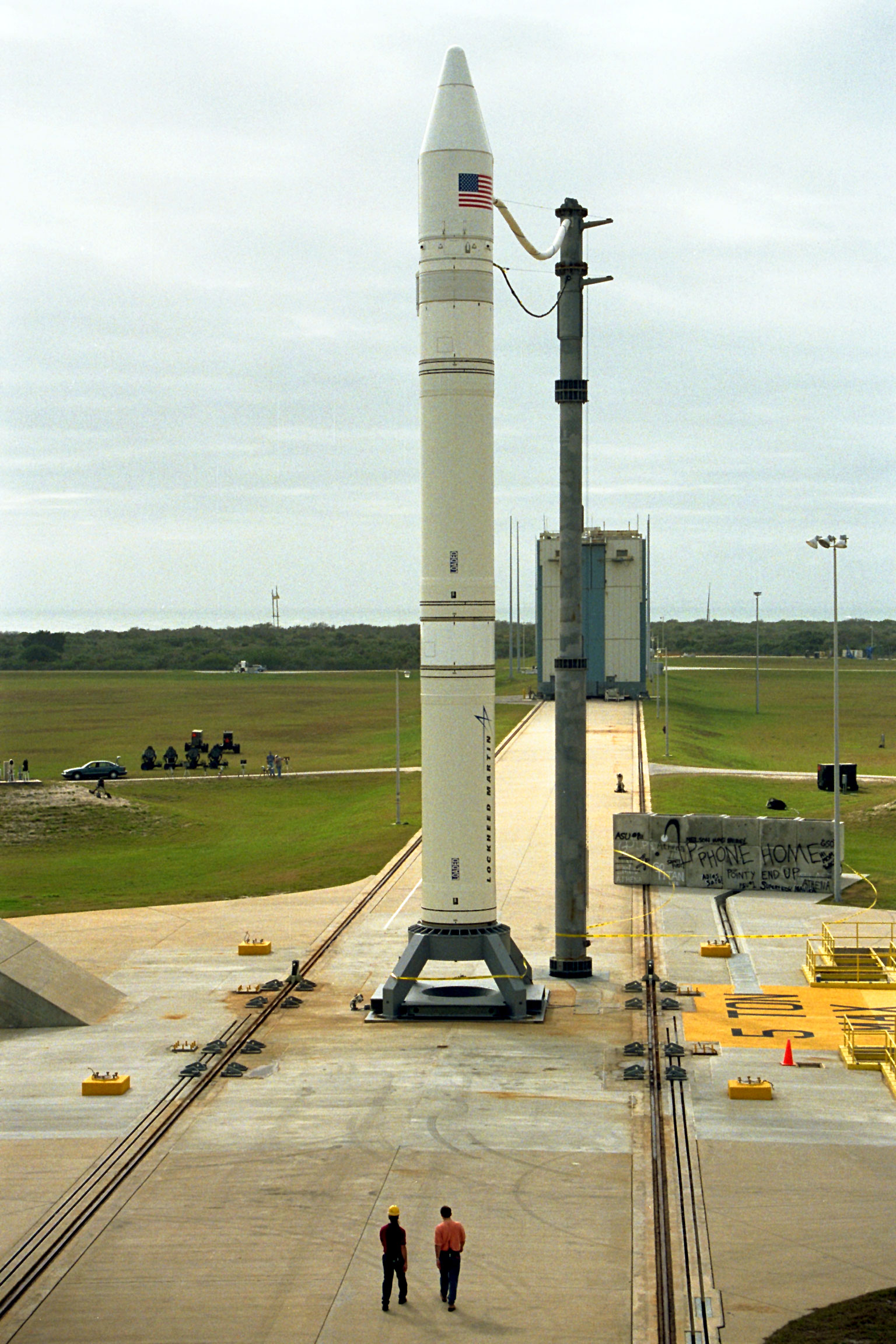
The Athena II stands 28.2 meters tall with a diameter of 2.36 meters, making it a relatively compact vehicle by orbital launch standards. Its solid-rocket architecture was chosen to reduce ground handling complexity and lower per-launch costs compared to liquid-fueled alternatives of comparable size. The vehicle is capable of delivering 2,065 kg to low Earth orbit (LEO) and 593 kg to geostationary transfer orbit (GTO), placing it firmly in the small-to-medium lift category and making it well suited for the growing commercial Earth observation satellite market of its era.
The Athena II adds a third solid-fuel stage over the baseline Athena I configuration, which accounts for its meaningfully higher performance to orbit. An Orbit Adjust Module (OAM), a small liquid-fueled upper stage, provides precise orbital insertion and attitude control after the main stack has burned out, a feature that proved attractive to customers requiring accurate final orbit placement.
Flight History
Our tracking record covers three Athena II launches, conducted across an operational window spanning 1998 to 1999, reflecting the vehicle's brief but notable period of activity. Of those three flights, two were successful and one resulted in a failure or partial failure.
The mission manifest highlights the vehicle's alignment with high-profile commercial and scientific programs. The Lunar Prospector mission, launched in January 1998, sent a NASA spacecraft into lunar orbit to map the Moon's surface composition and search for water ice — a landmark planetary science effort and one of the more prominent deep-space missions of its decade. The Ikonos program, representing Lockheed Martin's own commercial high-resolution Earth imaging satellite constellation, also flew on the Athena II. The first Ikonos launch in April 1999 did not achieve orbit successfully, while a subsequent Ikonos mission in September 1999 succeeded, inaugurating a new era of commercially available sub-meter satellite imagery.
Operational Context
Lockheed Martin stands as the primary customer in the tracked flight record, reflecting the degree to which the company used the Athena platform to serve its own satellite programs. Launches were conducted from Vandenberg Air Force Base in California, a site chosen for its suitability for polar and sun-synchronous orbits favored by Earth observation satellites.
Despite its capable performance and an ambitious commercial vision, the Athena II saw only limited flights before the program wound down. The competitive small-launch market of the late 1990s, combined with the high-profile failure of the first Ikonos mission, contributed to the vehicle's relatively short operational life. Nonetheless, its successful delivery of Lunar Prospector and the eventual Ikonos success leave the Athena II a notable entry in the history of post-Cold War commercial launch development.