Athena I
About the Athena I
Athena I
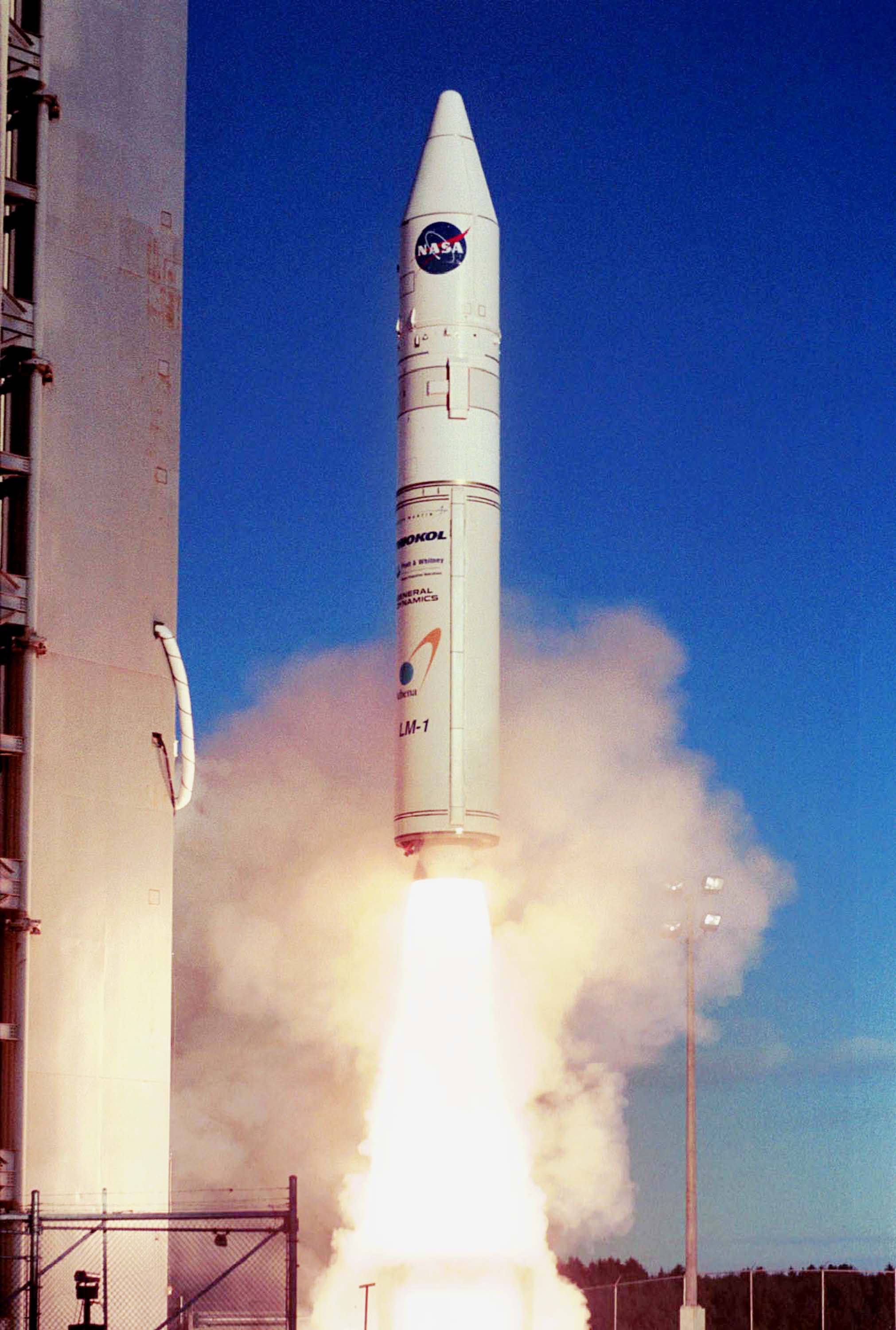
The Athena I is a small American orbital launch vehicle developed by Lockheed Martin as part of the Athena rocket family. Designed to serve the emerging commercial small-satellite market of the 1990s, it offered a relatively compact and cost-conscious path to orbit for lightweight payloads. The vehicle traces its heritage to the Lockheed Launch Vehicle (LLV) program, which sought to commercialize solid-propellant rocket technology originally developed for military applications.
Design and Capability
Standing 18.9 meters tall with a diameter of 2.36 meters, the Athena I is a slender, solid-fueled rocket built around two main stages. Its design prioritized simplicity and reliability over raw power, positioning it as a dedicated launcher for smaller spacecraft rather than a competitor to mid- or heavy-lift vehicles. With a payload capacity of 820 kilograms to low Earth orbit, it occupies the lower end of the orbital launch spectrum, suited to small scientific satellites, technology demonstrators, and modest commercial payloads.
The vehicle's upper stage includes a LOOS (Liquid Orbit Adjust System) for fine-tuning orbital insertion, giving it flexibility that purely solid-fueled rockets typically lack. Launches were conducted from facilities on both the east and west coasts of the United States, including Pad 46 at Cape Canaveral and Kodiak Launch Complex in Alaska — the latter being notable as one of the first commercial spaceports developed in the United States.
Flight History
Athena I flew four times between 1995 and 2001, recording three successes and one failure or partial failure. Among the missions tracked are a diverse range of payloads reflecting both commercial and scientific interests. The Lewis mission, an early Earth-observation satellite, represented one of the more prominent scientific payloads the vehicle carried. Formosat-1, also known as ROCSAT-1, was a Taiwanese remote-sensing and science satellite, illustrating the vehicle's appeal to international customers. The Starshine-OSCAR-43 mission combined a student-oriented reflector satellite with an amateur radio payload, demonstrating the vehicle's versatility. Gemstar DSS-1 represented a commercial communications demonstration payload.
Lockheed Martin stands as the primary customer in the flight record, reflecting the vehicle's origins as an in-house commercial product developed and flown by the same corporation.
Legacy and Context
The Athena I emerged during a transitional period in spaceflight when the commercial launch industry was beginning to mature and dedicated small-lift vehicles were seen as a viable niche. While its flight rate remained modest over its operational years, the vehicle contributed to expanding launch infrastructure — particularly in Alaska — and helped validate the commercial small-launch concept that would become far more prominent in the following decade.
Although the Athena family did not achieve the sustained commercial success its designers had envisioned, it occupies a meaningful place in American launch history as an early attempt to bring dedicated, market-oriented small-satellite launch services to the industry. Its relatively brief operational window of 1995 to 2001 reflects the competitive pressures and market realities that characterized the commercial launch sector during that era.