ASLV
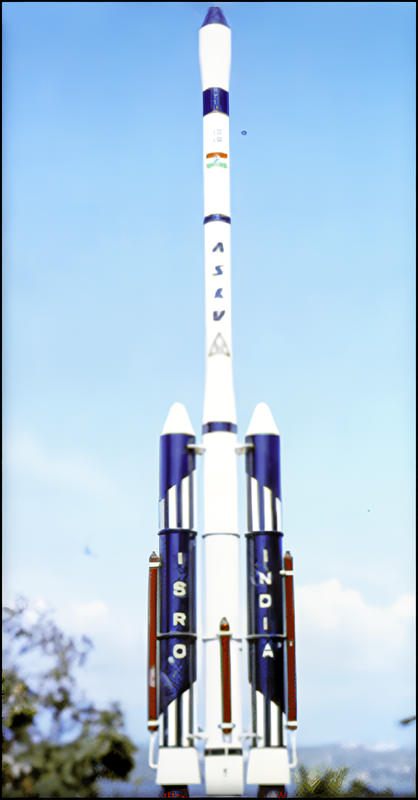
About the ASLV
ASLV (Augmented Satellite Launch Vehicle)
The Augmented Satellite Launch Vehicle, commonly known as the ASLV, is a small Indian orbital launch vehicle developed and operated by the Indian Space Research Organisation (ISRO). Designed as a transitional step between ISRO's earlier SLV-3 rocket and the more capable PSLV program, the ASLV served as a critical technology demonstrator and learning platform for India's expanding space launch ambitions.
Background and Design
The ASLV was a five-stage, solid-fueled rocket standing 23.5 metres tall with a core diameter of 1 metre. Its configuration featured two strap-on booster stages augmenting the core vehicle — a design philosophy that informed later Indian launch vehicles. With a payload capacity of approximately 150 kg to low Earth orbit, the ASLV was not intended as a high-capacity commercial workhorse, but rather as a means for ISRO to master the engineering challenges of vehicle staging, guidance, and payload integration at a larger scale than its predecessor.
The vehicle launched from the Satish Dhawan Space Centre (SHAR) at Sriharikota, on India's southeastern coast, which remains ISRO's primary launch facility to this day.
Flight History
Our records show four tracked flights between 1987 and 1994, reflecting the full span of the ASLV program. Of those four missions, two were successful and two resulted in failure or partial failure, giving the vehicle a success rate that underscores the developmental nature of the program.
All four missions carried payloads from the SROSS (Stretched Rohini Satellite Series) family, each built by ISRO for scientific research purposes. The flight sequence — SROSS-A, SROSS-B, SROSS-C, and SROSS-C2 — tells the story of a program that persisted through early setbacks. The first two missions, carrying SROSS-A and SROSS-B, ended in failure, dealing significant blows to the program's early momentum. ISRO pressed forward, and the subsequent flights carrying SROSS-C and SROSS-C2 achieved mission success, validating the vehicle's design and delivering functioning satellites to orbit.
The SROSS-C2 mission in 1994 stands as the final flight in our records, bringing the ASLV program to a close as ISRO shifted its focus toward the far more capable Polar Satellite Launch Vehicle (PSLV).
Legacy
Despite its modest payload capacity and mixed success record, the ASLV played an outsized role in shaping India's launch vehicle heritage. The program gave ISRO engineers hands-on experience with strap-on booster integration, closed-loop guidance systems, and heat shield technology — all of which fed directly into the development of the PSLV and, later, the GSLV. In this sense, the ASLV's greatest contribution was not the satellites it placed in orbit, but the institutional knowledge it generated along the way.
The Indian Space Research Organisation remains the sole customer reflected in our flight data, consistent with the ASLV's role as a government-funded national capability-building program rather than a commercial service. Its short operational life of roughly seven years nonetheless marks it as a foundational chapter in India's journey to becoming a significant spacefaring nation.