Ariane 6
About the Ariane 6
Ariane 6
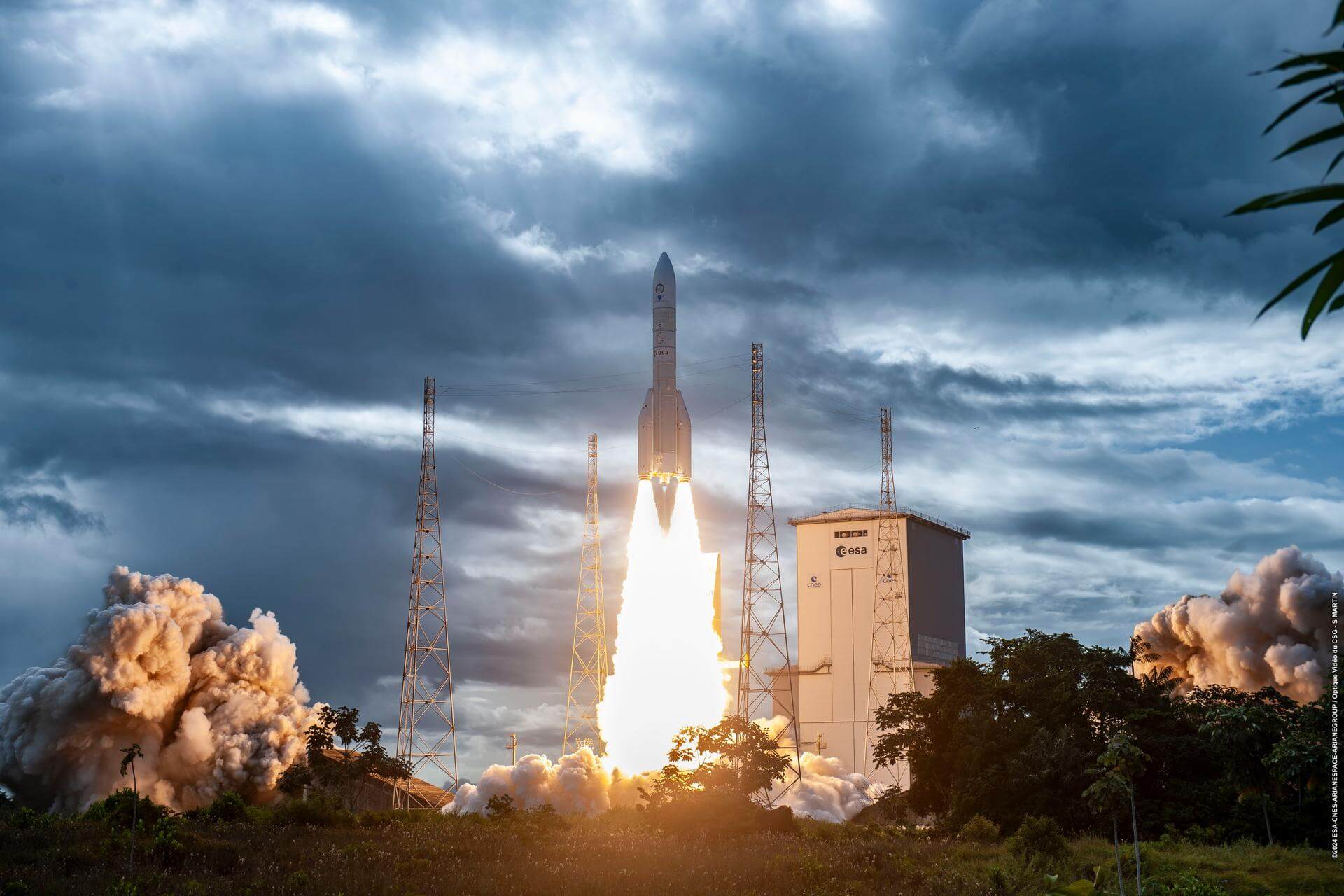
Ariane 6 is a European expendable orbital launch vehicle developed and operated by Arianespace under the direction of the European Space Agency (ESA), with ArianeGroup serving as the prime contractor. Designed as the successor to the long-serving Ariane 5, it is manufactured in Europe and launches from the Guiana Space Centre in Kourou, French Guiana. The vehicle was developed to restore European autonomous access to space and to compete more effectively in a commercial launch market increasingly shaped by reusable rocket systems.
Design and Configuration
Standing 63 metres tall with a core diameter of 5.4 metres, Ariane 6 follows the broad architectural lineage of its predecessor while introducing meaningful changes intended to reduce costs and improve operational flexibility. The rocket is available in two main configurations — the Ariane 62, equipped with two strap-on solid rocket boosters, and the Ariane 64, equipped with four — allowing operators to tailor the vehicle's lift capability to the demands of a given mission. Its upper stage uses a Vinci engine capable of multiple in-space restarts, a significant operational advantage for complex mission profiles involving multiple payload deployments or precise orbital insertion requirements.
Ariane 6 is capable of delivering 21,650 kg to low Earth orbit (LEO) and 11,500 kg to geostationary transfer orbit (GTO), figures that place it firmly in the heavy-lift category and make it well suited to large government and institutional payloads.
Operational History
Based on our tracked flight record, Ariane 6 has conducted 5 flights spanning the period 2027 through 2029, with Arianespace accounting for the vehicle's customer base across all tracked missions. The missions logged in our data reflect a focus on high-value institutional payloads for European governmental and defense clients.
Among the most prominent recent launches are two missions in the COMSATBw series — COMSATBw 1B and COMSATBw 2B — which form part of Germany's SATCOMBw Stufe 3 military satellite communications program. Ariane 6 has also carried pairs of Galileo Second Generation navigation satellites on two dedicated flights, designated Galileo L17 and Galileo L18, continuing Europe's long-standing commitment to expanding and modernizing its sovereign satellite navigation infrastructure. An additional mission, NEXUS-1, further demonstrates the vehicle's versatility across payload types.
Role and Significance
Ariane 6 represents a cornerstone of European space autonomy, ensuring that ESA member states and their institutional partners retain independent access to orbit without reliance on foreign launch providers. The vehicle's ability to carry large defense communications satellites, navigation constellations, and other strategic payloads underscores its importance as an instrument of both scientific ambition and national security policy.
While the commercial small-satellite market has gravitated toward newer, often reusable vehicles, Ariane 6 occupies a distinct and deliberate niche: reliable, high-capacity delivery of large, complex spacecraft for customers where mission assurance and payload volume take precedence over launch cost alone. Its ongoing manifest of European institutional missions reflects that positioning clearly.