Ariane 5 GS
About the Ariane 5 GS
Ariane 5 GS
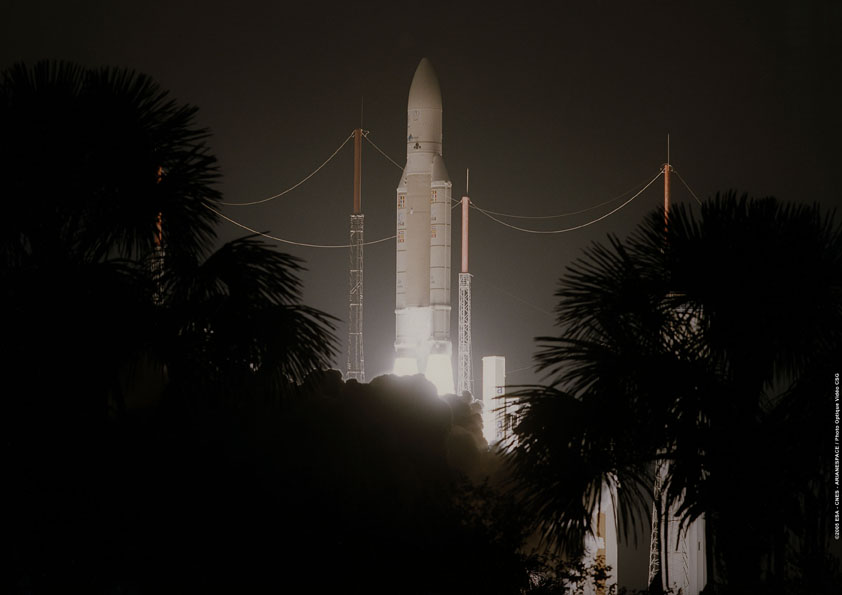
The Ariane 5 GS is a European orbital launch vehicle operated by Arianespace and manufactured by ArianeGroup (formerly Astrium), representing a transitional configuration within the long-running Ariane 5 family. Launched from the Guiana Space Centre in Kourou, French Guiana, it served as a bridge between the original Ariane 5 Generic baseline and the higher-performance Ariane 5 ECA variant that would come to dominate the commercial launch market.
Background and Configuration
The Ariane 5 GS retained the core architecture of the Ariane 5 Generic, including its cryogenic Vulcain main engine on the core stage and two solid rocket boosters, but incorporated the updated storable-propellant upper stage derived from later development efforts. Standing 55 meters tall with a diameter of 5.4 meters, the vehicle maintained the recognizable profile of the Ariane 5 family while offering meaningful improvements over its earliest predecessor. Its payload capacity to geostationary transfer orbit (GTO) stands at 6,600 kg, placing it in a capable but intermediate position compared to the higher-lift ECA variant that was being refined during the same period.
Operational History
Our flight record captures six launches of the Ariane 5 GS between 2005 and 2009, all of which were successful — a perfect mission record across its active service life. This reliability was consistent with Arianespace's broader commercial reputation and helped sustain customer confidence during a period when the ECA variant was recovering from an early developmental setback.
The vehicle's mission manifest reflects the commercial and governmental diversity typical of Arianespace's customer base. Early flights carried notable payloads including Thaicom 4, a high-capacity telecommunications satellite, and a dual-manifest mission lofting Syracuse 3A alongside Galaxy 15 for French military and commercial operators respectively. Subsequent missions demonstrated the GS variant's flexibility, including the delivery of INSAT-4A for the Indian Space Research Organisation alongside Meteosat 9 for EUMETSAT, and a dual-manifest flight carrying Intelsat 11 & Optus D2. The final missions in our record include the delivery of RASCOM-QAF 1 & Horizons-2 and the Helios 2B reconnaissance satellite for the French military, underscoring the vehicle's role in both commercial and strategic spaceflight.
Role and Legacy
The Ariane 5 GS occupied a specific and deliberate niche in the Ariane 5 product line. As the ECA variant — offering substantially greater GTO performance — matured and became Arianespace's primary commercial workhorse, the GS configuration fulfilled launch commitments for payloads suited to its lift class while maintaining the high launch cadence that European commercial launch services depended upon.
Its six-for-six success record, though modest in flight count, reflects a disciplined operational program. The Helios 2B mission in 2009 marked a fitting close to the GS variant's service life, with a sensitive governmental payload affirming the trust placed in the configuration to the end. The Ariane 5 GS stands as a reliable if understated chapter in the broader story of European access to space, bridging generations of a rocket family that defined commercial launch services for more than two decades.
- Dec 18, 2009Ariane 5 GS | Helios 2BSuccess
- Dec 21, 2007Ariane 5 GS | RASCOM-QAF 1 & Horizons-2Success
- Oct 05, 2007Ariane 5 GS | Intelsat 11 & Optus D2Success
- Dec 21, 2005Ariane 5 GS | INSAT-4A, Meteosat 9Success
- Oct 13, 2005Ariane 5 GS | Syracuse 3A & Galaxy 15Success
- Aug 11, 2005Ariane 5 GS | Thaicom 4Success