Ariane 5 ES
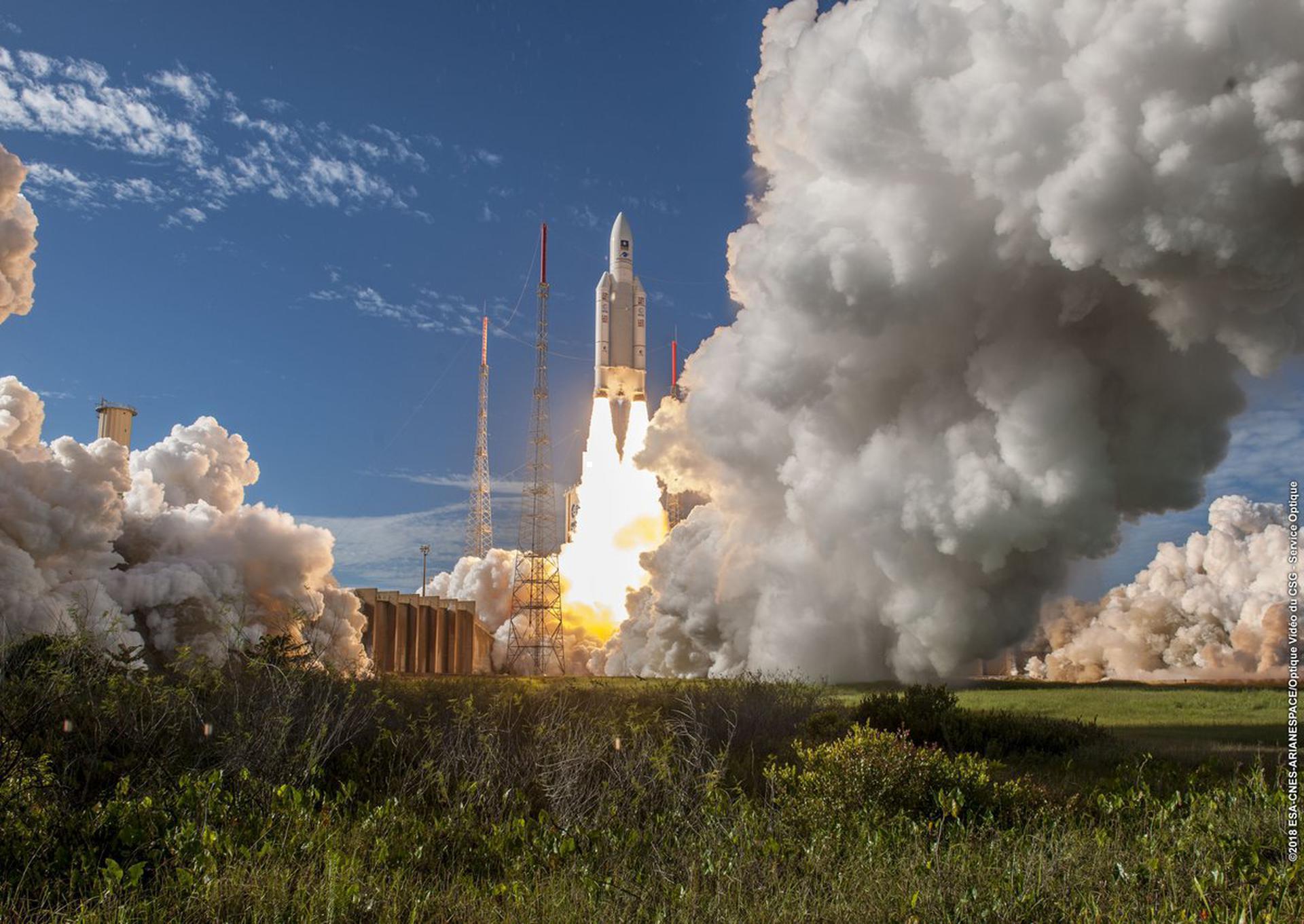
About the Ariane 5 ES
Ariane 5 ES
The Ariane 5 ES is a European expendable orbital launch vehicle and a specialized variant of the broader Ariane 5 family, operated by Arianespace and manufactured under the direction of ArianeGroup (formerly Astrium) in Europe. Developed to serve missions requiring delivery to low Earth orbit rather than the geostationary transfer orbits targeted by the more commercially prominent Ariane 5 ECA variant, the ES configuration played a focused and highly reliable role in European spaceflight during its operational years.
Design and Configuration
Standing 45.7 meters tall with a diameter of 5.4 meters, the Ariane 5 ES shares the core architecture of its sibling variants — a cryogenic main stage burning liquid hydrogen and liquid oxygen, augmented by two solid rocket boosters — but is distinguished by its restartable storable-propellant upper stage. This upper stage, derived from the Ariane 4 era, allows the vehicle to perform multiple burns in orbit, making it particularly well suited for deploying payloads into precise circular low Earth orbits. The vehicle is capable of delivering up to 21,000 kg to low Earth orbit. All Ariane 5 ES missions lifted off from the Guiana Space Centre in Kourou, French Guiana, taking advantage of the equatorial launch site's favorable position for orbital insertion.
Operational History
The Ariane 5 ES conducted 8 flights between 2008 and 2018, achieving a perfect record of 8 successes with no failures or partial failures recorded. This unblemished performance underscored the reliability that Arianespace cultivated across the Ariane 5 program as a whole.
The vehicle served two distinct and high-profile mission types during its service life. In its early years, it was the dedicated launcher for the Automated Transfer Vehicle (ATV), a European Space Agency resupply spacecraft designed to deliver cargo, fuel, water, and air to the International Space Station. Notable ATV missions carried aboard the Ariane 5 ES include the Edoardo Amaldi (ATV-003), Albert Einstein (ATV-004), and Georges Lemaitre (ATV-005), each named in honor of distinguished European scientists.
Following the retirement of the ATV program, the Ariane 5 ES transitioned to a second critical role: deploying operational satellites for the Galileo navigation constellation, Europe's own global satellite navigation system. The vehicle's ability to release multiple satellites simultaneously into circular medium Earth orbit made it an ideal fit. Successive Galileo launches — designated L8, L9, and L10 — each placed batches of Full Operational Capability (FOC) satellites, progressively expanding the Galileo constellation toward its intended coverage.
Legacy
The Ariane 5 ES represents a notable chapter in European institutional spaceflight, demonstrating how a tailored variant of an existing platform could serve strategic national and continental priorities — from crewed station logistics support to sovereign navigation infrastructure. Its perfect flight record across a decade of service reflects both the maturity of the Ariane 5 design and the operational discipline of Arianespace. The variant was retired after completing its Galileo deployment campaign in 2018, with future navigation launches transitioning to other vehicles.
- Jul 25, 2018Ariane 5 ES | Galileo L10 (FOC FM19-FM22)Success
- Dec 12, 2017Ariane 5 ES | Galileo L9 (FOC FM15-FM18)Success
- Nov 17, 2016Ariane 5 ES | Galileo L8 (FOC FM07 & FM12-FM14)Success
- Jul 29, 2014Ariane 5 ES | ATV-5 (Georges Lemaitre)Success
- Jun 05, 2013Ariane 5 ES | Albert Einstein ATV (ATV-004)Success
- Mar 23, 2012Ariane 5 ES | Edoardo Amaldi ATV (ATV-003)Success
- Feb 16, 2011Ariane 5 ES | Johannes Kepler ATV (ATV-002)Success
- Mar 09, 2008Ariane 5 ES | ATV-1 "Jules Verne"Success