Ariane 5 ECA
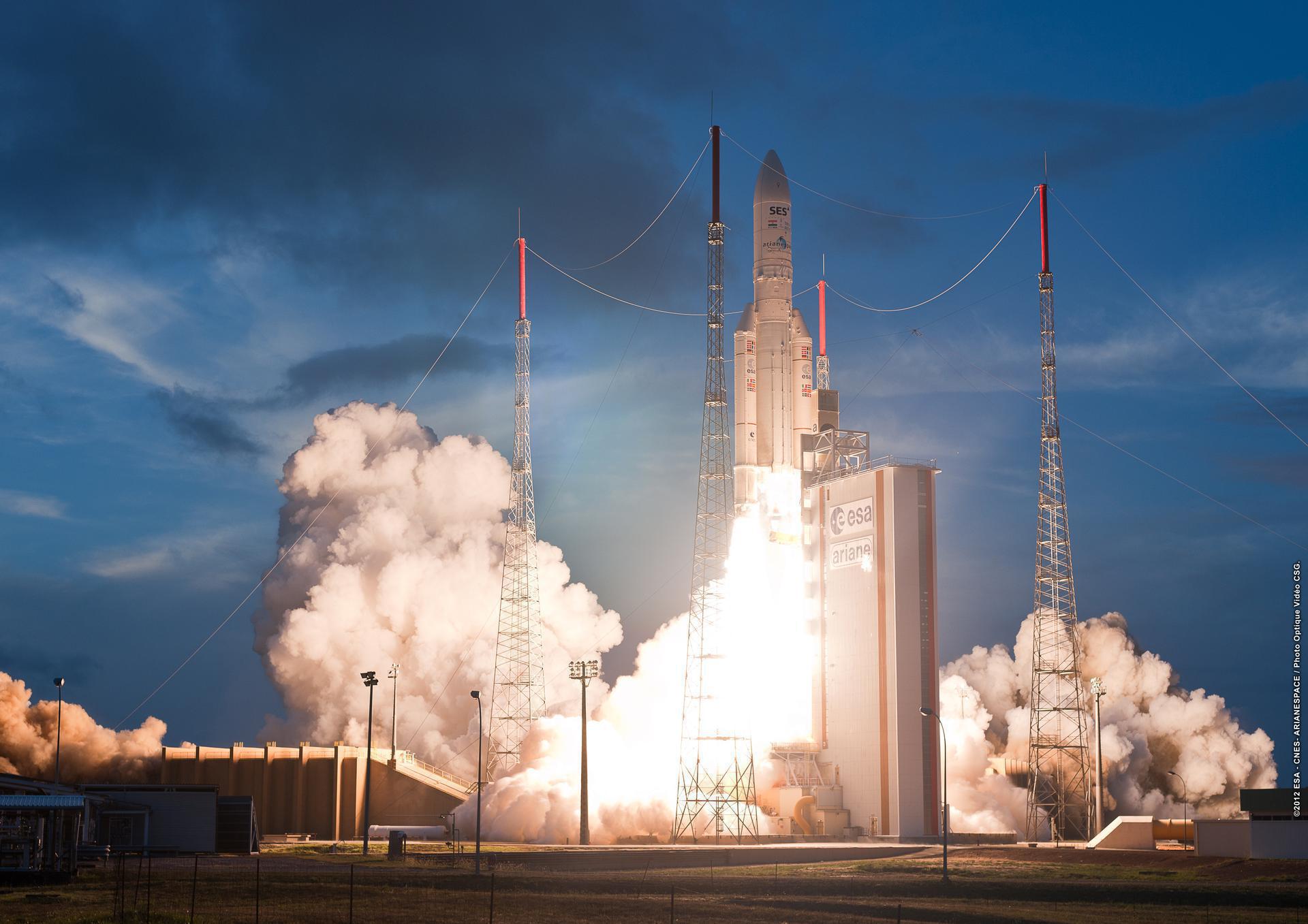
About the Ariane 5 ECA
Ariane 5 ECA+
The Ariane 5 ECA+ is an enhanced variant of the Ariane 5 heavy-lift launch vehicle, operated by Arianespace on behalf of the European Space Agency (ESA) and its member states. Manufactured by ArianeGroup, it represents the final and most capable evolution of the Ariane 5 family, which launched from the Guiana Space Centre at Kourou, French Guiana.
Role and Capability
The ECA+ designation identifies the rocket as an upgraded iteration of the long-running ECA (Evolution Cryotechnique type A) configuration, offering a payload capacity of approximately 10,200 kg to geostationary transfer orbit (GTO). Standing 57.7 metres tall with a diameter of 5.4 metres, the vehicle retained the core architecture of its predecessors — a cryogenic main stage burning liquid hydrogen and liquid oxygen, twin solid-propellant strap-on boosters, and a restartable upper stage — while incorporating refinements that pushed performance to new levels. This made it one of the most capable commercial launch vehicles in the world during its operational period.
Operational History
According to tracked flight data, the Ariane 5 ECA+ flew 11 times between 2019 and 2023, achieving a perfect success rate across all 11 missions. This reliability record is consistent with the broader Ariane 5 programme's reputation for dependability, which made it the vehicle of choice for high-value government and commercial payloads throughout its service life.
The rocket's manifest during this period reflected an exceptionally diverse and prestigious range of missions. Commercial telecommunications satellites launched on the ECA+ included Galaxy 35 & 36, Eutelsat Konnect VHTS, Measat-3d & GSAT 24, and Syracuse 4B paired with the German communications satellite Heinrich Hertz (H2Sat). These dual-payload missions to GTO were a signature capability of the Ariane 5, allowing two satellites to share a single flight and reducing costs for customers.
Landmark Missions
The most celebrated mission flown by the ECA+ variant was undoubtedly the James Webb Space Telescope (JWST), launched on behalf of NASA, ESA, and the Canadian Space Agency. Lifted off in December 2021, JWST represented the most complex and scientifically ambitious space observatory ever built, and the precision of the Ariane 5 ECA+'s injection reportedly placed the telescope on a trajectory so accurate that it significantly extended the observatory's projected operational lifetime by conserving onboard propellant.
The vehicle also launched JUICE (JUpiter ICy moons Explorer) for ESA in 2023, sending the spacecraft on its long journey toward the Jovian system to study the icy moons Ganymede, Callisto, and Europa. The MTG-I1 (Meteosat Third Generation Imager) meteorological satellite, a flagship European weather-monitoring mission, also flew aboard an ECA+ configuration.
Legacy
The Ariane 5 ECA+ concluded operations in 2023, closing out the entire Ariane 5 programme after more than two decades of service. Its final years demonstrated the rocket at the absolute peak of its capability, carrying payloads of immense scientific, strategic, and commercial significance. Its successor, Ariane 6, is designed to carry forward the European independent access to space that the Ariane 5 family established and defended throughout its lifetime.
- Jan 16, 2020Ariane 5 ECA | Eutelsat Konnect & GSAT-30Success
- Nov 26, 2019Ariane 5 ECA | TIBA-1 & Inmarsat-5 F5 (Global Xpress-5)Success
- Jun 20, 2019Ariane 5 ECA | Eutelsat 7C & AT&T T-16Success
- Feb 05, 2019Ariane 5 ECA | Saudi Geostationary Satellite 1/Hellas Sat 4 & GSAT-31Success
- Dec 04, 2018Ariane 5 ECA | GSAT-11 & GEO-KOMPSAT-2ASuccess
- Oct 20, 2018Ariane 5 ECA | BepiColomboSuccess
- Sep 25, 2018Ariane 5 ECA | Azerspace-2/Intelsat-38 & Horizons 3eSuccess
- Apr 05, 2018Ariane 5 ECA | DSN 1 & HYLAS 4Success
- Jan 25, 2018Ariane 5 ECA | Al Yah 3 & SES-14Partial Failure
- Sep 29, 2017Ariane 5 ECA | Intelsat 37e & BSAT-4aSuccess
- Jun 28, 2017Ariane 5 ECA | Hellas Sat 3 (Inmarsat S EAN) & GSAT-17Success
- Jun 01, 2017Ariane 5 ECA | ViaSat-2 & EUTELSAT 172BSuccess
- May 04, 2017Ariane 5 ECA | SGDC 1 & Koreasat 7Success
- Feb 14, 2017Ariane 5 ECA | SKY Brasil-1 (Intelsat-32e) & Telkom-3SSuccess
- Dec 21, 2016Ariane 5 ECA | Star One D1 & JCSAT-15Success
- Oct 05, 2016Ariane 5 ECA | Sky Muster II (NBN-Co 1B) & GSAT-18Success
- Aug 24, 2016Ariane 5 ECA | Intelsat 33e & Intelsat 36Success
- Jun 18, 2016Ariane 5 ECA | Echostar 18 & BRIsatSuccess
- Mar 09, 2016Ariane 5 ECA | Eutelsat 65 West ASuccess
- Jan 27, 2016Ariane 5 ECA | Intelsat 29eSuccess
- Nov 10, 2015Ariane 5 ECA | Arabsat 6B & GSAT-15Success
- Sep 30, 2015Ariane 5 ECA | Sky Muster I (NBN-Co 1A) & ARSAT-2Success
- Aug 20, 2015Ariane 5 ECA | Eutelsat 8 West B & Intelsat 34Success
- Jul 15, 2015Ariane 5 ECA | Star One C4 & MSG 4Success
- May 27, 2015Ariane 5 ECA | DirecTV 15 & Sky Mexico 1Success
- Apr 26, 2015Ariane 5 ECA | Thor-7 & SICRAL-2Success
- Dec 06, 2014Ariane 5 ECA | DirecTV-14 & GSAT-16Success
- Oct 16, 2014Ariane 5 ECA | Intelsat-30 & ARSAT-1Success
- Sep 11, 2014Ariane 5 ECA | MEASAT-3b & Optus 10Success
- Mar 22, 2014Ariane 5 ECA | Astra 5B & Amazonas 4ASuccess
- Feb 06, 2014Ariane 5 ECA | ABS-2 & Athena-FidusSuccess
- Aug 29, 2013Ariane 5 ECA | Eutelsat 25B / Es'hail 1 & GSAT-7Success
- Jul 25, 2013Ariane 5 ECA | Alphasat I-XL (Inmarsat-XL) & INSAT-3DSuccess
- Feb 07, 2013Ariane 5 ECA | Azerspace-1/Africasat-1a & Amazonas 3Success
- Dec 19, 2012Ariane 5 ECA | Skynet 5D & Mexsat-3Success
- Nov 10, 2012Ariane 5 ECA | Star One C3 & Eutelsat 21BSuccess
- Sep 28, 2012Ariane 5 ECA | Astra 2F & GSAT-10Success
- Aug 02, 2012Ariane 5 ECA | Intelsat 20 & HYLAS 2Success
- Jul 05, 2012Ariane 5 ECA | Echostar XVII & MSG-3Success
- May 15, 2012Ariane 5 ECA | JCSAT-13 & Vinasat-2Success
- Sep 21, 2011Ariane 5 ECA | Arabsat 5C & SES-2Success
- Aug 06, 2011Ariane 5 ECA | Astra 1N & BSAT-3c/JCSAT-110RSuccess
- May 20, 2011Ariane 5 ECA | ST-2 & INSAT-4G/GSAT-8Success
- Apr 22, 2011Ariane 5 ECA | Yahsat 1A & New DawnSuccess
- Dec 29, 2010Ariane 5 ECA | Hispasat-1E & Koreasat 6Success
- Nov 26, 2010Ariane 5 ECA | Intelsat 17 & HYLAS 1Success
- Oct 28, 2010Ariane 5 ECA | Eutelsat W3B & BSAT-3bSuccess
- Aug 04, 2010Ariane 5 ECA | RASCOM-QAF1R & NILESAT 201Success
- Jun 26, 2010Ariane 5 ECA | ArabSat-5A & COMS-1 (Chollian)Success
- May 21, 2010Ariane 5 ECA | Astra 3B & COMSATBw-2Success
- Oct 29, 2009Ariane 5 ECA | NSS-12 & Thor 6Success
- Oct 01, 2009Ariane 5 ECA | Amazonas 2 & COMSATBw-1Success
- Aug 21, 2009Ariane 5 ECA | JCSAT-12 & Optus D3Success
- Jul 01, 2009Ariane 5 ECA | TerreStar-1Success
- May 14, 2009Ariane 5 ECA | Herschel & PlanckSuccess
- Feb 12, 2009Ariane 5 ECA | Hot Bird 10, NSS-9, Spirale A, Spirale BSuccess
- Dec 20, 2008Ariane 5 ECA | Eutelsat W2M & Hot Bird 9Success
- Aug 14, 2008Ariane 5 ECA | AMC-21 & Superbird 7Success
- Jul 07, 2008Ariane 5 ECA | Badr-6 & ProtoStar ISuccess
- Jun 12, 2008Ariane 5 ECA | Türksat 3A & Skynet 5CSuccess
- Apr 18, 2008Ariane 5 ECA | Star One C2 & Vinasat-1Success
- Nov 14, 2007Ariane 5 ECA | Skynet 5B & Star One C1Success
- Aug 14, 2007Ariane 5 ECA | Spaceway-3 & BSAT-3ASuccess
- May 04, 2007Ariane 5 ECA | Astra 1L & Galaxy 17Success
- Mar 11, 2007Ariane 5 ECA | Skynet 5A & INSAT-4BSuccess
- Dec 08, 2006Ariane 5 ECA | WildBlue 1 & AMC-18Success
- Oct 13, 2006Ariane 5 ECA | DirecTV-9S, Optus D1, LDREX-2Success
- Aug 11, 2006Ariane 5 ECA | JCSAT-10 & Syracuse 3BSuccess
- May 27, 2006Ariane 5 ECA | Satmex 6 & Thaicom 5Success
- Mar 11, 2006Ariane 5 ECA | Spainsat & Hot Bird 7ASuccess
- Nov 16, 2005Ariane 5 ECA | Spaceway F2, TELKOM-2Success
- Feb 12, 2005Ariane 5 ECA | XTAR-EUR, Maqsat-B2, SloshsatSuccess
- Dec 11, 2002Ariane 5 ECA | Hot Bird 7 & StentorFailure