Ariane 42P
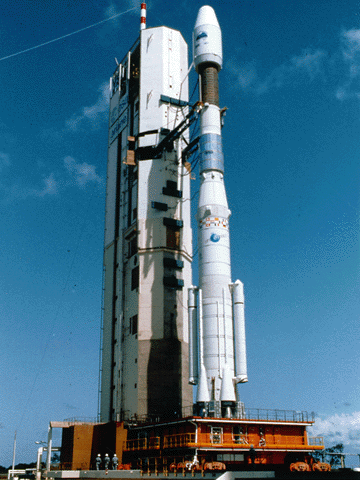
About the Ariane 42P
Ariane 42P
The Ariane 42P is a European expendable orbital launch vehicle operated by Arianespace and manufactured by Aérospatiale (later EADS) as part of the Ariane 4 family. Developed under the auspices of the European Space Agency, the Ariane 4 series represented a significant evolution in European launch capability, and the 42P variant served as one of the workhorse configurations of that family throughout its operational life.
Design and Configuration
The Ariane 42P stands 55.9 metres tall with a core diameter of 3.8 metres, placing it among the mid-range members of the Ariane 4 family. The "42P" designation reflects its booster configuration: the core stage is augmented by two solid-fuelled strap-on boosters, distinguishing it from the baseline Ariane 40 (no boosters) and the liquid-boosted variants. This arrangement gives the vehicle a capable lift performance of up to 6,000 kg to low Earth orbit and 2,990 kg to geostationary transfer orbit, making it well suited to medium-class commercial and institutional payloads. All Ariane 4 vehicles launch from the Guiana Space Centre at Kourou, French Guiana, a site chosen partly for its proximity to the equator, which benefits geostationary mission trajectories.
Operational History
The Ariane 42P was active from 1990 to 2002, flying 15 missions tracked in our flight record. Of those, 14 were fully successful, with one failure or partial failure, reflecting a strong but not unblemished record consistent with the broader Ariane 4 family's reputation for reliability. Over the course of its service life the vehicle became a trusted option for satellite operators seeking mid-capacity GTO delivery.
The vehicle carried a varied manifest of commercial telecommunications and Earth-observation satellites. Notable missions include SPOT 5, the French Earth-observation satellite; Mugunghwa 3, a South Korean communications satellite; Telkom 1, serving Indonesian telecommunications; Insat 2E, part of India's national satellite programme; Hot Bird 4, a European direct-broadcast satellite; and EchoStar II, serving the North American direct-to-home market. This diverse customer base underscores the Ariane 42P's role as a commercially competitive launcher during a period of rapid growth in the global satellite industry.
Role and Legacy
The Ariane 4 family as a whole became one of the most commercially successful launch vehicle families of the 1990s, and the 42P configuration contributed meaningfully to that record. Arianespace held a dominant share of the commercial launch market during this era, and vehicles like the 42P were central to that position. The family was eventually retired as the more capable Ariane 5 entered full service, offering a substantial increase in payload capacity suited to the growing mass of next-generation satellites.
The Ariane 42P thus occupies an important place in spaceflight history — a reliable, flexible vehicle that helped cement Europe's standing as an independent, commercially competitive space power during a defining decade for the global launch industry.
- May 04, 2002Ariane 42P | SPOT 5Success
- Sep 04, 1999Ariane 42P | Mugunghwa 3Success
- Aug 12, 1999Ariane 42P | Telkom 1Success
- Apr 02, 1999Ariane 42P | Insat 2ESuccess
- Feb 27, 1998Ariane 42P | Hot Bird 4Success
- Sep 11, 1996Ariane 42P | Echostar IISuccess
- Apr 20, 1996Ariane 42P | M-SAT 1Success
- Jun 10, 1995Ariane 42P | DirecTV 3Success
- Dec 01, 1994Ariane 42P | PAS 3Failure
- Nov 01, 1994Ariane 42P | Astra 1DSuccess
- Jun 25, 1993Ariane 42P | Galaxy 4HSuccess
- Dec 01, 1992Ariane 42P | Superbird A1Success
- Oct 28, 1992Ariane 42P | Galaxy 7Success
- Aug 10, 1992Ariane 42P | Topex-Poseidon, Kitsat 1 & S80/TSuccess
- Nov 20, 1990Ariane 42P | Satcom C1 & GStar 4Success