Ariane 40
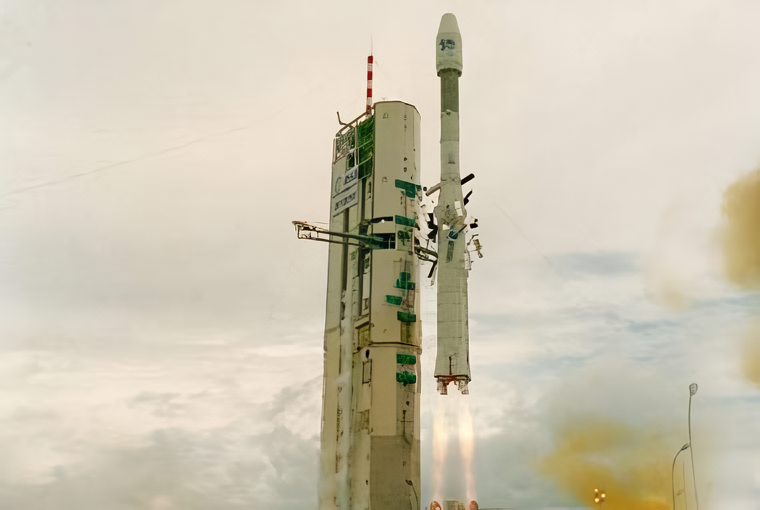
About the Ariane 40
Ariane 40
The Ariane 40 is a European orbital launch vehicle operated by Arianespace and produced under the Ariane 4 family developed by the European Space Agency (ESA) and its industrial partners. As the baseline, unaugmented configuration of the Ariane 4 series, the Ariane 40 carried no strap-on boosters, distinguishing it from its more powerful siblings such as the Ariane 42P and Ariane 44L. Launches took place from the Guiana Space Centre in Kourou, French Guiana, a site chosen for its proximity to the equator and its open ocean launch corridors.
Role and Design
The Ariane 40 stood 55.6 metres tall with a core diameter of 3.8 metres, and was capable of delivering up to 4,600 kg to low Earth orbit (LEO) or 2,290 kg to geostationary transfer orbit (GTO). As the lightest member of the Ariane 4 family, the Ariane 40 was particularly well suited to single-payload missions aimed at sun-synchronous or low Earth orbits rather than the commercial geostationary belt that heavier Ariane 4 variants typically served. Its three-stage architecture followed the same fundamental design as the rest of the Ariane 4 series, sharing common components and manufacturing heritage across the family.
Flight History
Within the records tracked here, the Ariane 40 flew seven times between 1990 and 1999, achieving a perfect success rate of seven successful missions with no recorded failures or partial failures. This unblemished record reflects both the reliability of the vehicle and the relatively conservative mission profiles it was assigned, which tended toward scientifically and strategically significant Earth observation payloads rather than commercial communications satellites.
The manifest reads as a roll call of landmark European remote sensing programmes. Notable missions included the launches of ERS-1 and ERS-2, the European Remote Sensing satellites developed by ESA that became foundational tools for environmental monitoring, ice sheet observation, and oceanography. The vehicle also lofted SPOT 3 and SPOT 4, members of France's long-running commercial Earth observation constellation operated by SPOT Image. Perhaps most sensitive of all were the Helios 1A and Helios 1B missions, military optical reconnaissance satellites operated jointly by France, Italy, and Spain — underscoring the trust placed in the Ariane 40's reliability for high-priority national security payloads.
Legacy
The Ariane 4 family as a whole is widely regarded as one of the most commercially successful launch vehicle programmes of its era, dominating the commercial launch market through much of the 1990s. The Ariane 40, as its unadorned baseline configuration, played a quieter but meaningful role within that legacy, serving European institutional customers whose missions demanded precision and dependability over maximum lift capacity. Its consistent delivery of Earth observation assets contributed directly to decades of European scientific research and strategic satellite capability.
The Ariane 40 was retired alongside the broader Ariane 4 programme as the successor Ariane 5 assumed operational status, closing a chapter on a vehicle that had served European spaceflight faithfully and without a single recorded loss.