Ariane 3
About the Ariane 3
Ariane 3
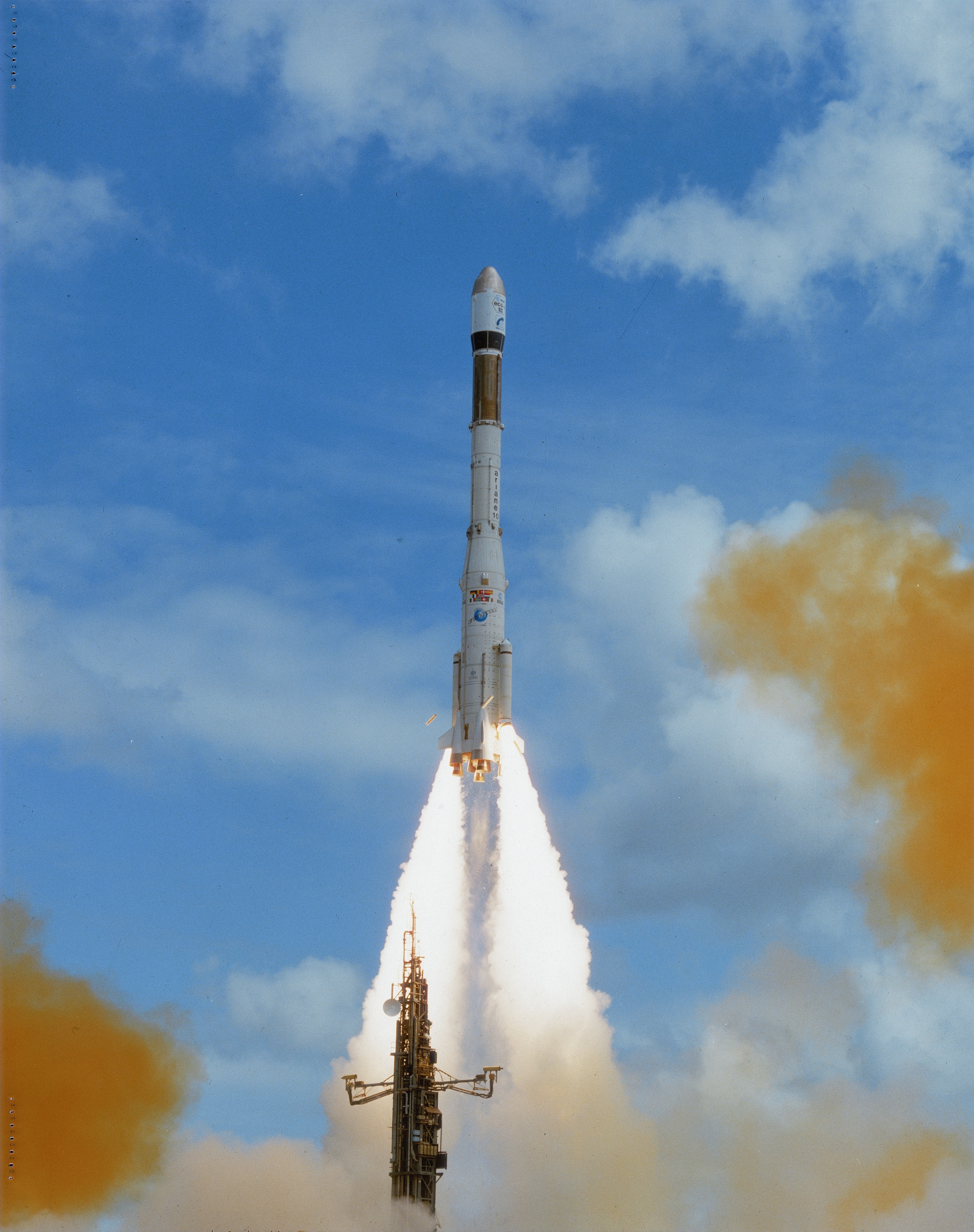
The Ariane 3 is a European expendable orbital launch vehicle developed and operated by Arianespace, the French-led commercial launch consortium that pioneered the commercial satellite launch industry. A member of the first-generation Ariane rocket family designed and built under the auspices of the European Space Agency, the Ariane 3 represented a direct evolution of its predecessor and played a meaningful role in establishing Europe as a competitive force in the global commercial launch market during the 1980s.
Design and Capability
Standing 49.13 metres tall with a core diameter of 3.8 metres, the Ariane 3 was a three-stage liquid-fuelled rocket augmented by a pair of solid-fuelled strap-on boosters — a key distinction from the boosterless Ariane 2. This configuration gave the vehicle a meaningful increase in performance, enabling it to deliver up to 2,700 kg to geostationary transfer orbit (GTO). That capacity made the Ariane 3 particularly well suited to the growing demand for heavier communications satellites in the mid-1980s, and it was frequently flown in a dual-launch configuration, carrying two satellites to GTO on a single mission. This dual-manifest capability was a commercial and operational advantage that Arianespace used effectively to reduce per-launch costs for customers.
All Ariane 3 missions were conducted from the Guiana Space Centre in Kourou, French Guiana — Europe's equatorial launch site, whose geographic location provides a natural performance advantage for missions targeting geostationary orbit.
Operational History
The Ariane 3 was active from 1984 to 1989, completing 11 tracked flights, of which 10 were fully successful and one resulted in a failure or partial failure. This reliability record reinforced Arianespace's reputation as a dependable commercial launch provider during a critical period of growth in the satellite industry.
The vehicle's customer manifest reflects the breadth of the commercial communications satellite market of the era. Notable missions included the deployment of Brasilsat A2 alongside Gstar 2, the dual launch of Aussat A3 and ECS 4, and the pairing of Spacenet 3R with Télécom 1C. The final tracked mission carried the Olympus satellite, a large experimental platform developed by the European Space Agency. Other missions served a diverse international clientele spanning North American, European, Australian, and Indian satellite programs, underscoring the vehicle's broad commercial appeal.
Legacy
The Ariane 3 was part of a rapid, overlapping development program that saw Arianespace operate multiple Ariane variants — including the Ariane 2 and later the substantially more powerful Ariane 4 — in close succession. While the Ariane 4 would go on to become one of the most commercially successful launch vehicles of its generation, the Ariane 3 served as an important transitional workhorse, demonstrating that European launch vehicles could reliably win and fulfill contracts in a competitive global marketplace. Its dual-launch business model, consistent performance record, and international customer base collectively helped lay the commercial and operational foundations that Arianespace would build upon throughout the following decade.
- Jul 12, 1989Ariane 3 | OlympusSuccess
- Sep 08, 1988Ariane 3 | GStar 3 & SBS 5Success
- Jul 21, 1988Ariane 3 | Insat 1C & ECS5Success
- Mar 11, 1988Ariane 3 | Spacenet 3R & Télécom 1CSuccess
- Sep 16, 1987Ariane 3 | Aussat A3 & ECS 4Success
- Mar 28, 1986Ariane 3 | Gstar 2 & Brasilsat A2Success
- Sep 12, 1985Ariane 3 | ECS 3 & Spacenet 3Failure
- May 08, 1985Ariane 3 | Gstar 1 & Télécom 1BSuccess
- Feb 08, 1985Ariane 3 | Arabsat 1A & Brasilsat A1Success
- Nov 10, 1984Ariane 3 | Spacenet 2 & Marecs 2Success
- Aug 04, 1984Ariane 3 | ECS 2 & Télécom 1ASuccess