Ariane 2
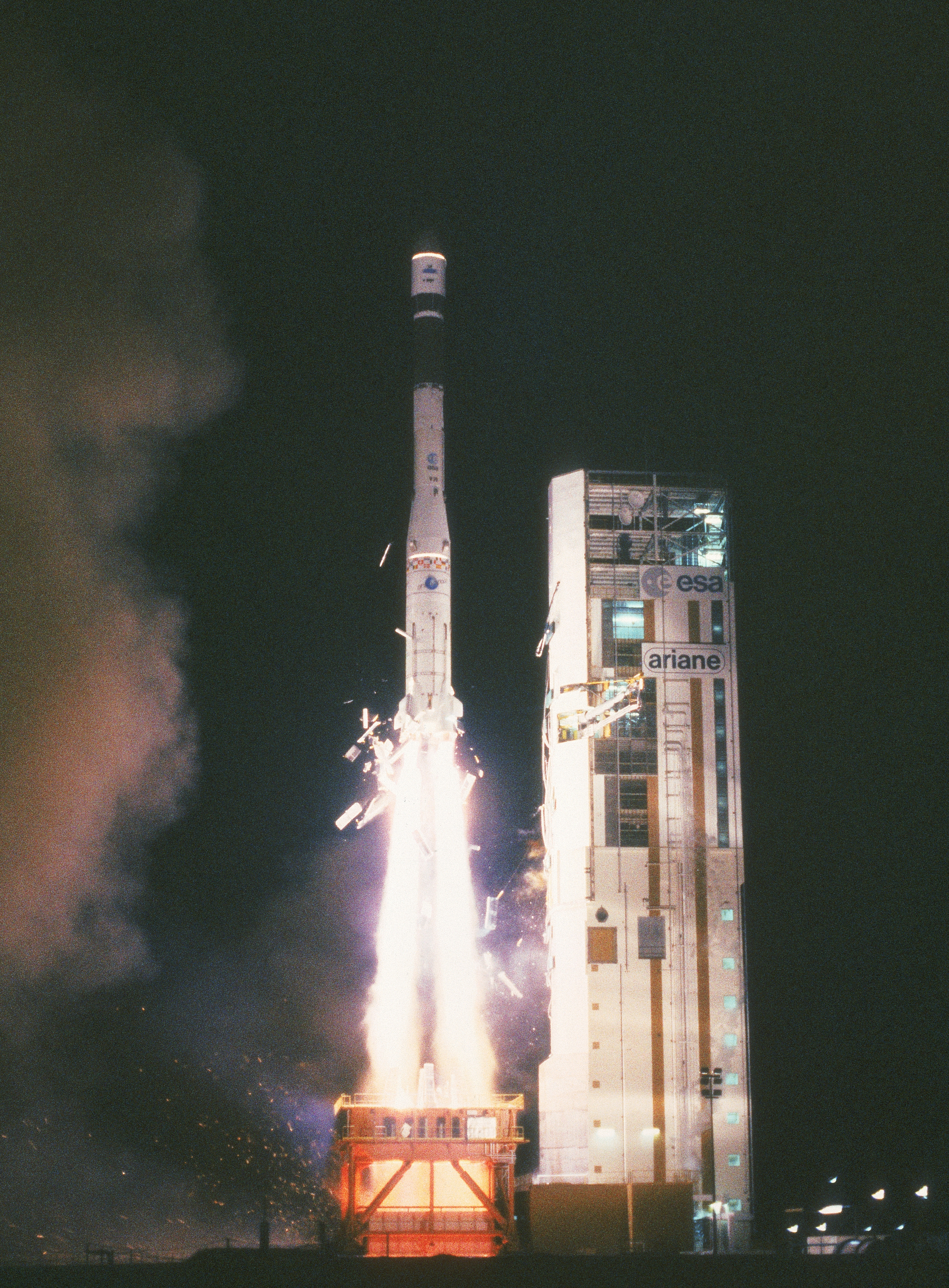
About the Ariane 2
Ariane 2
The Ariane 2 was a European expendable orbital launch vehicle developed and operated by Arianespace under the auspices of the European Space Agency (ESA). A member of the first-generation Ariane rocket family, it was manufactured in France and launched from the Guiana Space Centre (Centre Spatial Guyanais) in Kourou, French Guiana — the launch site that would become synonymous with European commercial launch operations.
Development and Design
Ariane 2 was a direct evolution of the original Ariane 1, sharing the same fundamental three-stage liquid-propellant architecture but incorporating uprated engines and a stretched third stage to achieve improved performance. Standing 49.13 metres tall with a core diameter of 3.8 metres, the vehicle was capable of delivering up to 2,175 kg to geostationary transfer orbit (GTO), making it meaningfully more capable than its predecessor. These improvements were developed in parallel with the closely related Ariane 3, with which Ariane 2 shared a high degree of commonality — the primary distinction being that Ariane 3 added strap-on solid rocket boosters for even greater payload capacity.
Operational History
Ariane 2 conducted its first flight in 1986 and remained in service through 1989, a relatively brief operational window that nevertheless aligned with a period of rapid growth in commercial satellite launches. According to tracked flight records, the vehicle flew six missions in total, achieving five successes alongside one failure or partial failure — a reliability profile broadly consistent with the maturing state of European launch technology during that era.
The missions flown by Ariane 2 reflected the commercial priorities of the time, with a focus on delivering communications and broadcast satellites to geostationary transfer orbit. Notable payloads included Intelsat 513, Intelsat 514, and Intelsat 515 for the International Telecommunications Satellite Organization, the TDF 1 French direct-broadcast television satellite, the TV-Sat 1 German broadcasting satellite, and the Tele-X Nordic communications satellite. These missions served European national broadcasters and global telecommunications operators, underscoring Arianespace's ambition to capture a dominant share of the commercial satellite launch market.
Role and Legacy
Ariane 2 occupied an important transitional role in the Ariane family's history. While it was never as commercially prominent as the later and more capable Ariane 4 — which would go on to become one of the most successful commercial launch vehicles of the 1990s — Ariane 2 helped validate the performance improvements that underpinned the entire next generation of European launchers. Its brief career demonstrated that Europe could field a reliable, competitive medium-lift vehicle capable of serving major international satellite operators.
The vehicle was retired as Ariane 4 entered full service, rendering the more limited Ariane 2 redundant within Arianespace's evolving fleet. Nonetheless, its six flights contributed meaningfully to the operational experience and institutional confidence that made European commercial launch services a lasting force in the global space industry.