Ariane 1
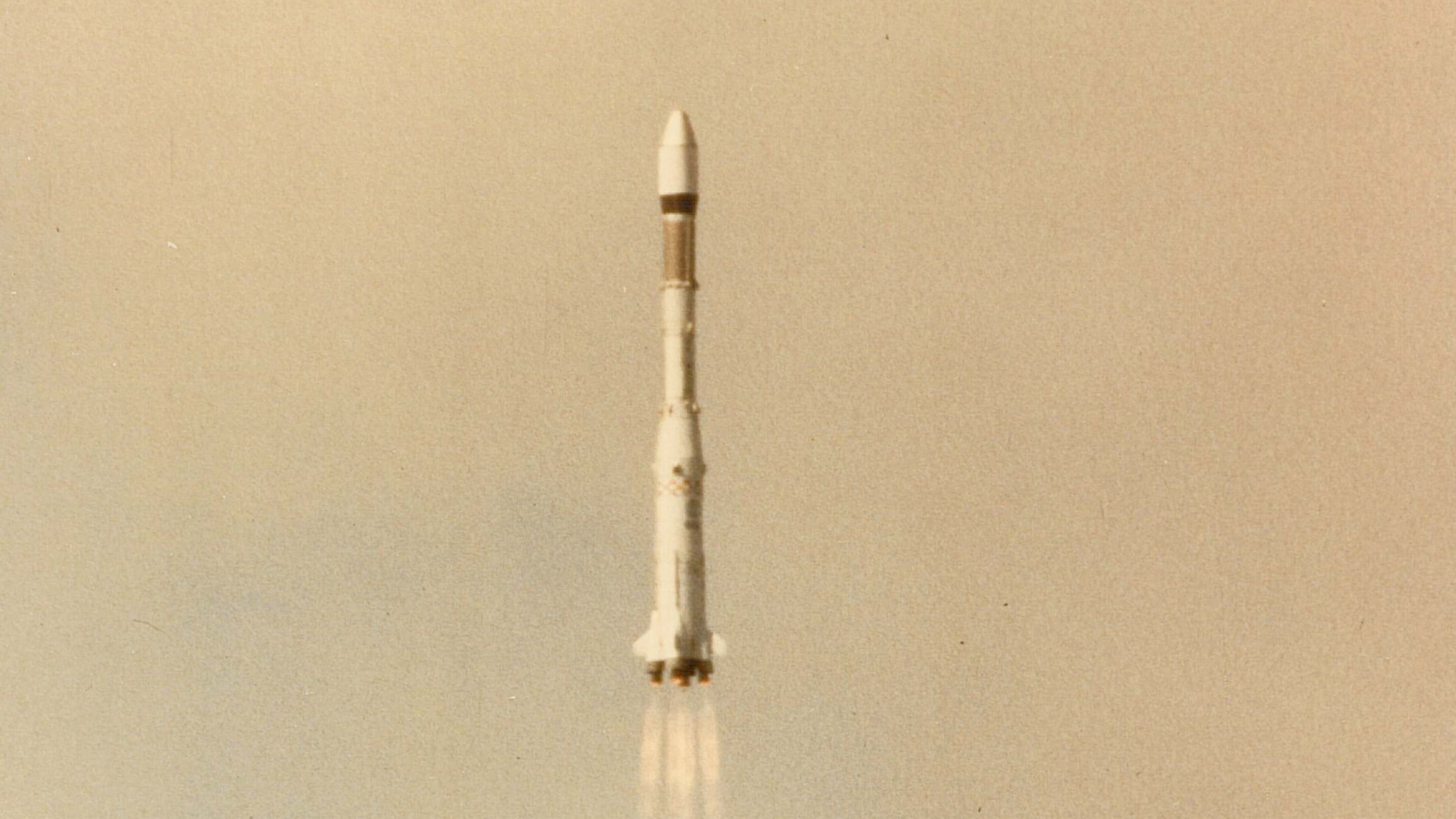
About the Ariane 1
Ariane 1
The Ariane 1 was a European orbital launch vehicle developed and operated under the auspices of the European Space Agency (ESA) and subsequently marketed commercially by Arianespace, the French-led consortium established to provide independent European access to space. It was the first member of the long-running Ariane rocket family and represented a landmark achievement in European spaceflight, demonstrating that Western Europe could field a sovereign, competitive launch capability outside of American or Soviet programs.
Design and Configuration
Standing 50 meters tall with a diameter of 3.8 meters, Ariane 1 was a three-stage liquid-fueled rocket. Its lower stages burned a combination of nitrogen tetroxide and UDMH, while the third stage used a cryogenic liquid hydrogen and liquid oxygen engine — an ambitious technical choice that reflected ESA's long-term commitment to high-performance upper-stage propulsion. The vehicle was capable of delivering 1,400 kg to low Earth orbit (LEO) and 1,850 kg to geostationary transfer orbit (GTO), a capacity well matched to the commercial communications satellite market of the early 1980s. All Ariane 1 missions launched from the Guiana Space Centre in Kourou, French Guiana, a site chosen for its proximity to the equator and its value for GTO-bound payloads.
Operational History
Our flight record captures 11 launches conducted between 1979 and 1986, of which 9 were successful and 2 resulted in failure or partial failure. The vehicle's debut in December 1979 marked the first successful flight of any Ariane rocket, validating years of European investment in indigenous launch technology.
Over its operational life, Ariane 1 carried a diverse manifest that reflected the commercial and scientific ambitions of its primary customers, Arianespace and ESA. Notable missions included the delivery of Intelsat 507 and Intelsat 508, affirming the rocket's competitiveness for commercial telecommunications satellites, and Spacenet 1, an early American commercial payload entrusted to a European vehicle — a significant vote of confidence in Arianespace's growing market position.
On the scientific side, Ariane 1 is perhaps best remembered for launching Giotto in 1985, ESA's interplanetary probe dispatched to intercept Halley's Comet — one of the most celebrated European science missions of the era. The vehicle also lofted SPOT 1, France's pioneering Earth-observation satellite, alongside the Swedish scientific satellite Viking, on a shared flight that demonstrated the dual-manifest capability increasingly important to commercial launch economics.
Legacy
Ariane 1 established the operational and commercial foundations upon which the subsequent Ariane 2, 3, and 4 variants were built, each offering progressively greater payload capability. By proving that Arianespace could reliably serve both institutional European customers and the open commercial market, Ariane 1 helped transform Kourou into one of the world's premier launch sites. Its success made Europe a genuine third force in space launch during the Cold War era and set the stage for the family's dominant position in the global commercial launch market through the 1990s.
- Feb 22, 1986Ariane 1 | SPOT 1 & VikingSuccess
- Jul 02, 1985Ariane 1 | GiottoSuccess
- May 23, 1984Ariane 1 | Spacenet 1Success
- Mar 05, 1984Ariane 1 | Intelsat 508Success
- Oct 19, 1983Ariane 1 | Intelsat 507Success
- Jun 16, 1983Ariane 1 | ECS 1Success
- Sep 09, 1982Ariane 1 | Marecs B & Sirio 2Failure
- Dec 20, 1981Ariane 1 | Marecs 1Success
- Jun 19, 1981Ariane 1 | Meteosat 2Success
- May 23, 1980Ariane 1 | FirewheelFailure
- Dec 24, 1979Ariane 1 | CAT 1Success