Angara A5/Briz-M
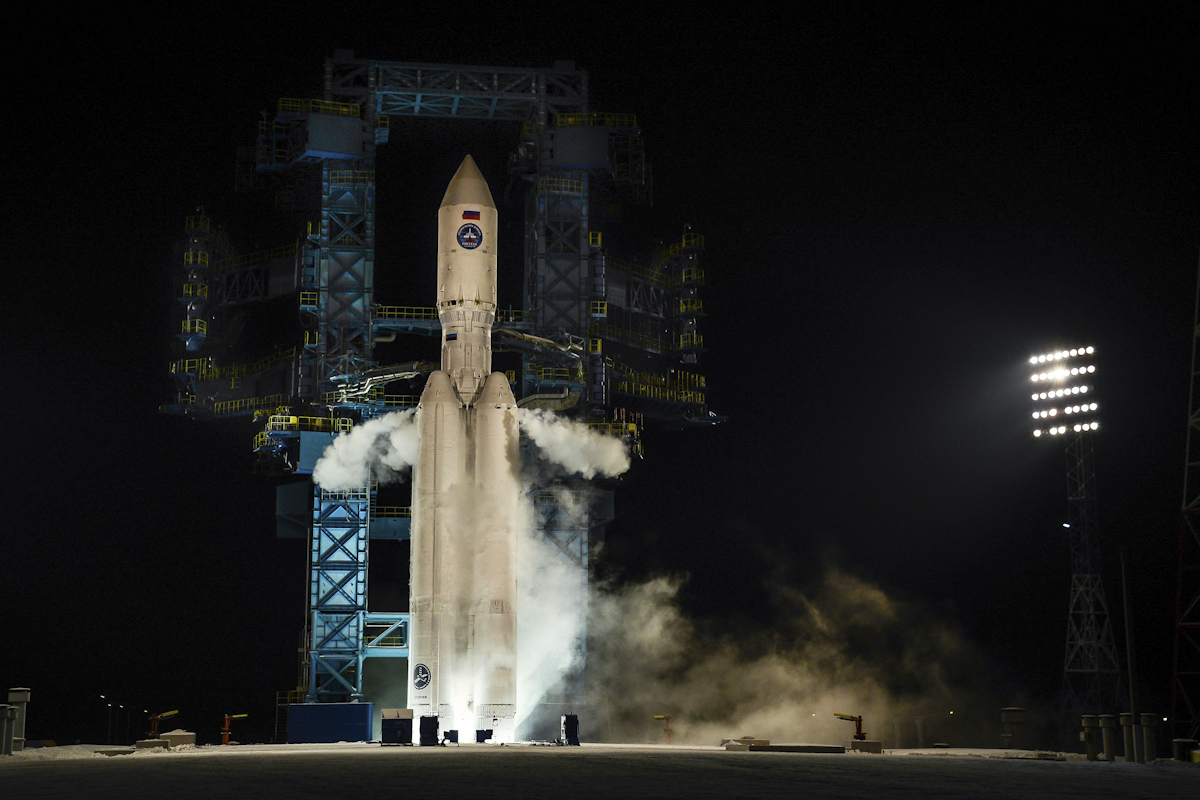
About the Angara A5/Briz-M
Angara A5/Briz-M
The Angara A5/Briz-M is a Russian heavy-lift orbital launch vehicle developed and operated by the Khrunichev State Research and Production Space Center. It represents the most capable configuration of the Angara rocket family, pairing the five-module A5 core stack with the Briz-M upper stage to deliver payloads to a wide range of orbits, including geostationary transfer orbit (GTO). The vehicle is a cornerstone of Russia's effort to field a modern, domestically manufactured launch system independent of facilities now located outside Russian territory.
Design and Configuration
The Angara family is built around a modular concept using a common core module called the Universal Rocket Module (URM). The A5 variant clusters five of these modules together — one central core and four strap-on boosters — producing a heavy-lift vehicle standing 55.4 meters tall with a maximum diameter of 8.86 meters. The Briz-M is a restartable upper stage with significant heritage from earlier Russian launch vehicles; its ability to perform multiple burns makes it well suited for delivering payloads to high-energy orbits such as GTO. The combination gives the Angara A5/Briz-M a payload capacity of 24,500 kg to low Earth orbit and 5,400 kg to geostationary transfer orbit.
Launch Site and Operations
Angara A5/Briz-M missions have launched from the Plesetsk Cosmodrome in northern Russia, a facility long used by the Russian military for space launch operations. The Russian Space Forces have been among the primary customers for the vehicle, reflecting its importance as a strategic national asset for deploying defense-related satellites.
Flight History
According to tracked flight data, the Angara A5/Briz-M has been active from 2014 through at least 2025, with three recorded flights — all successful. This relatively low flight cadence reflects both the vehicle's early development phase and its role as a high-value launcher reserved for significant payloads rather than routine commercial missions.
The three tracked missions illustrate the range of the vehicle's applications. One mission carried Kosmos 2589 and Kosmos 2590, satellites operated under the Russian military's Kosmos designation program. Another mission delivered the IPM payload. A third flight, conducted with a dummy payload, was an early test mission used to validate the vehicle's performance before operational service — a standard practice for new heavy-lift rockets.
Significance and Context
The Angara A5/Briz-M holds considerable strategic importance for Russia's space program. It was designed to replace older Soviet-era heavy-lift vehicles and to consolidate launch capability on Russian soil. Its development was lengthy and technically demanding, making each successful mission a meaningful milestone. While its flight rate remains modest compared to some contemporary heavy-lift vehicles operated by other space agencies, the Angara A5/Briz-M has established a perfect success record across all tracked launches, demonstrating the reliability of its core architecture. Ongoing use into 2025 confirms that the vehicle remains an active and relevant part of Russia's national launch infrastructure.