Angara A5/Blok DM-03
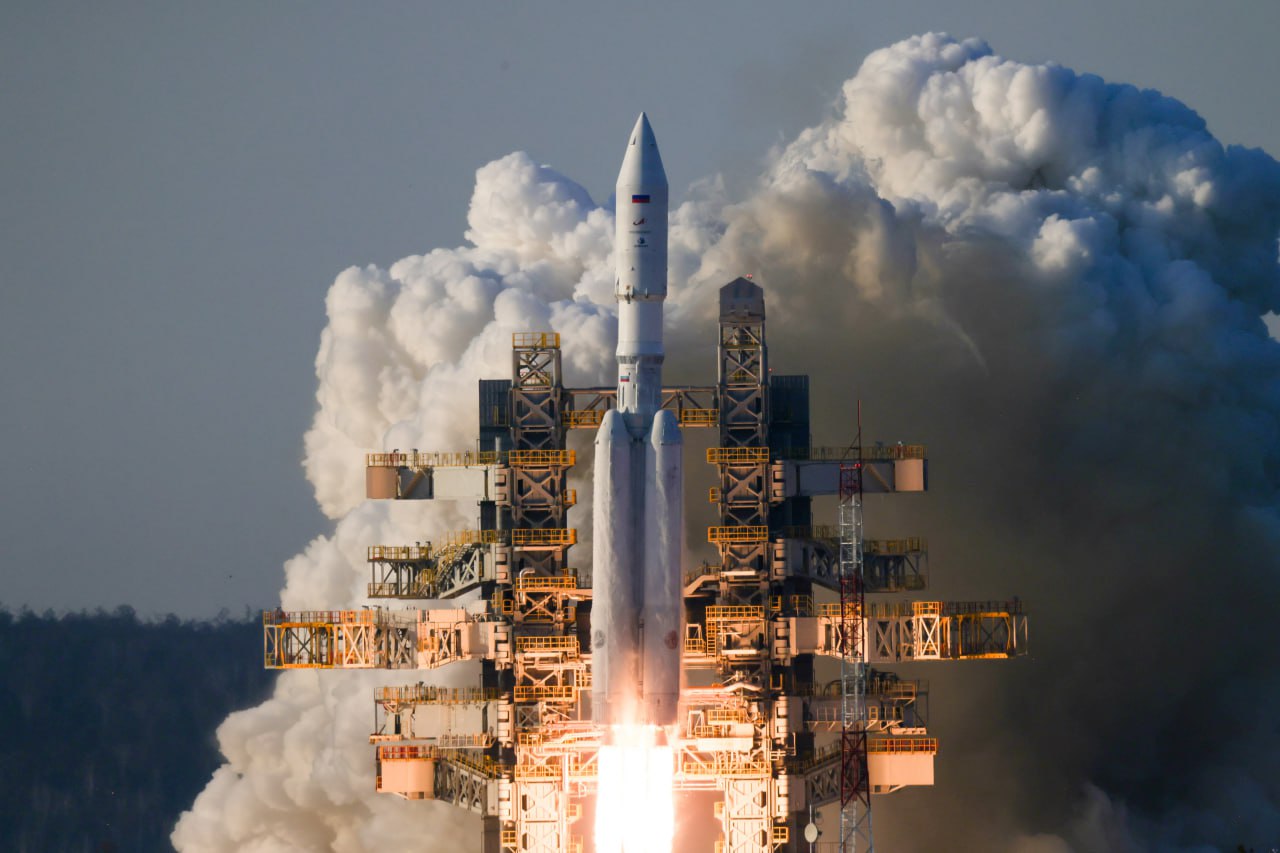
About the Angara A5/Blok DM-03
Angara A5/Blok DM-03
The Angara A5/Blok DM-03 is a Russian heavy-lift orbital launch vehicle configuration operated by Khrunichev State Research and Production Space Center, one of Russia's principal aerospace enterprises. It represents a specific upper-stage pairing within the broader Angara rocket family, combining the five-module Angara A5 core with the Blok DM-03 cryogenic upper stage to achieve enhanced performance for high-energy orbital insertions, particularly to geostationary transfer orbit (GTO).
Vehicle Overview
The Angara family was developed as a next-generation successor to older Soviet-era launchers, designed to give Russia domestic heavy-lift capability independent of launch sites in Kazakhstan. The A5 variant is the heaviest configuration in the family, built around a cluster of universal rocket modules. Standing 55.4 meters tall with a maximum diameter of 8.86 meters, the vehicle is a substantial heavy-lift system capable of delivering 24,500 kg to low Earth orbit (LEO) and 7,000 kg to geostationary transfer orbit. The Blok DM-03 upper stage, derived from a lineage of Blok D stages with a long heritage in Soviet and Russian spaceflight, uses liquid oxygen and kerosene propellants and is designed for the high-energy burns required to place heavy payloads into GTO or geostationary orbit.
Launch History
Our flight record tracks two flights of this specific configuration between 2021 and 2024, yielding one success and one failure or partial failure. Both missions were conducted from Vostochny Cosmodrome, Russia's newer launch facility in the Far East, underscoring the Angara program's role in establishing Vostochny as a major national launch site.
The first tracked mission, the Vostochny Angara Test Flight, was a dedicated developmental flight intended to validate the vehicle's performance from Vostochny. The second tracked mission carried a dummy payload, a common approach in flight-test campaigns where engineers instrument a mass simulator to gather data without risking an operational satellite. The presence of a partial failure in this small flight record reflects the inherent challenges of qualifying a new vehicle configuration and a new launch infrastructure simultaneously.
Role and Significance
The Angara A5/Blok DM-03 configuration occupies an important strategic position in Russia's launch portfolio. By pairing the heavy A5 core with the high-energy Blok DM-03 stage, the vehicle is suited to delivering large communications or government satellites directly to geostationary orbit — a mission profile previously served by the Proton-M rocket. The Angara program broadly represents Russia's effort to modernize its launch fleet with a vehicle that uses less toxic propellants in its lower stages compared to Proton's nitrogen tetroxide and UDMH combination, though the Blok DM-03 upper stage retains its own propellant requirements.
With a limited but growing flight record, this configuration remains in an active development and early operational phase. Future flights will be critical in establishing the reliability and cadence needed for it to take on a central role in Russian heavy-lift launch services.