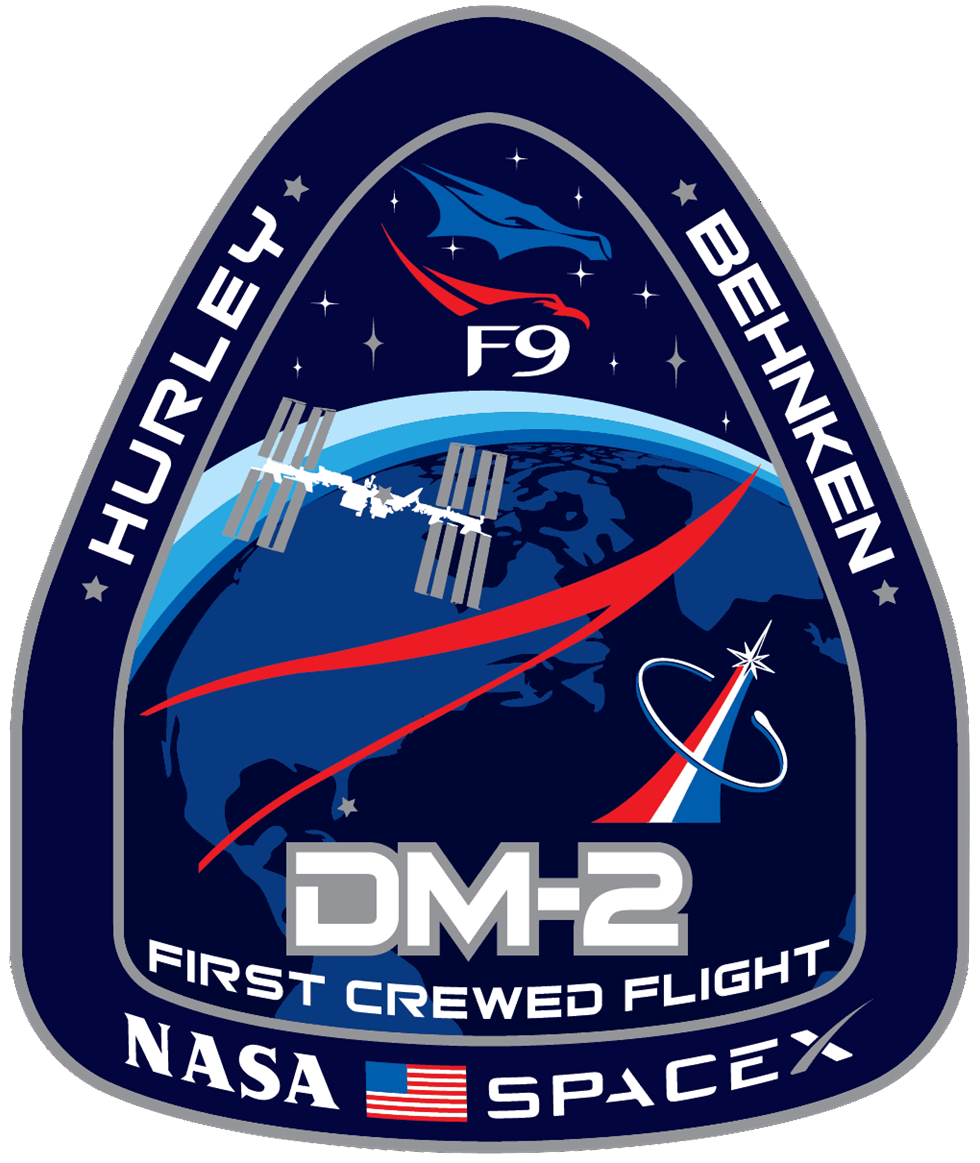
Falcon 9 Block 5 | SpX-DM2 (Demonstration Mission 2)
Crew Dragon Demo-2 — first crewed flight from US soil since the Shuttle (2020).
About this launch
Background
For nearly a decade following the retirement of the Space Shuttle in 2011, the United States lacked the capability to launch its own astronauts into orbit from its own soil. During that interval, NASA astronauts bound for the International Space Station were entirely dependent on seats aboard Russian Soyuz spacecraft, departing from the Baikonur Cosmodrome in Kazakhstan. The arrangement was functional but costly, politically uncomfortable, and widely regarded as a gap that a spacefaring nation of America's ambitions should not tolerate indefinitely.
The answer came through NASA's Commercial Crew Program, an initiative designed to foster the development of privately built and operated crew transportation systems that could restore domestic human launch capability. Rather than funding and owning the hardware outright, NASA acted as a customer, working with commercial partners to certify their vehicles for carrying astronauts to the station. SpaceX emerged as one of the primary partners under this framework, developing the Crew Dragon spacecraft and adapting its Falcon 9 rocket to meet the stringent human-rating requirements that crewed spaceflight demands.
The path toward crewed flight proceeded in carefully staged steps. An uncrewed demonstration mission, Demo-1, had already confirmed that Crew Dragon could successfully reach the station, dock autonomously, and return safely to Earth. Demo-2 represented the next and most consequential threshold: placing human beings aboard the vehicle for the first time and validating the entire system — launch pad, rocket, spacecraft, and mission operations — under real flight conditions with NASA astronauts.
The Launch
On Saturday, 30 May 2020 at 19:22:45 GMT, a Falcon 9 Block 5 rocket lifted off from Launch Complex 39A at Kennedy Space Center in the United States, carrying NASA astronauts Robert Behnken and Douglas Hurley aboard the Crew Dragon spacecraft. The choice of launch site carried its own historical resonance: Launch Complex 39A was the same pad from which Apollo 11 had departed for the Moon in 1969 and from which many Space Shuttle missions had flown. Its use for this occasion was deliberate and fitting.
The mission, formally designated SpX-DM2 — Crew Dragon Demonstration Mission 2 — had been some years in the making and had weathered numerous delays, technical reviews, and ultimately the logistical complications of operating during a global pandemic. Weather had scrubbed an earlier launch attempt just days before. When conditions finally cooperated, the launch proceeded cleanly. The Falcon 9 performed its ascent without anomaly, and the Block 5 first stage successfully returned to a drone ship for recovery — a by-then-routine element of SpaceX operations that nonetheless underscored how thoroughly the economics and engineering of the launch industry had shifted.
Behnken and Hurley, both veteran NASA astronauts and former test pilots with prior Shuttle experience, were the natural choices for a flight that was itself a test. They had spent years training on the Crew Dragon system and were intimately familiar with its design philosophy, its manual controls, and its failure modes. Hurley served as spacecraft commander, while Behnken was joint operations commander. Together they represented a bridge between the Shuttle era and the commercial era just beginning to open.
The moment the vehicle cleared the tower and climbed into a clear Florida sky, it ended an absence of American crewed orbital launch capability that had lasted the better part of a decade. It was the first time NASA astronauts had launched from United States soil since the final Space Shuttle mission in 2011 — a distinction that lent the event an emotional and historical weight felt well beyond the aerospace community.
The Mission
Following a successful ascent to low Earth orbit, Crew Dragon conducted rendezvous and docking operations with the International Space Station. Once aboard the station, Behnken and Hurley integrated with the resident crew and began what would prove to be an extended stay. The original mission design had deliberately left the duration flexible: how long the two astronauts remained on orbit would depend on the readiness of the next commercial crew launch, allowing operational needs to govern the timeline rather than an arbitrarily fixed schedule.
During their time aboard the station, Behnken and Hurley were not passive passengers. They conducted spacewalks, participated in scientific research activities, and worked alongside their crewmates on the regular maintenance and operational demands of station life. Critically, they also performed systematic evaluations of the Crew Dragon spacecraft itself, assessing its systems from orbit in ways that ground testing alone could not replicate. This in-orbit testing was an essential component of the Demo-2 mission's purpose as a flight test, feeding data back to SpaceX and NASA engineers evaluating the vehicle's performance against certification requirements.
For NASA's Commercial Crew Program, the mission served as the final major validation exercise before Crew Dragon could be formally certified for operational, long-duration missions. Certification meant that the vehicle was no longer a prototype being evaluated — it would become a trusted workhorse, capable of routinely ferrying crews to and from the station in the same way the Shuttle had once done, though now under a fundamentally different ownership and operational model.
The return journey came on 3 August 2020, when the Crew Dragon spacecraft successfully undocked from the station and executed its deorbit burn, reentering the atmosphere and descending under parachutes to a splashdown in the Gulf of Mexico at 18:48 UTC. The water landing — the first for a NASA crew since the Apollo era — was itself a nod to earlier chapters of American spaceflight history. Recovery teams were on station and retrieved Behnken and Hurley without incident. Both astronauts were reported to be in good health following what had been a demanding and landmark flight. The mission was declared a success in full.
Legacy
The significance of SpX-DM2 extends in multiple directions simultaneously. At the most immediate level, it restored the United States to the ranks of nations capable of launching their own astronauts on their own rockets from their own territory — a capability that carries both practical and symbolic dimensions that are difficult to separate. The reliance on Soyuz, for all its reliability, had been a source of persistent national unease, and its end was broadly welcomed.
More broadly, the mission marked the maturation of the commercial crew model as a viable approach to human spaceflight. Rather than building government-owned hardware through traditional cost-plus contracting arrangements, NASA had, over the preceding decade, nurtured a competitive commercial sector and then certified its products for human use. The success of Demo-2 validated that methodology in the most demanding way possible: by trusting human lives to it. Subsequent operational Crew Dragon missions would follow, establishing a cadence of crewed flights that the Commercial Crew Program had originally envisioned.
For SpaceX, Demo-2 was also a proof of concept for the company's broader ambitions. Building a vehicle capable of satisfying NASA's human-rating standards is among the most demanding engineering challenges in the industry. Achieving that on a reusable platform — the Falcon 9 Block 5 first stage had flown before — demonstrated that the cost-reduction philosophy underlying SpaceX's business model was not incompatible with the safety margins that crewed flight requires.
Launch Complex 39A at Kennedy Space Center, with its layered history stretching from Apollo through the Shuttle and now into the commercial era, remains an active and storied facility. The mission launched from it on 30 May 2020 added another consequential chapter to that history — one that future accounts of human spaceflight will mark as the opening of a genuinely new phase, defined by commercial operators, reusable hardware, and a model of partnership between government and industry that continues to shape how humanity reaches orbit.