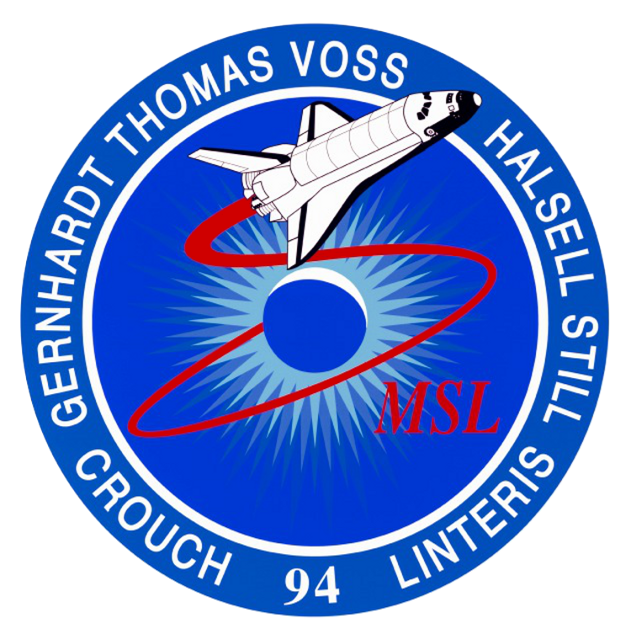
STS-94 (Columbia / MSL-1 reflight)

Mission timeline
- T+00:00:00LiftoffA full reflight of STS-83 — same orbiter, same crew, same payload.
- T+00:08:30Microgravity Science Lab-1
- T+376:06:40Deorbit burn
- T+376:46:00Landing — KSC
About this mission
Background
By the mid-1990s, NASA's Microgravity Science Laboratory program represented one of the agency's most ambitious efforts to exploit the near-weightless environment of low Earth orbit for fundamental research. The Spacelab module, carried in the shuttle's payload bay, provided scientists with a pressurized laboratory in which experiments in combustion physics, fluid dynamics, and materials science could be conducted over an extended mission. STS-83, launched in April 1997 aboard the orbiter Columbia, was intended to deliver a full run of these investigations — but the mission was cut dramatically short when one of the three fuel cells supplying electrical power began showing anomalous readings. Rather than risk continued operations, flight controllers brought the crew home after fewer than four days, leaving the majority of the scientific program untouched.
The decision that followed was nearly without precedent. NASA managers determined that the only satisfactory course of action was a complete reflight — the same orbiter, Columbia, the same seven-person crew, and the identical MSL-1 payload, turned around and relaunched as quickly as possible. The mission was redesignated STS-94 and scheduled for early July 1997. The crew included commander James Halsell and pilot Susan Still, with mission specialists Janice Voss, Donald Thomas, and Michael Gernhardt, and payload specialists Roger Crouch and Gregory Linteris — precisely the team that had trained together and begun the work weeks earlier. Such a wholesale reflight was exceptionally rare in the history of human spaceflight, and it underscored both how seriously NASA regarded the scientific investment and how confident the agency was that the underlying vehicle could be quickly recertified.
Launch and Ascent
STS-94 lifted off from Kennedy Space Center on 1 July 1997, beginning a mission explicitly designed to finish what STS-83 could not. The launch itself was, by design, unremarkable — a deliberate repetition rather than a new beginning. Within minutes of liftoff, Columbia was in orbit and the crew was preparing to reopen the laboratory they had closed under frustrating circumstances only weeks before. At approximately eight and a half minutes into the flight, as the main engines cut off and the orbiter settled into its preliminary trajectory, attention aboard shifted swiftly to the Microgravity Science Lab-1 payload that dominated the aft cargo bay and the pressurized Spacelab module stretching behind the crew cabin.
The fuel cell that had ended STS-83 early had been replaced and thoroughly tested. With that concern resolved, the crew moved with practiced efficiency into the science operations that were the mission's entire reason for existing. Because the crew had already lived with these experiments once, and had in some cases begun collecting data before being recalled, they brought an unusual intimacy to the work — they knew the hardware, knew its quirks, and had already thought through many of the operational challenges.
Scientific Operations
The Microgravity Science Laboratory carried a broad portfolio of experiments focused on phenomena that gravity normally obscures or distorts. Combustion science was a particular priority: researchers sought to understand how flames behave in microgravity, where the absence of buoyancy-driven convection produces spherical, slowly spreading fires quite unlike anything observable on the ground. These observations had direct relevance to spacecraft fire safety as well as to the fundamental chemistry of combustion. Gregory Linteris, one of the payload specialists, was among the scientists most deeply involved in this work.
Alongside combustion, the laboratory hosted investigations into protein crystal growth, the behavior of complex fluids, and the solidification of metallic and semiconductor materials. In each case, the goal was to observe physical processes in a cleaner, more controlled environment than Earth's surface permits — producing data and, in some cases, physical samples that could be analyzed long after landing. The extended duration of STS-94, lasting more than fifteen days in orbit, gave researchers substantially more time than the abbreviated STS-83 had allowed, ultimately enabling most of the planned experimental program to be completed.
The crew worked in rotating shifts to keep the laboratory running continuously, maximizing the time experiments spent in the stable microgravity environment. Ground-based science teams monitored results in real time and adjusted procedures as findings emerged — a collaboration that reflected how sophisticated shuttle-era Spacelab operations had become by the late 1990s.
Reentry and Legacy
After more than fifteen days in orbit, Columbia performed its deorbit burn at approximately 376 hours and six minutes into the mission, committing the orbiter to a return trajectory. The spacecraft touched down at Kennedy Space Center roughly forty minutes later, completing a mission that had, against considerable odds, salvaged an entire scientific program.
STS-94 occupies an unusual position in the catalog of American human spaceflight. The concept of reflying not just the same vehicle but the same crew on the same payload to finish interrupted work was a practical expression of institutional commitment — a willingness to absorb the cost and complexity of an additional launch rather than accept a partial failure. No equivalent wholesale reflight had been attempted in the shuttle program before, and none would be repeated after.
The scientific return was substantial. Data gathered during STS-94 contributed to a body of microgravity research that influenced both subsequent space station experiment programs and terrestrial applications in materials processing and combustion engineering. For the crew members themselves, the mission carried a particular satisfaction: they had trained for a specific set of objectives, seen those objectives interrupted through no fault of their own, and then been given the rare opportunity to return and complete them. The mission stands as a testament to what institutional resolve and careful engineering can accomplish when a program refuses to accept an incomplete result.
Drop this interactive replay into any page — free, no signup. Please keep the attribution link.
<iframe src="https://lowearth.app/embed/mission/sts-94" width="640" height="480" style="border:0;border-radius:12px;max-width:100%" title="STS-94 (Columbia / MSL-1 reflight) mission replay — LowEarth" loading="lazy" allowfullscreen></iframe>