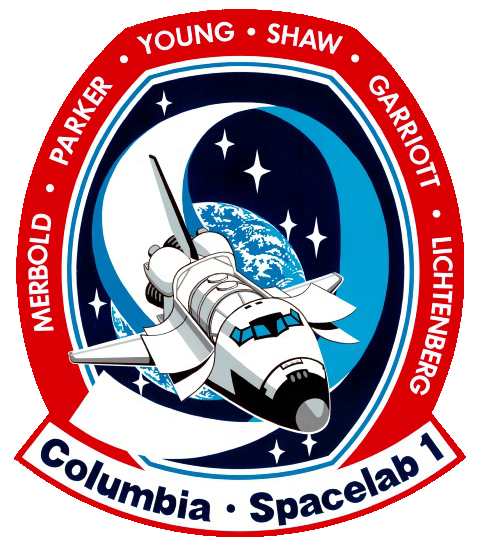
STS-9 (Columbia / Spacelab 1)

Mission timeline
- T+00:00:00Liftoff
- T+00:08:30On orbitFirst flight of the European-built Spacelab; first six-person crew.
- T+246:56:40Deorbit burn
- T+247:47:00Landing
About this mission
Background
By the early 1980s, the Space Shuttle had proven it could reach orbit and return safely, but NASA and its international partners were eager to exploit the cavernous payload bay for sustained scientific work. The answer was Spacelab, a pressurized laboratory module and accompanying pallet system designed and built by the European Space Agency and its industrial contractors. Conceived under a 1973 agreement between NASA and ESA, Spacelab represented Europe's most ambitious contribution to human spaceflight to that point: a reusable, shirtsleeve working environment that would ride inside the Shuttle, remain attached throughout a mission, and return to Earth for refurbishment and reuse. After nearly a decade of development, the hardware was ready, and STS-9 was designated to carry it aloft for the first time.
Columbia was the natural choice of orbiter. The oldest and heaviest of the Shuttle fleet, it had already accumulated several missions of experience and carried the structural provisions needed to support Spacelab's mass and power demands. The crew assembled for STS-9 reflected the mission's dual character as both an operational spaceflight and an international scientific enterprise. Commander John Young, one of the most experienced astronauts in history with flights stretching back to Gemini, was paired with pilot Brewster Shaw on his first spaceflight. The mission specialist corps included Owen Garriott, a veteran of Skylab who brought deep experience in orbital science operations, and Robert Parker, an astronomer. Rounding out the six-person crew were two payload specialists — Byron Lichtenberg of MIT and Ulf Merbold of West Germany, flying under ESA auspices. Merbold's selection made him the first ESA astronaut to fly in space, a milestone that carried considerable symbolic and political weight for European human spaceflight ambitions.
The crew of six was itself historic. No spacecraft had ever launched with so many people aboard, and managing a crew of that size in orbit required careful coordination of sleep schedules, equipment use, and scientific shifts. The team was divided into two working groups that operated in rotating shifts, allowing experiments to run around the clock throughout the mission.
Launch and Orbital Operations
Columbia lifted off from Kennedy Space Center on 28 November 1983. Approximately eight and a half minutes after launch, the stack reached orbit and the mission's scientific program began almost immediately. The Spacelab module, nestled in the payload bay with its tunnel connecting directly to the Shuttle's middeck, gave the crew access to a fully equipped laboratory without the need for spacesuits. Scientists on the ground could communicate directly with crew members running experiments, creating a working dynamic closer to an airborne research aircraft than to the cramped capsules of earlier human spaceflight.
Over the course of the mission, the crew conducted more than seventy experiments spanning atmospheric physics, astronomy, solar physics, materials science, fluid mechanics, and life sciences. Spacelab's design philosophy emphasized flexibility: the combination of the enclosed module and open pallets carrying instruments pointed at the sky allowed a broad range of disciplines to share a single flight. European and American investigators had competed for time on the manifest, and the resulting science program was genuinely international in character, reflecting the cooperative framework that had produced Spacelab itself.
Merbold and Lichtenberg, as payload specialists, had trained extensively on the specific instruments they were responsible for, supplementing the mission specialists' broader operational expertise. The arrangement demonstrated a model for scientific spaceflight that would be refined over subsequent Shuttle missions and eventually carried forward into Space Station operations.
Anomalies and Return
The mission was not without difficulty. During the final hours of the flight, two of Columbia's auxiliary power units — which drive the hydraulic systems essential for controlling the aerosurfaces during reentry and landing — caught fire. The crew dealt with the emergency, and the damage was contained, but the incident underscored the hazards that could accompany even a largely successful mission. Columbia executed its deorbit burn at approximately 246 hours and 57 minutes into the flight and touched down at Edwards Air Force Base at roughly 247 hours and 47 minutes elapsed time, concluding a mission that had lasted just over ten days. The landing occurred on 8 December 1983.
Post-flight inspection also revealed that two of the shuttle's general-purpose computers had failed during reentry, compounding concerns about the final phase of the mission. Despite these technical issues, the orbiter and crew were recovered safely, and the scientific harvest of the mission was judged a success.
Legacy
STS-9 established Spacelab as a functional and productive research platform, validating years of European investment and demonstrating that complex, multidisciplinary science could be conducted efficiently in orbit. The mission flew a template — rotating shifts, payload specialist crew members, international experiment teams in direct contact with orbit — that became standard practice for subsequent Spacelab flights and informed the operational concepts eventually adopted for the International Space Station.
Ulf Merbold's participation opened a door. He would fly again, and ESA would go on to develop a cadre of professional astronauts whose roles grew steadily over the following decades. John Young's command of STS-9 added yet another chapter to a career unmatched in its breadth, stretching from the first crewed Gemini mission to the first Shuttle flight and now to the first Spacelab mission.
The technical anomalies of the final hours were studied carefully by engineers and contributed to ongoing improvements in Shuttle systems. But the dominant memory of STS-9 in the history of spaceflight is as a moment of genuine expansion: more people in space at once than ever before, a European laboratory working as advertised, and a partnership between continents that had moved from agreement on paper to results in orbit.
Drop this interactive replay into any page — free, no signup. Please keep the attribution link.
<iframe src="https://lowearth.app/embed/mission/sts-9" width="640" height="480" style="border:0;border-radius:12px;max-width:100%" title="STS-9 (Columbia / Spacelab 1) mission replay — LowEarth" loading="lazy" allowfullscreen></iframe>