
STS-73 (Columbia / USML-2)
Mission timeline
- T+00:00:00Liftoff
- T+00:08:30US Microgravity Lab-2Fluid physics, combustion and crystal-growth research.
- T+381:13:20Deorbit burn
- T+381:53:00Landing — KSC
About this mission
Background
By the mid-1990s NASA's Space Shuttle programme had evolved well beyond its original role as an orbital truck. The agency had invested heavily in transforming Columbia's payload bay into a flying research laboratory, and the Spacelab module — a pressurised cylinder developed in partnership with the European Space Agency — gave scientists weeks of continuous access to the microgravity environment that no ground-based facility could replicate. The first United States Microgravity Laboratory mission, USML-1, had flown aboard Columbia in June 1992 and returned results compelling enough to justify a direct follow-on. USML-2, manifested as STS-73, was that follow-on: a focused, 16-day research campaign designed to push further into the fluid-physics, combustion-science, and crystal-growth questions that its predecessor had opened.
Columbia was the natural vehicle of choice. The oldest orbiter in the fleet, it was also the heaviest and the only one configured to carry the full, long Spacelab module with its associated tunnel and support hardware. For USML-2, Columbia's middeck and the Spacelab module were loaded with an interconnected suite of experiments representing years of preparation by university, government, and industry science teams across the United States.
Crew and Preparation
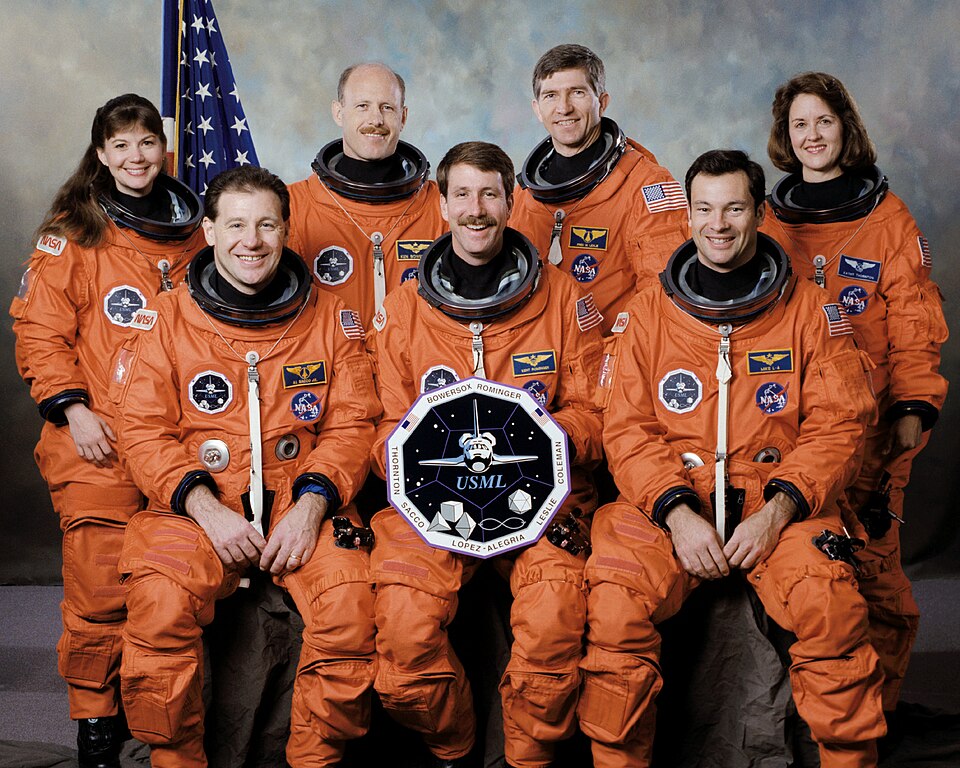
STS-73 assembled a seven-person crew that blended experienced pilots with dedicated mission specialists and payload specialists whose primary loyalty was to the laboratory rather than to the orbiter itself. Commander Kenneth Bowersox and Pilot Kent Rominger were responsible for flying Columbia, while mission specialists Kathryn Thornton, Catherine Coleman, and Michael Lopez-Alegria managed the vehicle's systems and supported the research programme. The two payload specialists — physicist Fred Leslie and chemical engineer Albert Sacco — brought deep domain expertise in fluid dynamics and crystal growth respectively, reflecting NASA's philosophy on these long-duration science missions of embedding the experimenters directly in the crew.
Training for a Spacelab mission of this complexity was prolonged and highly specific. Crew members rotated through simulations of the individual experiments, learning to recognise off-nominal conditions, collect samples at precise moments, and maintain the careful housekeeping that continuous scientific operations demanded. Because the experiments ran around the clock, the crew divided into two alternating shifts, a working pattern that maximised utilisation of Columbia's limited on-orbit time and one that the crew rehearsed extensively before flight.
The Flight
Columbia lifted off from Kennedy Space Center on 20 October 1995, rising through the Florida sky and clearing the atmosphere before main engine cutoff placed the stack on its initial orbital trajectory. Within the first nine minutes of flight the vehicle was in orbit, and the crew moved quickly to open the Spacelab tunnel and begin activating experiment hardware. Scientific operations were under way almost immediately; the mission had been designed to waste as little time as possible.
The research agenda was organised into three broad disciplines. Fluid-physics investigations examined how liquids behave in the absence of buoyancy-driven convection — phenomena directly relevant to manufacturing processes, heat-transfer technologies, and the fundamental understanding of surface-tension-driven flows. Combustion experiments took advantage of the same environment to study how flames ignite, spread, and extinguish when gravity-induced flow is removed, producing spherically symmetric flames and other behaviours impossible to sustain on the ground. Crystal-growth experiments, led in large part by Sacco's work on zeolite crystals, sought to produce specimens of a purity and structural perfection unattainable in terrestrial laboratories, with implications for catalysis and materials science.
Day after day, across both working shifts, the crew tended this portfolio of experiments — adjusting parameters, photographing results, downlinking data to principal investigators at the Marshall Space Flight Center's Payload Operations Control Center in Huntsville, Alabama, who could direct the science in near real time. That two-way communication loop between orbit and the ground was a hallmark of the Spacelab programme and greatly extended what any single crew could accomplish.
After more than 15 complete days of productive research, Columbia performed its deorbit burn at mission elapsed time T+381 hours 13 minutes, committing the vehicle to re-entry. The orbiter crossed the coast of Florida and touched down on Runway 33 at Kennedy Space Center at T+381 hours 53 minutes, completing a mission that had exceeded the planned duration in scientific productivity if not in calendar time.
Legacy and Significance
STS-73 returned what investigators described as an exceptionally rich harvest of data. The fluid-physics results contributed to a body of knowledge that later informed the design of spacecraft thermal-management systems and industrial crystal-growth furnaces. The combustion findings fed directly into NASA's broader microgravity combustion programme, which sought to improve the efficiency and safety of combustion technologies by understanding their most basic mechanisms. Sacco's zeolite crystals were among the highest-quality specimens yet grown in space, demonstrating a clear quality advantage over Earth-grown counterparts and encouraging further investment in orbital materials processing.
Beyond its scientific cargo, USML-2 affirmed the operational maturity of the Spacelab system and the round-the-clock research model that would later inform the design and utilisation philosophy of the International Space Station. The mission demonstrated that a relatively small, well-trained crew could sustain continuous, high-quality laboratory work in orbit for two weeks, managing dozens of simultaneous investigations with minimal support from the ground beyond scientific direction. Several members of the STS-73 crew went on to prominent roles in the Station programme, carrying with them the lessons learned in Columbia's Spacelab module.
For Columbia itself, STS-73 was one of the defining missions of its long career as NASA's premier science platform — a vehicle that, mission after mission, proved that the Space Shuttle could be far more than a launch system and instead serve as a genuine orbiting laboratory for fundamental human enquiry.
Drop this interactive replay into any page — free, no signup. Please keep the attribution link.
<iframe src="https://lowearth.app/embed/mission/sts-73" width="640" height="480" style="border:0;border-radius:12px;max-width:100%" title="STS-73 (Columbia / USML-2) mission replay — LowEarth" loading="lazy" allowfullscreen></iframe>