
STS-68 (Endeavour / SRL-2)
Mission timeline
- T+00:00:00Liftoff
- T+00:08:30Space Radar Laboratory-2A second radar pass to see seasonal change since SRL-1.
- T+269:06:00Deorbit burn
- T+269:46:00Landing — Edwards
About this mission
Background
By the early 1990s, Earth-observation scientists had long understood that a single snapshot of the planet's surface told only part of the story. Seasonal shifts, flooding cycles, vegetation growth, and the slow creep of desertification all demanded repeated measurements taken months apart under comparable conditions. The Space Radar Laboratory program was designed precisely to answer that need. Flying aboard NASA's Space Shuttle, SRL combined three imaging radar instruments — the Spaceborne Imaging Radar-C (SIR-C) and the X-Band Synthetic Aperture Radar (X-SAR), the latter a joint contribution from the German space agency DASA and the Italian space agency ASI — into a single, powerful remote-sensing suite capable of penetrating cloud cover, operating day or night, and detecting subtle changes in surface texture and moisture.
The first mission, STS-59, had flown in April 1994 aboard Endeavour, gathering a global baseline dataset of hundreds of carefully chosen target sites. The scientific strategy called for a near-identical follow-on flight roughly six months later, during a different season, so that the same regions could be re-imaged under changed environmental conditions. That second flight was STS-68.
Crew and Preparation
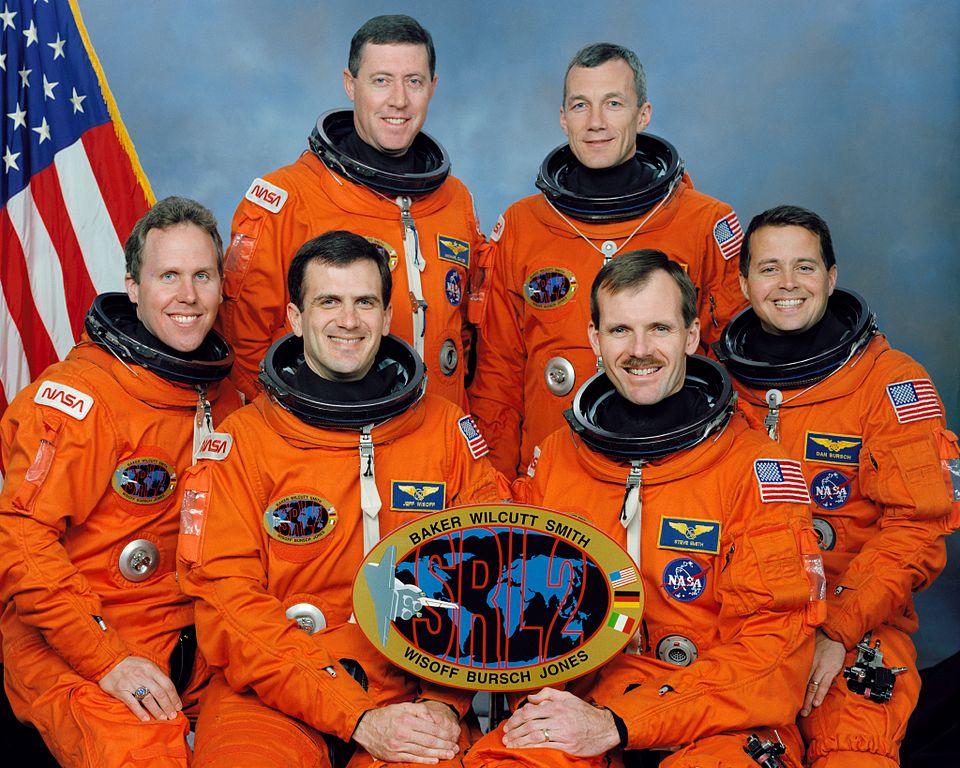
Commander Michael Baker and Pilot Terrence Wilcutt led a crew of four mission specialists: Steven Smith, Daniel Bursch, Peter Wisoff, and Thomas Jones. Jones and Wisoff, in particular, had deep ties to the SRL science program, and the crew trained extensively with the instrument teams and principal investigators who would be analyzing the radar data from the ground. Because the mission's value depended entirely on replicating the geometry of the STS-59 passes as closely as possible, flight planners worked to match orbital inclination and ground-track timing with exceptional care.
STS-68 carried a pointed reminder of the risks inherent in spaceflight even before it left the ground. A launch attempt on August 18, 1994 was aborted at T−1.9 seconds — one of the latest pad abortions in Shuttle program history — when onboard computers detected an anomalous reading in a main engine turbopump. The crew sat in their seats as the engines shut down and the countdown clock stopped with Endeavour's hold-down bolts still engaged. The fault was traced to a faulty sensor and a high-pressure oxidizer turbopump that required replacement, pushing the mission back to the end of September.
The Flight
Endeavour lifted off from Kennedy Space Center on September 30, 1994. Within minutes of reaching orbit, the crew opened the payload bay and brought the SRL instruments to life. The radar suite began its work almost immediately, sweeping the ground below with microwave pulses tuned to multiple wavelengths and polarizations. The multifrequency approach was key: different radar wavelengths interact with surface features in distinct ways, with longer C-band pulses penetrating vegetation canopies to sense moisture in underlying soil, while shorter X-band returns responded to surface roughness and structure. Together the channels produced richly layered datasets that no single sensor could have captured alone.
Over the course of the mission the crew conducted operations around the clock in alternating shifts, guided by a detailed science timeline that prioritized hundreds of target zones distributed across every continent except Antarctica. Targets ranged from tropical rainforests in Brazil and Southeast Asia to the arid plains of the Sahara and the agricultural heartlands of North America. Coastal wetlands, volcanic calderas, glaciated mountain ranges, and urban agglomerations all fell within the instrument's planned coverage. Ground teams relayed real-time feedback to the crew, occasionally redirecting observations when cloud-free windows opened over sites that had been obscured during the STS-59 pass.
The mission lasted approximately eleven days, concluding with a deorbit burn and a landing at Edwards Air Force Base in California. The extended flight time allowed a comprehensive global dataset to be assembled, and the return to Edwards — rather than the Kennedy Space Center runway — reflected prevailing weather and operational conditions at the time of reentry.
Science and Legacy
The scientific harvest from STS-68 was exceptional. When researchers laid the SRL-2 data alongside the SRL-1 images from STS-59, change became visible in ways that ground-based observation could never efficiently reproduce. In agricultural regions, the maturation of crops between spring and autumn showed up as measurable shifts in radar backscatter. In equatorial forests, subtle variations hinted at seasonal changes in canopy moisture. Along river deltas and coastal plains, differences in inundation extent illustrated the dynamic interplay between precipitation patterns and landscape form. In volcanically active areas, including Mount Kīlauea in Hawaii, surface deformation between the two passes provided data relevant to understanding eruptive cycles.
Beyond any single finding, STS-68 validated a methodology: repeat-pass spaceborne radar observation conducted at seasonal intervals could become a routine and powerful tool for environmental monitoring. The datasets generated by the two SRL missions fed directly into scientific literature for years afterward, informing studies on carbon budgets in tropical forests, soil erosion modeling, and hydrological mapping. The multi-agency collaboration that produced the X-SAR instrument demonstrated that international partnerships in Earth science were not only feasible but productive, a model that would influence later programs.
STS-68 also stands as a demonstration of the Space Shuttle's versatility as a science platform. The ability to fly a sophisticated, multi-instrument payload, operate it continuously with a trained crew, and return it safely to Earth for refurbishment made possible a class of experiment that robotic satellites of the era could not replicate with comparable flexibility. Together, STS-59 and STS-68 remain among the most scientifically productive Earth-observation missions ever flown by a crewed spacecraft.
Drop this interactive replay into any page — free, no signup. Please keep the attribution link.
<iframe src="https://lowearth.app/embed/mission/sts-68" width="640" height="480" style="border:0;border-radius:12px;max-width:100%" title="STS-68 (Endeavour / SRL-2) mission replay — LowEarth" loading="lazy" allowfullscreen></iframe>