
STS-60 (Discovery)
Mission timeline
- T+00:00:00LiftoffSergei Krikalev becomes the first Russian cosmonaut to fly on a US Space Shuttle.
- T+00:08:30On orbitFlew the Wake Shield Facility; a first step toward the ISS partnership.
- T+198:20:00Deorbit burn
- T+199:09:00Landing — KSC
About this mission
Background
When the Cold War ended and the Soviet Union dissolved in 1991, the United States and Russia faced an unusual opportunity: two space programmes that had spent decades in competition could, for the first time, pursue meaningful cooperation. Early discussions between NASA and the Russian Space Agency led to a landmark agreement in 1992, under which a Russian cosmonaut would fly aboard the Space Shuttle and American astronauts would train for extended missions aboard the Mir space station. The arrangement was not merely symbolic. Both nations understood that pooling experience in orbital operations, life-support systems, and long-duration human spaceflight would be essential groundwork for any shared infrastructure in low Earth orbit. STS-60, assigned to orbiter *Discovery*, was chosen as the first concrete expression of that agreement.
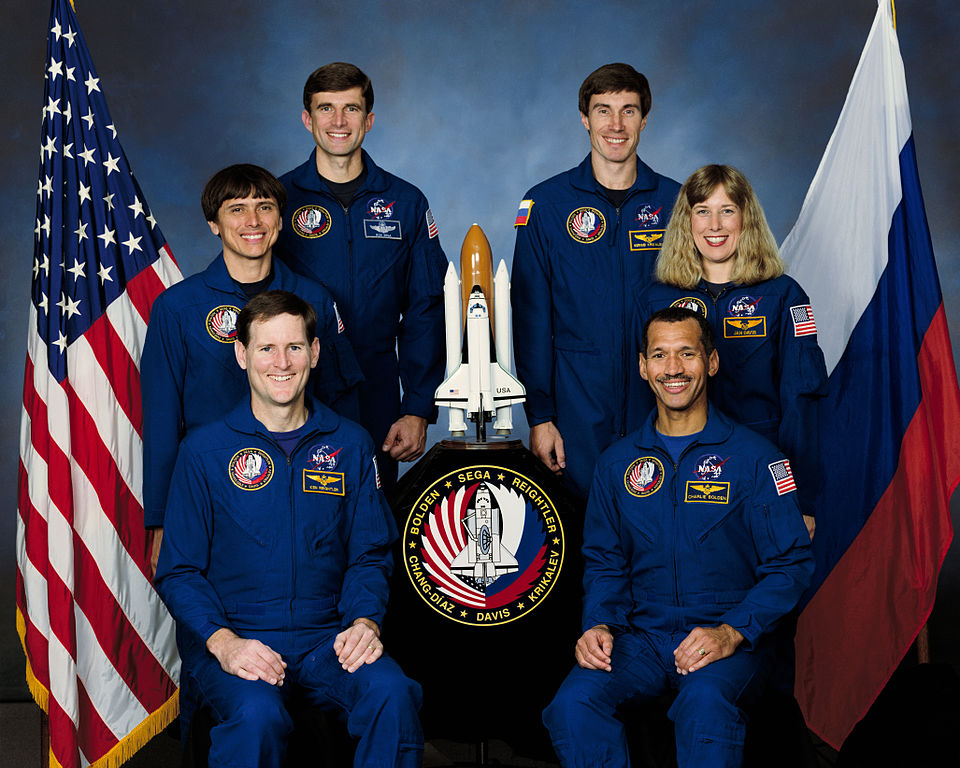
The crew reflected the new partnership. Commander Charles Bolden, a veteran of two previous Shuttle missions, led a complement that included Pilot Kenneth Reightler and Mission Specialists Jan Davis, Ronald Sega, and Franklin Chang-Díaz — himself a pioneering figure as the first Costa Rican-born American astronaut. The sixth seat went to Sergei Krikalev, a highly experienced cosmonaut who had already spent an extraordinary combined time aboard Mir, including a prolonged stay that had made him something of a symbol of post-Soviet upheaval. His inclusion in the STS-60 crew was both a technical and a diplomatic statement.
Crew and Preparations
Training for STS-60 required integrating Krikalev into NASA's shuttle systems while simultaneously giving his American crewmates familiarity with Russian procedures and terminology. The process exposed both sides to differences in engineering philosophy and operational culture that would later inform every phase of the Shuttle–Mir programme and the design of the International Space Station. Krikalev trained at Johnson Space Center in Houston alongside his colleagues, participating in the same simulations and emergency drills as any other mission specialist. NASA took care to ensure his role was substantive rather than ceremonial: he was assigned genuine responsibilities for payload operations and systems monitoring during the flight.
The primary payloads for STS-60 included the Wake Shield Facility, an experimental free-flying platform designed to generate an ultra-high vacuum in the wake of its own passage through the residual upper atmosphere. Scientists hoped that this near-perfect vacuum environment — far cleaner than anything achievable inside a laboratory — could be used to grow exceptionally pure semiconductor thin films. The mission also carried the SPACEHAB commercial pressurised module in the payload bay, providing additional working and storage volume for secondary experiments in materials science, biology, and technology development.
The Flight
*Discovery* lifted off from Kennedy Space Center on 3 February 1994. At the moment of liftoff, Sergei Krikalev became the first Russian cosmonaut to fly aboard an American spacecraft — a milestone that had seemed almost inconceivable a decade earlier. The ascent was nominal, and the crew reached orbit approximately eight and a half minutes after launch.
Once on orbit, the crew deployed the Wake Shield Facility for its initial free-flight period. Although the thin-film results from this first deployment fell short of the ultra-vacuum performance expected — the facility would fly again on later missions with refinements — the operation demonstrated the basic concept and gave engineers valuable data about the behaviour of the platform in the orbital environment. The SPACEHAB module supported a productive programme of secondary experiments throughout the mission, with crew members cycling through its pressurised interior to tend to biological samples and conduct materials processing runs.
Krikalev participated actively in crew activities throughout the eight-day flight, operating equipment, assisting with payload tasks, and serving as a living demonstration that joint operations between American astronauts and Russian cosmonauts were not only politically feasible but practically straightforward. His presence aboard *Discovery* was closely watched by space agencies, legislators, and the public on both sides of the former Iron Curtain.
The deorbit burn was executed cleanly, and *Discovery* returned to Kennedy Space Center approximately 199 hours after launch, completing a mission that had proceeded without major incident from beginning to end.
Legacy
STS-60 occupies a precise and important place in the history of human spaceflight. It demonstrated, in the most direct possible way, that American and Russian space professionals could train together, live together in a confined spacecraft, and conduct complex operations as a single crew. The mission removed much of the uncertainty that had surrounded the proposed Shuttle–Mir programme: if one cosmonaut could fly a Shuttle mission successfully, a sustained rotation of cosmonauts and astronauts between the two nations' vehicles was achievable.
The cooperation initiated by STS-60 expanded rapidly. The Shuttle–Mir programme that followed saw seven American astronauts spend long-duration tours aboard the Russian station between 1995 and 1998, while multiple Russian cosmonauts flew on subsequent Shuttle missions. The mutual trust, technical vocabulary, and operational protocols developed through those exchanges were carried directly into the International Space Station programme, which began construction in orbit in 1998. Without the institutional confidence built during this period, the multinational management of the ISS — involving not only the United States and Russia but also the European Space Agency, Japan, and Canada — would have been far more difficult to establish.
For Krikalev personally, STS-60 added another chapter to an already remarkable career. He would go on to fly a further Shuttle mission, serve aboard the ISS during its first long-duration expedition, and eventually log more time in space than almost any other human being. His flight on *Discovery* in February 1994 marked the moment the partnership became real.
Drop this interactive replay into any page — free, no signup. Please keep the attribution link.
<iframe src="https://lowearth.app/embed/mission/sts-60" width="640" height="480" style="border:0;border-radius:12px;max-width:100%" title="STS-60 (Discovery) mission replay — LowEarth" loading="lazy" allowfullscreen></iframe>