
STS-6 (Challenger)
Mission timeline
- T+00:00:00LiftoffMaiden flight of Challenger.
- T+00:08:30On orbit
- T+10:00:00TDRS-1 deployed
- T+83:20:00First Space Shuttle spacewalkMusgrave and Peterson make the program’s first EVA.
- T+119:43:20Deorbit burn
- T+120:23:00Runway landing — Edwards
About this mission
Background
By the time NASA prepared its sixth Space Shuttle mission, the program had already demonstrated that a reusable orbiter could reach orbit and return safely. Yet STS-6 was no routine incremental step. It introduced an entirely new vehicle — Orbiter Vehicle-099, named *Challenger* — and carried two objectives that would mark genuine firsts for American human spaceflight: the deployment of a revolutionary new communications satellite and the first extravehicular activity ever performed from a Space Shuttle. Together, those goals made STS-6 one of the most consequential early missions of the Shuttle era.
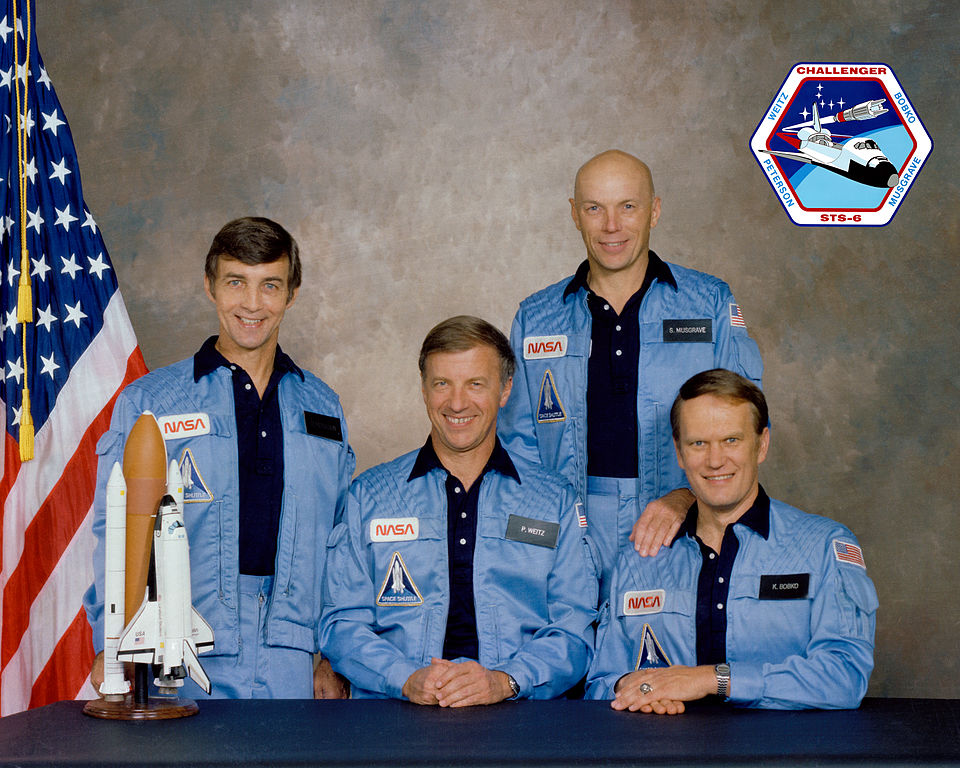
*Challenger* had been built as a structural test article and later converted to a flight-worthy orbiter, incorporating manufacturing improvements over its predecessor *Columbia*. It was lighter and in several respects more capable. Commanding the mission was Paul Weitz, a Skylab veteran, with Karol Bobko serving as pilot. Mission specialists Story Musgrave and Donald Peterson rounded out the four-person crew, and it was this latter pair who would be called upon to prove that astronauts could work productively in the vacuum of space from the new orbiter's airlock.
Crew and Preparation
The assignment of Musgrave and Peterson to perform the spacewalk reflected months of preparation in NASA's Neutral Buoyancy Simulator, where the two men practiced the procedures they would execute in orbit. The Shuttle program had not yet demonstrated an EVA capability; *Columbia*'s earlier flights had validated the orbiter's core systems but had not included a spacewalk. Proving that the airlock hardware, the new Shuttle Extravehicular Mobility Unit (EMU) spacesuits, and crew procedures all functioned as designed was therefore a critical milestone before more demanding EVA work — such as satellite retrieval or Space Station construction — could be contemplated.
The primary payload was the first Tracking and Data Relay Satellite, designated TDRS-1. Built for NASA by TRW, the TDRS system was designed to replace the agency's worldwide network of ground stations by relaying communications between low-Earth-orbit spacecraft and a small number of geosynchronous satellites. A successful deployment would dramatically increase the fraction of each orbit during which an orbiting vehicle could communicate with the ground — a capability that would prove essential for the Shuttle program and, later, for the International Space Station.
The Flight
*Challenger* lifted off from Launch Complex 39A at Kennedy Space Center on April 4, 1983. The ascent proceeded normally, and the crew reached a stable orbit approximately eight and a half minutes after launch. Early in the mission, the crew prepared TDRS-1 for deployment, and at roughly ten hours into the flight the satellite was released from the payload bay and its Inertial Upper Stage booster was ignited to begin the journey toward geostationary orbit.
The deployment, however, was not without difficulty. A malfunction in the IUS booster left TDRS-1 in a lower and more elliptical orbit than planned. Over the following weeks, NASA engineers conducted an extensive recovery effort, using the satellite's own small thrusters in a series of carefully calculated burns to raise and circularize the orbit. The effort ultimately succeeded, and TDRS-1 went on to provide years of operational service — a testament to the ingenuity of the flight operations teams on the ground.
The mission's other landmark event arrived at approximately eighty-three hours and twenty minutes into the flight. Musgrave and Peterson suited up, depressurized the airlock, and floated out into the payload bay, becoming the first astronauts to perform a spacewalk from the Space Shuttle. The EVA lasted roughly four hours and seventeen minutes. The two mission specialists evaluated the new EMU suits under actual spaceflight conditions, tested hardware, and confirmed that an astronaut could maneuver and work effectively in the Shuttle's payload bay environment. No major anomalies were reported. The spacewalk validated the equipment and procedures that would underpin every subsequent Shuttle EVA, including the celebrated Hubble Space Telescope servicing missions.
Return and Legacy
After a mission lasting just under five days, *Challenger* fired its orbital maneuvering engines for the deorbit burn at approximately one hundred nineteen hours and forty-three minutes after launch. The orbiter descended through the atmosphere and touched down on the runway at Edwards Air Force Base in California at roughly one hundred twenty hours and twenty-three minutes mission elapsed time, completing a flight that had achieved both of its principal objectives.
The significance of STS-6 extended well beyond its individual accomplishments. *Challenger*'s debut expanded the Shuttle fleet at a time when NASA was under pressure to increase its launch cadence and demonstrate the program's commercial and scientific value. The TDRS-1 recovery, though stressful, ultimately produced an operational asset that would serve as the communications backbone for Shuttle and Station operations for decades. Most enduringly, the first Shuttle EVA opened a chapter that would include some of the most technically ambitious and visually iconic moments in spaceflight history — satellite rescues, telescope repairs, and ultimately the assembly of the largest structure ever constructed in space.
Musgrave and Peterson's four hours outside *Challenger* proved that human beings, wearing the new generation of American spacesuits and operating from the Shuttle's airlock, could do useful work in the void. That proof of concept, validated quietly over the Pacific in April 1983, would echo through every spacewalk that followed.
Drop this interactive replay into any page — free, no signup. Please keep the attribution link.
<iframe src="https://lowearth.app/embed/mission/sts-6" width="640" height="480" style="border:0;border-radius:12px;max-width:100%" title="STS-6 (Challenger) mission replay — LowEarth" loading="lazy" allowfullscreen></iframe>