
STS-27 (Atlantis)
Mission timeline
- T+00:00:00LiftoffInsulation struck the orbiter on ascent, badly damaging the heat-shield tiles.
- T+00:08:30Classified DoD missionThe crew feared the tile damage could be fatal on reentry; the orbiter survived with one tile lost.
- T+104:25:00Deorbit burn
- T+105:06:00Landing — Edwards
About this mission
Background
STS-27 was the third dedicated Department of Defense mission flown by the Space Shuttle program and, measured by what nearly befell it, one of the most consequential flights in the history of American human spaceflight. Launching from Kennedy Space Center on 2 December 1988 aboard the orbiter *Atlantis*, the mission came less than three years after the *Challenger* disaster had grounded the fleet and forced NASA to confront the limits of its safety culture. The agency had returned to flight only four months earlier with STS-26, and public confidence in the program was still fragile. Against that backdrop, STS-27 departed with a crew of five and a classified payload for the National Reconnaissance Office — the precise nature of which has never been officially confirmed in full, though it is broadly understood to have been a signals-intelligence or reconnaissance satellite.
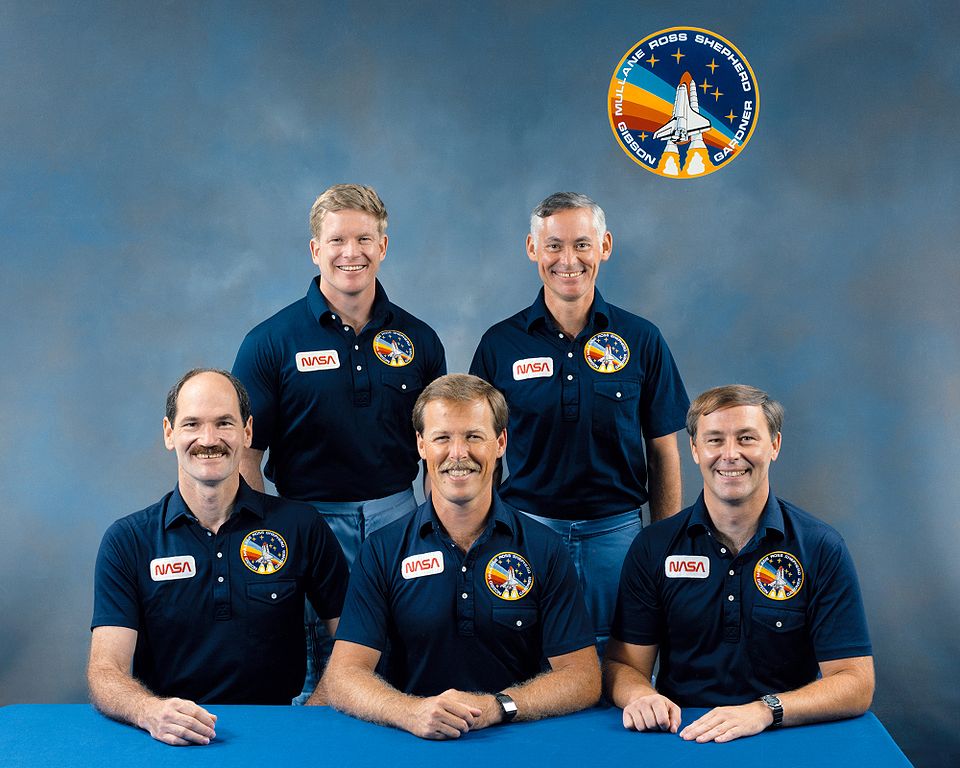
The crew was commanded by Robert Gibson, a veteran naval aviator and former test pilot. He was joined by pilot Guy Gardner and mission specialists Richard Mullane, Jerry Ross, and William Shepherd, the last of whom would later become the first commander of the International Space Station. All five were either active military officers or had military backgrounds, a deliberate composition reflecting the mission's national-security character. Because of its DoD classification, virtually all communications, objectives, and in-flight details were withheld from the public during and immediately after the flight.
Ascent and the Tile Damage
Liftoff occurred at the opening of the launch window on 2 December 1988. Within seconds of clearing the launch tower, a piece of ablative insulation from the solid rocket booster nose-cap assembly struck *Atlantis* during the violent aerodynamic environment of ascent. The impact was not detected in real time by the crew, but post-launch film review by engineers on the ground revealed that debris had peppered the orbiter's underside — the thermal protection system of reinforced carbon-carbon and ceramic tiles that shielded the vehicle from the roughly 3,000-degree heat of reentry.
When engineers analyzed the imagery more carefully, they found that hundreds of tiles had been damaged. One tile on the orbital maneuvering system pod had been lost entirely, leaving bare metal exposed to the reentry plasma. The damage pattern was severe enough that some engineers quietly feared the vehicle might not survive reentry. Photographs taken by the crew on orbit were transmitted to the ground for analysis, but the resolution was insufficient for an unambiguous damage assessment. Mission managers ultimately concluded that the exposed area — protected in part by a metal antenna bracket beneath the missing tile — was survivable, a judgment that proved correct but that carried an uncomfortable margin of uncertainty.
The mission's classified payload was successfully deployed, though all details of that operation remain restricted. The crew carried out their assigned objectives over the course of the four-day flight, working under the additional psychological weight of knowing that their heat shield had been compromised.
Reentry and Landing
The deorbit burn was executed at approximately 104 hours and 25 minutes into the mission, committing *Atlantis* to its return through the atmosphere. As the orbiter descended into the upper atmosphere and the reentry interface began, the crew and controllers on the ground could only wait. The thermal protection system performed well enough: the bracket beneath the missing tile held, temperatures in the exposed area remained within limits the vehicle could tolerate, and *Atlantis* emerged from the plasma blackout intact.
The orbiter touched down at Edwards Air Force Base, California, at approximately 105 hours and 6 minutes mission elapsed time, rolling to a stop on the lakebed runway without incident. To the outside world, the mission appeared to have been a routine if secretive success. For years, the true nature of what had happened during ascent was not widely known, classified along with the rest of the mission's details.
Legacy and the Shadow of Columbia
The full significance of STS-27 did not become apparent until after the *Columbia* disaster of 1 February 2003, when the orbiter disintegrated during reentry following damage to its leading-edge thermal protection system caused by foam shed from the external tank during launch. Investigators and historians examining the Columbia accident traced a decades-long institutional pattern in which NASA had grown accustomed to debris strikes and tile damage without catastrophic consequence — a normalization of deviance that made each successive incident seem more acceptable than it should have been.
STS-27 stood as the starkest precursor. The mission had sustained damage that, under slightly different circumstances — a different location, a different angle of impact, an area without the fortuitous presence of a metallic bracket — could have produced a disaster functionally identical to *Columbia*'s. Instead, *Atlantis* landed safely, the damage was assessed after the fact, and the program moved on. The lesson that ascent debris posed an existential risk to the orbiter was available in 1988; it was not acted upon with the urgency the evidence warranted.
Richard Mullane and others from the crew later spoke publicly about the fear they carried during that reentry, and their accounts became part of the broader historical reckoning with NASA's decision-making culture in the shuttle era. STS-27 is remembered not as a failure but as a warning that went unheeded — a flight that survived by a margin too narrow for comfort, and whose story was classified long enough that its lessons could not circulate freely through the institution that most needed them.
Drop this interactive replay into any page — free, no signup. Please keep the attribution link.
<iframe src="https://lowearth.app/embed/mission/sts-27" width="640" height="480" style="border:0;border-radius:12px;max-width:100%" title="STS-27 (Atlantis) mission replay — LowEarth" loading="lazy" allowfullscreen></iframe>