
STS-128 (Discovery / ISS)
Mission timeline
- T+00:00:00Liftoff
- T+00:08:30On orbit
- T+55:33:20Delivers science racks & rotates crewA Leonardo module of experiment racks and a treadmill.
- T+277:46:40Undocking
- T+331:54:00Deorbit burn
- T+332:34:00Landing — Edwards
About this mission
Background
Space Shuttle Discovery's thirty-seventh mission, STS-128, flew at a pivotal moment in the International Space Station's construction history. By the summer of 2009, the orbital laboratory had grown large enough to support a permanent crew of six — double its earlier capacity — but its internal outfitting still lagged behind its structural growth. Dedicated logistics flights were needed to deliver the science hardware, crew accommodations, and exercise equipment that would let six people live and work productively in space for months at a time. STS-128 was one of those missions: unglamorous by the standards of assembly flights that added new modules or trusses, but essential to turning a construction site into a functioning research laboratory.
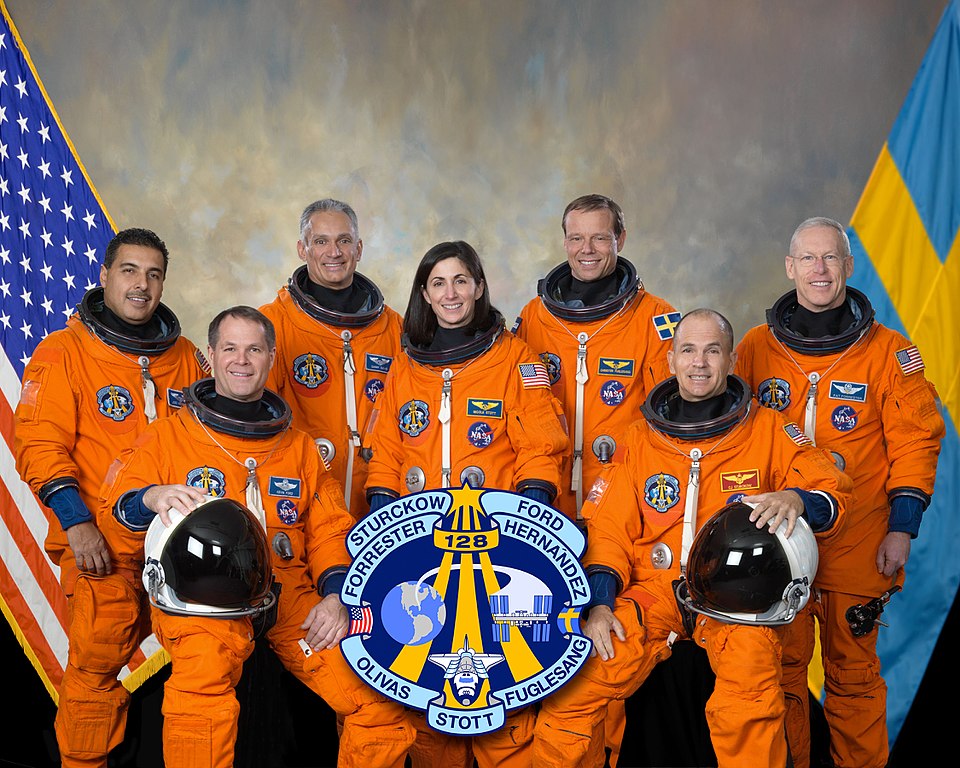
The mission carried a crew of seven. Commander Frederick "C.J." Sturckow was making his fourth spaceflight, supported by Pilot Kevin Ford. Mission specialists Patrick Forrester, José Hernández, Christer Fuglesang, and John "Danny" Olivas rounded out the shuttle crew. The seventh seat belonged to Nicole Stott, who would remain aboard the station as a flight engineer, replacing Timothy Kopra and thereby executing the crew-rotation portion of the flight's dual mandate. Hernández drew particular public attention as a former migrant farmworker from California whose path from the strawberry fields of the San Joaquin Valley to orbit became one of the more celebrated personal stories of the shuttle era.
Pre-launch and Ascent
Discovery lifted off from Launch Complex 39A at Kennedy Space Center on 28 August 2009, carrying the Italian-built Multi-Purpose Logistics Module (MPLM) *Leonardo* in its payload bay. The ascent was largely nominal, and approximately eight and a half minutes after liftoff the vehicle was established in its parking orbit, on course for a rendezvous with the station.
The MPLM *Leonardo* had flown before, serving as a pressurized cargo container that could be grappled by the station's robotic arm, mated to a berthing port, unloaded in shirtsleeve conditions, reloaded with equipment returning to Earth, and then stowed back in the shuttle's bay for the trip home. For STS-128 it carried a particularly significant cargo: two International Standard Payload Racks, including the Fluids Integrated Rack and the Materials Science Research Rack-1, which would anchor new avenues of microgravity research. The module also delivered a third crew quarters unit — a soundproofed sleep station that helped make six-person continuous habitation genuinely livable — along with the Combined Operational Load-Bearing External Resistance Treadmill, universally known by the acronym COLBERT.
Operations at the Station
At roughly fifty-five and a half hours into the mission, following docking and the customary leak checks and hatch openings, the primary logistics work began in earnest. The station's robotic arm lifted *Leonardo* from Discovery's payload bay and berthed it to the Unity node. Over the following days, the combined crews transferred tonnes of cargo, carefully removing the experiment racks from their launch restraints and installing them in the station's Destiny laboratory. The COLBERT treadmill — named through a NASA public contest won by television comedian Stephen Colbert, who had encouraged his audience to vote for his name — was installed in the Tranquility node, then still awaiting its own launch but planned for the near future.
The mission also included three spacewalks conducted by Forrester, Olivas, and Fuglesang, during which the crew replaced an empty ammonia tank assembly on the station's truss, retrieved a Japanese experiment from the station's exterior, and performed other maintenance tasks. These extravehicular activities, totaling more than twenty hours combined, addressed hardware servicing items that could not be accomplished from inside the laboratory.
Nicole Stott's formal transition to the station crew occurred during the docked period, completing the crew-rotation element of the flight. Timothy Kopra, who had arrived on STS-127 in July, transferred to Discovery's middeck for the return journey. Stott would remain on the station for several months and eventually return to Earth aboard the shuttle on STS-129 — the last American to return from a long-duration ISS mission on a shuttle rather than a Soyuz capsule.
Undocking, Return, and Legacy
Discovery undocked from the station at approximately 277 hours and 46 minutes into the mission, drawing the docked phase to a close after a highly productive period of cargo transfers and extravehicular operations. The shuttle performed its customary close-range inspection pass before departing the station's vicinity and configuring for re-entry.
The deorbit burn was executed at just over 331 hours and 54 minutes mission elapsed time, committing the vehicle to its return to Earth. Discovery landed at Edwards Air Force Base in California rather than the primary runway at Kennedy Space Center, touching down approximately forty minutes after the deorbit burn. The choice of Edwards reflected weather and orbital mechanics considerations, and added the logistical step of ferrying the orbiter back to Florida atop NASA's Shuttle Carrier Aircraft — a routine but time-consuming procedure.
STS-128 was never a headline-grabbing mission in the manner of the Hubble servicing flights or the dramatic early assembly missions, but its contributions were real and lasting. The science racks it delivered enabled experiments in fluid physics and materials science that continued for years. The crew accommodations it brought made six-person residency sustainable. The COLBERT treadmill became a familiar piece of station hardware, serving the cardiovascular fitness needs of successive long-duration crews and earning an unlikely measure of cultural celebrity along the way. Perhaps most significantly, the rotation of Nicole Stott onto the station continued the unbroken chain of human habitation that had begun in November 2000 — a chain that logistics flights like STS-128 quietly sustained, resupply by resupply, throughout the shuttle program's final years.
Drop this interactive replay into any page — free, no signup. Please keep the attribution link.
<iframe src="https://lowearth.app/embed/mission/sts-128" width="640" height="480" style="border:0;border-radius:12px;max-width:100%" title="STS-128 (Discovery / ISS) mission replay — LowEarth" loading="lazy" allowfullscreen></iframe>