
STS-105 (Discovery / ISS crew rotation)
Mission timeline
- T+00:00:00Liftoff
- T+00:08:30On orbit
- T+55:33:20Swaps ISS crews (Exp 2 ↔ Exp 3)Delivered the Leonardo module of supplies.
- T+250:00:00Undocking
- T+284:53:00Deorbit burn
- T+285:33:00Landing — KSC
About this mission
Background
By the summer of 2001, the International Space Station had graduated from a construction project to a continuously inhabited outpost. The resident-crew rotation model — sending up a fresh expedition while the incumbent one returned to Earth — had become the operational heartbeat of the program. STS-105 was tasked with precisely this choreography: relieving Expedition 2 after its months aboard the station and installing Expedition 3 in its place. The mission also carried the Multi-Purpose Logistics Module (MPLM) *Leonardo*, a pressurized Italian-built cargo container that could be berthed directly to the station's Unity node, allowing its contents to be transferred in a shirt-sleeve environment before it was returned to the orbiter's payload bay for the trip home.
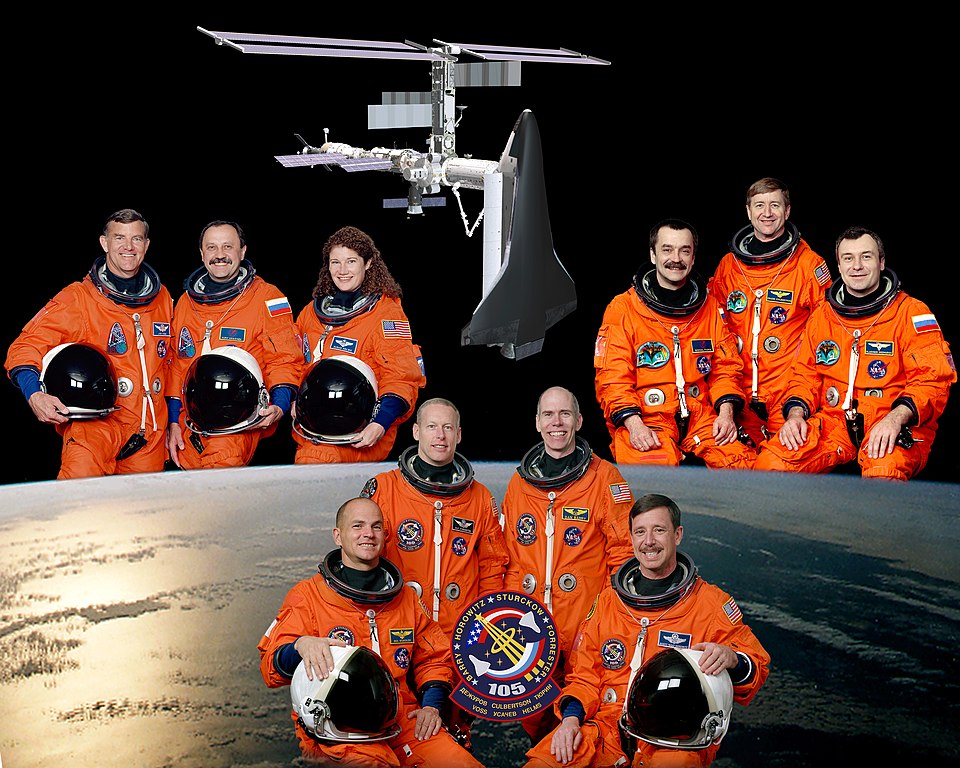
Space Shuttle *Discovery* was the chosen vehicle, a fitting assignment for an orbiter that had already compiled a distinguished record in ISS support flights. Commander Scott Horowitz and Pilot Frederick "C.J." Sturckow led the crew, joined by Mission Specialists Daniel Barry and Patrick Forrester, both of whom were assigned the extravehicular activities planned for the mission. The Expedition 2 crew — Yury Usachev, James Voss, and Susan Helms — had been aboard the station since March 2001 and would return to Earth as STS-105 passengers. The three members of Expedition 3 — Frank Culbertson, Vladimir Dezhurov, and Mikhail Tyurin — rode up with *Discovery* to begin their own long-duration stay.
Launch and Ascent
*Discovery* lifted off from Launch Complex 39-B at Kennedy Space Center on 10 August 2001. The ascent proceeded nominally, and the orbiter reached a stable orbit approximately eight and a half minutes after liftoff. Over the following days, the crew performed the standard rendezvous sequence, incrementally raising *Discovery*'s orbit until the shuttle was in the correct phasing geometry to approach the station. The rendezvous profile used by shuttle crews at this stage of the ISS program was well-rehearsed, involving a series of engine burns calculated to bring the vehicle to a point below and behind the station before the final approach and docking.
Docking, Crew Rotation, and Spacewalks
*Discovery* docked with the International Space Station, and the formal crew handover took place at roughly 55 hours and 33 minutes into the mission. This moment marked the official transition: Expedition 2's tenure ended as Expedition 3 assumed responsibility for the station. The overlap period — during which both expedition crews were simultaneously aboard — allowed for extensive face-to-face briefings, a transfer of operational knowledge that mission planners considered essential to continuity of on-orbit operations.
*Leonardo* was lifted from the payload bay by the station's robotic arm and berthed to the Unity node, giving the combined crew access to tonnes of cargo: equipment, spare hardware, science experiment materials, clothing, food, and water. The transfer of goods was methodical and time-consuming, and the MPLM remained attached to the station for the bulk of the docked period before being re-loaded with items bound for return — waste materials, completed experiments, and equipment no longer needed on orbit — and moved back into *Discovery*'s payload bay.
Barry and Forrester conducted two spacewalks during the docked phase. The EVAs focused on station outfitting, including the installation of handrails and other hardware intended to improve the external worksite for future construction activities. The spacewalks added to the growing inventory of external work accomplished during the early assembly era, incrementally maturing the station's infrastructure ahead of the major truss and solar array deliveries that would define subsequent missions.
After an extensive docked period, *Discovery* undocked from the station at approximately 250 hours into the mission, leaving Expedition 3 to begin what would prove to be a historically significant increment — Culbertson and his crewmates would be aboard on 11 September 2001, the only Americans not on Earth during that day's events.
Return and Legacy
Following undocking, *Discovery* performed the customary separation and fly-around of the station before withdrawing to a safe distance. The crew carried out the standard post-undocking inspections and prepared the vehicle for reentry. The deorbit burn was executed at approximately 284 hours and 53 minutes into the mission, committing the orbiter to its return trajectory. *Discovery* touched down at Kennedy Space Center roughly 40 minutes later, at mission elapsed time 285 hours and 33 minutes, completing a flight of nearly twelve days.
STS-105 was not a mission defined by a single dramatic event but rather by the reliable execution of a complex, multi-layered operation. It demonstrated that the shuttle could simultaneously serve as a crew ferry, a cargo freighter, and a construction support vehicle — roles that had to be integrated seamlessly within a single flight. The successful rotation of Expedition 2 and Expedition 3 validated the logistics model that NASA and its international partners intended to sustain for years to come.
The presence of *Leonardo* underscored the multinational character of the program. The MPLM had been built by the Italian Space Agency under a barter agreement with NASA and represented one of the most tangible contributions a partner nation had made to the station's supply chain. Its repeated use across multiple shuttle flights would prove critical to building up the station's consumable reserves and science capability during the assembly era.
In retrospect, STS-105 occupies a quiet but consequential place in the ISS record. It was the last shuttle mission to launch before the September 2001 attacks reshaped the world the crew had left behind, and the Expedition 3 crew it delivered would find themselves witnessing those events from orbit. The mission stands as a marker of the moment when routine station operations were still new enough to feel like an achievement in themselves — and when maintaining a permanent human presence in space remained the ambitious, hard-won thing it had always been.
Drop this interactive replay into any page — free, no signup. Please keep the attribution link.
<iframe src="https://lowearth.app/embed/mission/sts-105" width="640" height="480" style="border:0;border-radius:12px;max-width:100%" title="STS-105 (Discovery / ISS crew rotation) mission replay — LowEarth" loading="lazy" allowfullscreen></iframe>