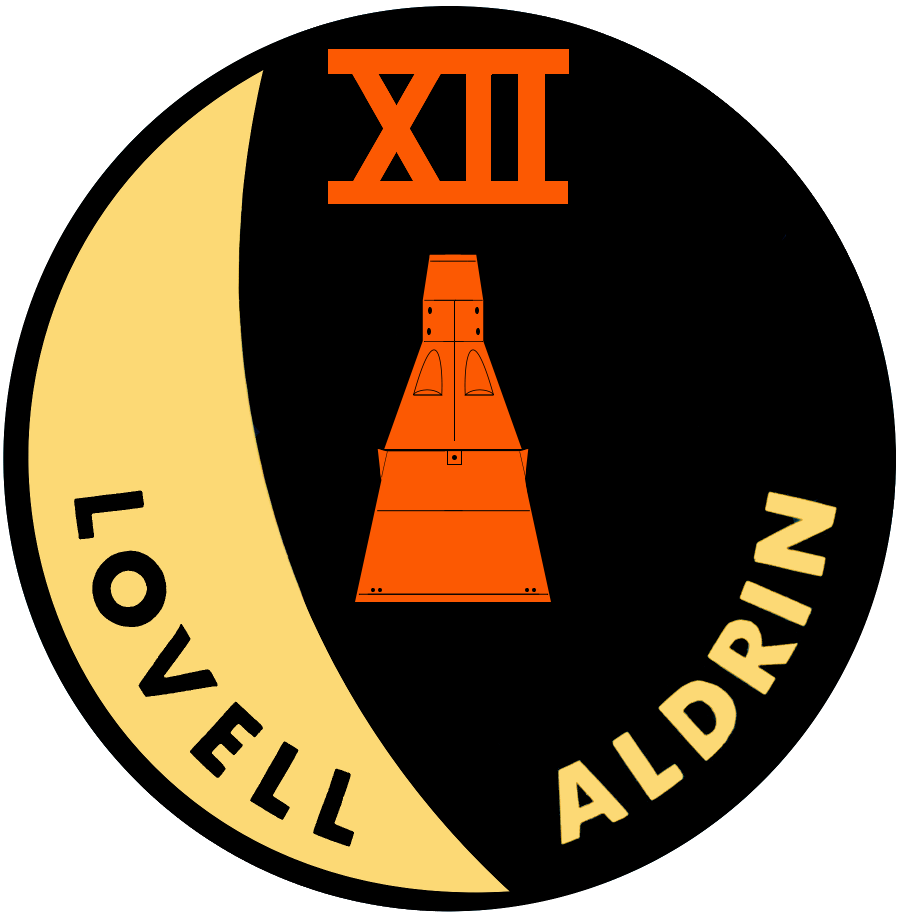
Gemini 12

Mission timeline
- T+00:00:00Liftoff
- T+00:06:00Orbit insertion
- T+03:20:00Docks with Agena
- T+27:46:40Aldrin’s EVAs solve the problemOver 5 hours of spacewalks with new handholds and training finally make EVA routine.
- T+93:53:20Retrofire
- T+94:34:00SplashdownThe final Gemini flight.
About this mission
Background
By the autumn of 1966, NASA's Gemini program had accomplished nearly everything asked of it. Astronauts had rendezvoused and docked with target vehicles, demonstrated long-duration endurance in orbit, and rehearsed the navigational techniques that Apollo would depend upon. One stubborn problem remained unsolved: extravehicular activity. Three successive crews — on Gemini IX-A, X, and XI — had struggled outside their spacecraft, exhausting themselves within minutes against tasks that had looked routine in planning. Handrails were absent where they were needed, foot restraints were inadequate, and the suits' internal resistance turned every deliberate movement into a fight. Unless NASA could prove that astronauts could work productively in open space, the moonwalks of Apollo would be in jeopardy. Gemini 12, the program's final mission, was assigned the explicit task of solving that problem once and for all.
Selected to fly the mission were James A. Lovell Jr. and Edwin E. "Buzz" Aldrin Jr. Lovell, a veteran of Gemini VII, brought calm operational experience to the commander's seat. Aldrin brought something more targeted: a doctoral dissertation on orbital mechanics and an almost obsessive preparation for spacewalking. He had spent hundreds of hours underwater in a neutral-buoyancy tank at the Neutral Buoyancy Simulator, rehearsing each EVA task in conditions that closely mimicked the weightlessness of orbit. He arrived at the launch pad arguably better prepared for a spacewalk than any astronaut before him.
Launch and Rendezvous
Gemini 12 lifted off from Launch Complex 19 at Cape Kennedy on 11 November 1966. Orbit insertion was achieved approximately six minutes after launch, placing the spacecraft on a trajectory to intercept the Agena Target Vehicle that had been orbited earlier the same day. The rendezvous and docking proceeded with practiced efficiency; Lovell and Aldrin closed on the Agena and achieved a hard dock roughly three and a half hours into the mission. The maneuver was by this point a well-understood Gemini skill, but it remained a prerequisite for the central business of the flight.
One complication arose when the Agena's primary propulsion system showed anomalous readings, forcing the crew and flight controllers to forgo the high-apogee orbit that earlier Gemini flights had used to demonstrate long-range rendezvous. The crew adapted their flight plan accordingly, and Aldrin used a sextant-based manual rendezvous technique to demonstrate that precise orbital interception was achievable without relying on the onboard radar alone — a quiet but significant navigational proof.
The Spacewalks
The heart of the Gemini 12 mission unfolded across multiple EVA periods that together exceeded five hours, all of them performed by Aldrin. Where previous spacewalkers had thrashed and overheated, Aldrin moved with deliberate economy. The difference was preparation and hardware. New handholds and foot restraints had been added to the spacecraft's exterior based on lessons learned from the three preceding troubled EVAs, and Aldrin used them systematically, pausing between tasks, keeping his exertion rate low, and treating zero-g mobility as a skill requiring patience rather than force.
He performed a stand-up EVA, working from the open hatch while still tethered, and then a full umbilical EVA during which he moved to the Agena and completed a series of assigned tasks at the rear of the spacecraft. Photographers, bolt-turning exercises, and equipment evaluations were completed calmly and on schedule. His suit telemetry stayed within normal limits throughout. The contrast with Gene Cernan's near-incapacitating struggle on Gemini IX-A, less than six months earlier, was stark. Aldrin had not merely survived the spacewalk — he had made it look manageable.
These EVAs, logged beginning around 27 hours and 46 minutes into the mission, represented a turning point in human spaceflight. The conclusion was now empirical rather than theoretical: given the right restraints, the right training, and the right pace, a human being could perform useful work in the vacuum of space for extended periods. Apollo's lunar surface operations, which would require astronauts to traverse, sample, and perform experiments over multiple hours in suits not fundamentally unlike those worn by Aldrin, had just been validated in principle.
Reentry and Legacy
After nearly four days in orbit, Gemini 12 fired its retrorocket at approximately 93 hours and 53 minutes into the mission. Splashdown in the Atlantic Ocean followed roughly 40 minutes later, closing the Gemini program. The spacecraft and crew were recovered in good condition, and with them came the data, the techniques, and the confidence that the program had been designed to accumulate.
Gemini 12's legacy operates on two distinct levels. At the programmatic level, it completed a sequence of ten crewed Gemini flights in just under twenty months — a pace of operations that had no precedent in American spaceflight and has rarely been matched since. The program demonstrated rendezvous, docking, long-duration flight, and, finally on this last mission, productive EVA. Every one of the skills Apollo would require had been tested and refined.
At the human level, the mission is inseparable from Buzz Aldrin's subsequent career. The EVA methodology he developed and proved on Gemini 12 — systematic neutral-buoyancy training, deliberate pacing, purpose-built external restraints — became the template for every American spacewalk that followed. Less than three years later, Aldrin would walk on the Moon as part of Apollo 11, becoming one of the first two humans to do so. The arc from the underwater tank in Houston to the Sea of Tranquility ran directly through the exterior of Gemini 12.
Jim Lovell would go on to command Apollo 13, the mission remembered for its near-catastrophic failure and successful improvised recovery. That he and Aldrin together flew the last Gemini mission gives Gemini 12 an almost novelistic quality: two men who would define the next era of exploration, closing the chapter that made it possible.
Drop this interactive replay into any page — free, no signup. Please keep the attribution link.
<iframe src="https://lowearth.app/embed/mission/gemini-12" width="640" height="480" style="border:0;border-radius:12px;max-width:100%" title="Gemini 12 mission replay — LowEarth" loading="lazy" allowfullscreen></iframe>