Zvezda Service Module
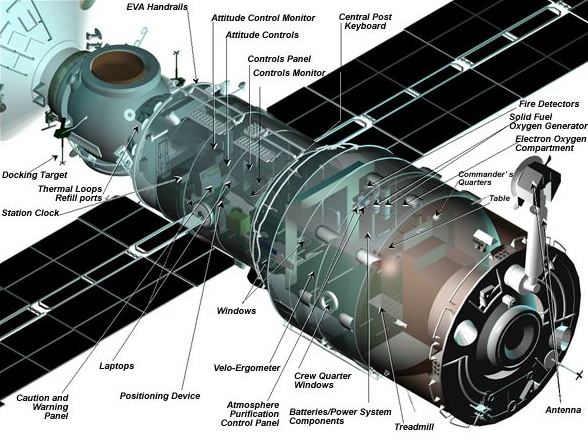
About Zvezda
Zvezda — Russian for "star" — serves as the Service Module of the International Space Station's Russian Orbital Segment, operated by Roscosmos. Launched on 12 July 2000 aboard a Proton-K rocket, it arrived as the third major component joined to the nascent station and immediately transformed what had been an uncrewed orbital outpost into a place where human beings could actually live and work for extended periods. More than two decades on, Zvezda remains central to the structural coherence and day-to-day operation of the Russian segment, fulfilling functions that range from propulsion and attitude control to life support and crew habitability. Because it is permanently attached to the station rather than operating as a free-flying spacecraft, Zvezda is not assigned its own catalogue number; it is tracked as part of the ISS under NORAD identifier 25544.
Purpose and Role
From the moment it docked with the embryonic station, Zvezda assumed responsibilities that no other module at the time was equipped to handle. It became the primary source of life-support infrastructure for the assembling complex, managing the atmospheric systems — oxygen generation, carbon dioxide removal, and air circulation — that make sustained human presence possible in the vacuum of low Earth orbit. Alongside those environmental functions, Zvezda took on electrical power distribution, routing energy from the station's solar arrays to the systems that needed it and managing the balance between generation and consumption as the station's configuration evolved.
Equally important is Zvezda's role in keeping the ISS where it belongs. The module houses propulsion systems capable of performing reboost maneuvers, which periodically raise the station's orbit to counteract the gradual decay caused by atmospheric drag at altitudes of roughly 400 kilometres. It also provides attitude control, orienting the station so that solar arrays face the sun, radiators face deep space, and docking ports align correctly for arriving vehicles. In the early assembly phase, before the station had grown large enough to share these burdens across multiple systems, Zvezda carried essentially the entire load. It additionally handles data processing functions, acting as one of the key command-and-control nodes for the Russian segment and maintaining communication links with ground controllers.
Beyond its mechanical and systems roles, Zvezda established the first permanent crew quarters on the ISS. It contains sleeping accommodations, exercise equipment, and the sanitary facilities that crews depend on during long-duration missions. In this sense the module blends the functions of a ship's engine room and a ship's living quarters: it keeps the vessel flying while also keeping its inhabitants alive and reasonably comfortable.
Launch and Assembly
Zvezda lifted off from the Baikonur Cosmodrome on 12 July 2000, carried into orbit by a Proton-K launch vehicle — a heavy-lift rocket with a long heritage in Soviet and Russian space operations. The module launched independently and conducted an automated rendezvous before docking with the station stack that was already in orbit, which at that point consisted of the Russian Zarya module and the American Unity node. The addition of Zvezda changed the character of that assembly entirely. Where the earlier pair had provided structural connection and some utilities storage, they lacked the propulsion, life support, and habitation infrastructure needed to support a crew. Zvezda supplied all of that at once.
The timing of Zvezda's arrival was critical to the broader assembly sequence. The station had been accumulating in orbit with no one aboard, dependent on periodic automated and crewed visits to maintain it. Once Zvezda was in place and its systems were verified, the station crossed the threshold from construction site to inhabited outpost. Expedition 1 — the first long-duration crew — arrived later in 2000, taking up residence in the module's living quarters and beginning what would become a continuous human presence aboard the ISS that has persisted ever since. Zvezda's launch therefore represents a clear before-and-after moment in the station's history: before it, the ISS was a structure under construction; after it, the ISS was a crewed laboratory and home.
Design and Interior
Zvezda's interior reflects its dual identity as both a technical powerhouse and a habitable space. The module is divided into functional zones that serve different purposes, moving from densely packed engineering systems at one end to more open crew-oriented spaces toward the other. Visitors to the Russian segment pass through or around racks of equipment — communications hardware, environmental control units, power management systems — alongside the more human-scale features of crew quarters, a galley area, and sanitary facilities.
The module's design draws on decades of Soviet and Russian space station experience, particularly the heritage of the Mir station and the Salyut series that preceded it. Russian spacecraft designers developed considerable expertise in packaging a large number of critical functions into a single pressurized hull, and Zvezda reflects that approach. Systems are layered and, where possible, redundant, because in the early years of ISS assembly the module was carrying life-critical functions without the backup that a fully assembled station would eventually provide through its many interconnected components.
Externally, Zvezda features multiple docking ports that have allowed subsequent Russian modules and visiting spacecraft to attach to the aft and other faces of the station. Russian Soyuz crew vehicles and Progress cargo spacecraft have docked with Zvezda regularly over the years, using it as a gateway for crew rotations and resupply deliveries. This docking traffic underscores the module's continuing centrality: it is not merely a historical artifact of early assembly but an active interface point for ongoing station operations.
The module also supports extravehicular activity, with equipment and procedures in place for spacewalks conducted from the Russian segment. While the specifics of Russian EVA architecture differ from those used on the American side of the station, Zvezda plays a supporting role in the infrastructure that makes such operations possible.
Significance and Current Status
Zvezda's significance in the history of the ISS is difficult to overstate. It was the module that made the station real in the most practical sense — the component whose arrival converted an orbital construction project into a habitable outpost. Every subsequent phase of ISS assembly, every expedition crew, and every scientific result produced aboard the station rests on the foundation that Zvezda established when it docked in 2000 and when Expedition 1 moved in later that year.
As of its current operational status, Zvezda remains attached to the ISS and continues to function as the structural and operational core of the Russian Orbital Segment. Its propulsion systems still perform reboosts; its life-support infrastructure still contributes to the station's atmospheric management; its docking ports still receive visiting vehicles. The module has now operated in orbit for well over two decades, an extraordinary service life for a spacecraft, and one that required sustained maintenance and periodic repairs to achieve.
That longevity has not been without challenge. Like any hardware subjected to the thermal cycling, radiation, and mechanical stresses of the space environment over many years, Zvezda has required attention to maintain its integrity. The module's continued operation speaks both to the durability of its original design and to the ongoing work of engineers and cosmonauts who have tended to it across successive expeditions.
Tracked under the ISS's NORAD catalogue number 25544, Zvezda moves with the station through low Earth orbit, circling the planet at an inclination that allows coverage of the vast majority of the Earth's populated surface — a trajectory chosen not arbitrarily but to serve both scientific observation and the launch access requirements of the station's international partners. Within that orbit, Zvezda continues to do what it was built to do: keep the station moving, keep it pointed correctly, and keep the people inside it alive.
Part of the International Space Station. The station is tracked as one object — track the ISS live.